What Gets Lost in Translation
Japanese Curry Is Not Indian Curry. It's a Stew.
Japanese curry reached Japan via Britain as a flour-thickened, stew-like dish. What's really in a roux block, and how to build one from scratch.
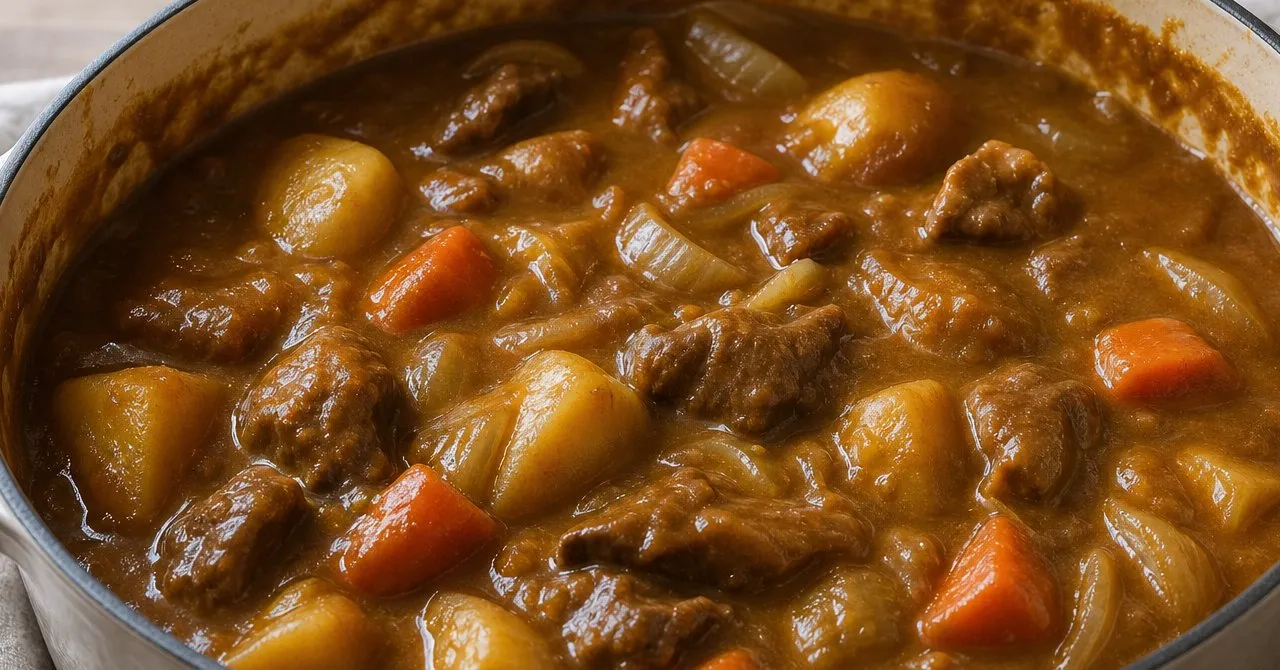
If you have made Japanese curry from scratch using an English recipe — curry powder, flour, butter, simmer, serve — and it came out tasting thin, sharp, and somehow unfinished, the problem was probably not your technique.
The problem is that the recipe was aiming at the wrong target.
The short answer
Japanese curry reached Japan by way of Britain, not directly from India, and the way it is built puts it closer to a European brown-roux stew than to most Indian curries. The dividing line is flour. Japan’s earliest curry recipes already thicken with wheat flour; Indian curries are generally thickened with onion, tomato, yogurt or nut pastes, and rarely with flour.
And in Japanese homes today, the standard way to make curry is with a commercial solid roux block — an engineered product with more than thirty listed ingredients, in which curry powder is only the sixth. “Curry powder plus flour plus butter” reproduces, at most, three of the top six.
None of which means you can’t make excellent Japanese curry from scratch. It means you need to know what you’re actually rebuilding.
The flour was there from the beginning
A common assumption in English writing is that the thickness of Japanese curry is a later Japanese modification — that somewhere along the way, cooks started adding flour.
They didn’t. It arrived thickened.
Japan’s earliest known curry recipes appear in two books on Western cooking published in 1872. One, Seiyō Ryōri Shinan (西洋料理指南, “A Guide to Western Cooking”), lists scallion, ginger, garlic, butter, shrimp, sea bream, oyster, chicken, red frog, wheat flour and curry powder. The food historian Kosuge Keiko has suggested that the frog hints at French influence. The other, Kanagaki Robun’s Seiyō Ryōri Tsū (西洋料理通), calls for beef, chicken, scallion, apple, wheat flour, yuzu and curry powder.
Flour is in both of the first recipes. So is the framing — these are books about Western cooking, and curry is in them as a Western dish.
By 1908, the Naval Cooking Reference Manual (海軍割烹術参考書), compiled by the Maizuru Naval Barracks, describes the method in unmistakable terms: melt beef suet, add flour and roast it to about a “fox color” (狐色, a golden brown), add curry powder, then dissolve it in stock to a thin, lightly thickened consistency (「スープ」ニテ薄トロノ如ク溶シ).
That is a browned roux — fat and flour cooked together before liquid goes in, the same foundation used in French and British brown sauces and stews, with curry powder folded in.
House Foods, maker of Vermont Curry, explains the word in its consumer Q&A:
もともと「ルー(ルウ)」の語源はフランス語の「roux」で、「赤褐色の、赤茶色の」という意味です。 — The word “roux” originally comes from the French roux, meaning “reddish-brown.”
As a cooking term, House adds, it has long referred to flour cooked in fat and used to thicken sauces and soups.
On the family tree, Japanese curry sits much closer to beef stew than to Indian curry.
While we’re here: the Friday navy story, corrected
You will find it in a great many English articles: the Japanese navy served curry on Fridays so sailors could keep track of the days at sea.
The Japan Maritime Self-Defense Force tells it differently. According to its own website, curry moved from Saturday to Friday after the force adopted a five-day week; naval-cuisine researcher Takamori Naoshi dates the Friday habit to around the late 1980s. The JMSDF describes the “keeping track of the days” explanation as one that grew up after the weekend curry habit was already established — not as the reason for it.
The broader claim that the navy originated Japanese curry is also shaky. Takamori has said that no evidence has been found that the navy is the root of Japanese-style curry — and the 1872 recipes predate the 1908 naval manual by 36 years.
What Japanese homes actually do
Here is the fact that most reframes the whole question: Japanese home curry is a boxed-roux dish. Not as a shortcut, and not as a decline from some earlier scratch tradition — solid roux blocks have been on the market since the 1950s, and for some 70 years the boxed roux has been the tradition.
The evidence:
- Household purchases. A third-party analysis of Japan’s Family Income and Expenditure Survey (2022) estimates that residents buy about 1.88 twelve-serving boxes of curry roux per person per year, ranging from 2.44 in Nagano to 1.32 in Saitama (figures based on prefectural capital cities).
- Where people eat it. In a 2018 MyVoice survey (10,516 respondents), 80.7% of those who eat curry said they eat home-made curry, versus 49.8% for retort pouches and 26.8% at restaurants (multiple answers allowed).
- Market size. Curry roux alone sold ¥45.4 billion at retail in fiscal 2024 (April 2024–March 2025, Intage SRI+), within a ¥126.5 billion market for curry and related products such as hayashi and curry-udon bases.
- Concentration. A Kobe University business case study puts House Foods’ share of the curry-roux market at roughly 60%.
- Frequency. S&B estimates, from industry production data, that people in Japan eat curry roughly 79 times a year — more than once a week in some form.
Put together: roux is bought in every region, about four in five curry eaters make it at home, and a handful of manufacturers, led by House Foods, dominate the category. Market data show no sizable segment of home cooks making curry from whole spices instead of roux.
Which leads to an uncomfortable but useful conclusion: the flavor English speakers are chasing when they say “Japanese curry” is largely a flavor designed by a few food companies. If you want to hit it from scratch, you have to know what they put in it.
What’s actually in the box
Here is the full ingredient list for House Vermont Curry (medium hot), in Japanese labeling order — ingredients in descending order by weight, followed (after the slash) by additives, which are ranked separately:
Edible fats and oils (beef tallow–lard blend, palm oil), wheat flour, sugar, salt, starch, curry powder, whole milk powder, defatted soybean, creaming powder, honey, yeast extract, onion extract, roasted onion powder, tomato powder, onion powder, banana paste, pork extract, milk-powder wheat-flour roux, skim milk powder, apple paste, spices, garlic powder, soy sauce processed product, tomato extract, cheese powder, roasted garlic powder, whey powder, powdered fat / coloring (caramel, paprika), seasoning (amino acids etc.), emulsifier, flavoring, acidulant, spice extract (contains milk, wheat, soy, chicken, banana, pork, apple)
Eight things worth noticing:
1. Fat is first — and it isn’t butter. A beef tallow and lard blend, plus palm oil. Animal and vegetable fats together, chosen for how the block sets at room temperature and how it melts.
2. Curry powder is sixth. Behind fat, flour, sugar, salt, and starch. Spice is not the lead ingredient.
3. Sugar ranks third. Then honey, apple paste, banana paste, tomato. Sweetness is structural, not a garnish.
4. Umami is layered. Yeast extract, onion extract, pork extract, tomato extract, soy sauce processed product — plus added amino acid seasoning.
5. Dairy shows up at least four times — whole milk powder, skim milk powder, cheese powder, whey powder — plus a creaming powder and a milk-powder roux.
6. Onion appears in three forms and garlic in two — including roasted versions of each alongside plain powders or extracts. Both a lighter note and a browned note.
7. Starch is listed separately from flour. Thickening is being adjusted independently of the roux.
8. There’s an emulsifier, which helps keep fat and water combined. Without one, a homemade roux is more prone to separating, especially if it is fat-heavy or boiled hard.
And the flour isn’t merely mixed with fat — it’s roasted. House’s factory documentation describes slowly roasting flour in edible fat to draw out its “umami and toastiness”; S&B’s describes heating flour and oil above 212°F (100°C) to drive off water and develop aroma.
So: a boxed roux is not a spice blend. It’s a roasted roux plus layered umami plus sugar and salt plus dairy plus fruit plus an emulsifier. Curry powder, flour, and butter reproduces at most three of the top six ingredients — and the fat only loosely — with essentially none of the supporting architecture.
Why it’s sweet — and who decided that
The sweetness of Japanese curry surprises people, and it’s usually explained as a corporate decision to make curry kid-friendly. That’s true as far as it goes, but the idea came from home kitchens first.
House began developing Vermont Curry in 1962. At the time, per the company’s own account, curry meant something spicy — “food for grown-ups.” House narrowed its target to children and young women. And here is where the idea came from:
子どもにカレーを食べさせる時、辛さを抑えるために、バナナやみかんなど、様々な果物を加えていた家庭が多くありました。 — Many households, when feeding curry to children, were adding bananas, mandarin oranges and other fruits to tone down the heat.
Households were already doing it. The company productized an existing home practice. The working name was “Fruit Curry”; the final name came from the “Vermont health method” of apple cider vinegar and honey, then popular in Japan.
Retailers pushed back hard — the company’s account quotes them saying a sweet curry with apple and honey “can’t possibly sell.” Within a few months it was a runaway hit, and House couldn’t increase production fast enough to keep it in stock.
Doctoring the pot is still popular. In a 2022 Netorabo popularity poll of curry “secret ingredients,” chocolate (20.1% of votes) and coffee (15.1%) ranked first and second.
The other source of sweetness is onions, and it’s real chemistry. House’s explanation: heating volatilizes and breaks down the pungent and bitter compounds, so sweetness registers more strongly by comparison; and as onions brown, their amino acids react with sugars — the Maillard reaction — generating aroma. S&B’s R&D division compared minced onion sautéed over low heat for 0, 15, 30 and 40 minutes and found that the longer the sauté, the stronger the sweetness, umami, and roasted character, and the weaker the perceived spiciness. At 40 minutes the onion reached a golden “fox color.”
Note, though, that House’s own basic recipe only sautés the onions until soft. Long caramelizing is an upgrade, not the everyday Japanese method.
One more thing English articles get wrong: the heat levels
There is no industry standard for 甘口 / 中辛 / 辛口 (mild / medium hot / hot). S&B states that each manufacturer sets its own criteria. S&B’s own method combines measured capsaicin (chili) and piperine (pepper) content with panel tasting that accounts for ingredients, viscosity, and seasoning. Glico likewise says heat comes down to capsaicin and piperine, and that the degree of mild, medium and hot differs by manufacturer. S&B even notes that two of its own “medium hot” products can taste different in heat.
What the grades are really for is the family table: one pot, one brand, a heat level everyone can eat. That’s the Vermont Curry idea, institutionalized. Medium hot was the favorite at 59.9% in a 2022 online survey of 1,000 mostly student respondents.
Making it from scratch
If you want to build Japanese curry without a box, aim at what the box actually contains: a roasted roux, layered umami, fruit sweetness, dairy, and enough salt. What a home kitchen can’t easily replicate is the separately added starch and the emulsifier.
The roux
- 60 g fat — for example 30 g unsalted butter + 30 g lard or beef tallow (the box uses a tallow–lard blend plus palm oil; all-butter is a common alternative)
- 60 g all-purpose flour
- 2 tbsp curry powder
- 1 tsp garam masala (optional)
Melt the fats over medium-low heat. Add the flour and cook, stirring constantly, for 10–15 minutes, until it reaches a light-to-medium golden brown — the “fox color” of the 1908 manual — and smells toasty. Darker roux has noticeably less thickening power. Take it off the heat, stir in the curry powder and garam masala, and let the residual heat bloom the spices for about 30 seconds without scorching them.
Set aside. It will firm up as it cools; that’s expected.
The base
- 2 medium onions (about 400 g), thinly sliced
- 2 tbsp neutral oil, divided
- 500 g beef chuck or pork shoulder, in 1-inch (2–3 cm) cubes
- 900 mL water or light stock
- 1 tbsp soy sauce + 1 tsp Worcestershire sauce — umami
- 1 tbsp tomato paste — umami and acidity
- ½ apple, grated + 1 tsp honey — fruit sweetness
- 1 tsp instant dashi or a piece of kombu (optional; adds more glutamate)
- 2 carrots, roll-cut
- 2 medium potatoes, in large chunks
1. The onions. Cook them in 1 tbsp oil over medium-low, stirring often, for 30–40 minutes, until golden brown. S&B’s sensory tests found sweetness and umami rise with sauté time. If you’re short on time, cooking them only until soft is what House’s basic recipe does.
2. The meat. Brown it in a separate skillet with the remaining 1 tbsp oil, then add it to the onions.
3. The liquid and seasonings. Add the water or stock along with the soy sauce, Worcestershire, tomato paste, grated apple, honey, and dashi or kombu. Bring to a boil and skim the foam. Add the honey here, with the water, not later — see below.
4. The simmer. Simmer gently, partly covered, until the meat is close to tender — about 60–90 minutes for beef chuck. Top up with water if the level drops well below where it started. Remove the kombu.
5. The vegetables. Add the carrots and potatoes and simmer 15–20 minutes more, until tender.
Bringing it together
Turn off the heat. Wait for the simmer to stop completely.
This isn’t fussiness. House explains that adding roux to a pot at a full boil makes the flour in it form a film that resists dissolving; turning off the heat, it says, brings the pot down to about 194°F (90°C). S&B is more specific: wheat starch begins to gelatinize at 140°F (60°C) and is fully gelatinized at 176–185°F (80–85°C), so roux dropped into boiling liquid gels on the surface and forms lumps. S&B recommends cooling to below 176°F (80°C) first.
Ladle a little hot liquid into the roux, whisk smooth, then stir that back into the pot. Return to low heat and simmer, stirring, for about 10 minutes until it thickens.
To finish:
- 2 tbsp whole milk or 1 tbsp heavy cream — dairy, for richness. (The starch gel, not the dairy, is what mainly holds the sauce together.)
- Salt to taste. Start with about 1 tsp (6 g) and adjust; salt is the fourth-largest ingredient in a commercial block, and this recipe has little salt beyond the soy sauce and dashi.
- 1–2 tsp sugar (optional), if you want to get closer to boxed sweetness.
Two things that will silently ruin the thickening
Don’t return your tasting spoon to the pot. House Foods says it directly: saliva contains amylase, an enzyme that breaks down the starch that creates the thickening. Taste with a separate spoon.
Add honey (and miso) early, not late. Both contain amylase too. House’s advice is to add honey when you add the water and boil for at least 20 minutes before the roux goes in, so heat deactivates the enzyme; it says the same applies to miso, mirin and soy sauce used as secret ingredients. Stirred into a finished, cooling pot, they can thin it out.
And yes — leave it overnight
S&B’s explanation of why day-two curry is better: flavors and aromas from the ingredients, spices, and seasonings meld; amino acids and nucleotides from the meat and sugars from the vegetables leach into the sauce, deepening richness and umami; and on reheating the potatoes break down into the sauce, softening the spice, heat, and salt into something rounder.
Cool it quickly and refrigerate within two hours; reheat until steaming hot.
Japanese curry vs. Indian curry
| Japanese curry | Indian curry | |
|---|---|---|
| Lineage | Reached Japan via Britain; earliest Japanese recipes 1872 | Indigenous, regional |
| Thickened by | Wheat starch gelatinization (roux) | Onion, tomato, yogurt, nut pastes — solids |
| Fat | Beef tallow / lard / palm in boxed roux, or butter | Varies by region (e.g., ghee, mustard oil, coconut oil) |
| Spices | Pre-blended curry powder, added to roux | Individually toasted and ground, layered through cooking |
| Sweetness | Deliberate and structural (fruit, honey, sugar) | Usually not the focus |
| Consistency | Thick, clings to rice, sets when cool | Ranges from thin gravy to dry |
| Nearest relative | Beef stew | — |
FAQ
Is Japanese curry really not Indian? Its roots are Indian, but it reached Japan by way of Britain as a flour-thickened, stew-like dish. Japan’s earliest curry recipes (1872) already contain wheat flour and appear in books about Western cooking.
Should I just buy the boxed roux? If you want the taste most Japanese people mean by “curry,” yes — that flavor is defined by those products, and there’s nothing inauthentic about using one. One estimate based on Japan’s household survey puts purchases at about 1.88 boxes per person per year. Make it from scratch when you want control or curiosity, not for authenticity points.
Why does my homemade curry separate? Commercial roux contains an emulsifier; yours doesn’t. Keeping the fat in proportion to the flour and simmering gently rather than hard-boiling after the roux goes in both help.
Why won’t mine thicken? Common causes, per House Foods: not enough sustained heat to gelatinize the starch (it needs 140–149°F (60–65°C) or more, held for a while); roux added to a pot at a full boil, which makes lumps instead of body; too much liquid; or amylase — from a tasting spoon returned to the pot, or from honey or miso added late instead of being boiled with the liquid.
What’s the difference between mild, medium hot, and hot? Whatever the manufacturer decided. There’s no cross-industry standard; S&B, for example, measures capsaicin and piperine and runs its own tasting panels. Compare within a brand, not across brands.
Do I have to caramelize the onions for 40 minutes? No. House’s basic recipe only softens them. S&B’s sensory tests found sweetness, umami, and roasted character increase — and perceived spiciness decreases — with longer sautéing, up to the 40 minutes they tested.
How this article was researched
The figures and historical details in this article trace to the Japanese-language and official sources listed below, chiefly manufacturers’ own publications, the Japan Maritime Self-Defense Force, and published surveys and market data. Survey and market figures are reported with their year and basis, because several are estimates or cover a specific population. Quotations are kept short and translated by us. The from-scratch recipe is synthesized from House Foods’ and S&B’s published guidance and the 1908 naval method; it has not been kitchen-tested by this site.
Sources
Japanese primary sources:
- ハウス食品 — カレーの日本史 明治
- ハウス食品 — バーモントカレー誕生秘話
- ハウス食品 — バーモントカレー〈中辛〉商品カタログ(原材料名)
- ハウス食品 — Q. ルウ(ROUX)とは何ですか
- ハウス食品 — Q. なぜいったん火を止めてからルウを入れるのですか
- ハウス食品 — カレーにとろみがつかない時の対処法
- ハウス食品 — あめ色玉ねぎがカレーをおいしくする理由
- ハウス食品 — 基本のカレーの作り方
- ハウス食品 — バーモントカレー工場 原料・焙煎
- S&Bカレー.com — カレーの日本史
- S&Bカレー.com — なぜ一度火を止めてからルウを入れるの?
- S&Bカレー.com — 一晩おいたカレーがおいしいのはなぜ?
- S&Bカレー.com — 日本人は年間どれくらいカレーを食べる?
- エスビー食品 研究開発 — 具材とカレーライスの味な関係(2) 玉ねぎ
- エスビー食品 — 甘口・中辛・辛口の基準は?
- 江崎グリコ — カレーの辛さの度合いはどうなっているのですか?
- 海上自衛隊 — 艦めし豆知識(金曜カレー)
- カレーライス — Wikipedia (ja)(西洋料理指南・西洋料理通・海軍割烹術参考書の記述)
- 海軍割烹術参考書 — Wikipedia (ja)
- メシ通 — 「日本式カレーは海軍から始まった」説は本当か?
Data:
- region-case.com — カレールーの消費量 都道府県ランキング(令和4年、家計調査ベースの推計)
- マイボイスコム — カレーに関するアンケート調査(2018年、n=10,516)
- インテージ SRI+ — カレー市場 2024年度(業界紙報道)
- ITmedia — 好きな辛さ1位は中辛(2022年、n=1,000)
- ねとらぼ調査隊 — 「カレーの隠し味」人気ランキング(2022年)
- 長内厚(神戸大学経済経営研究所)— ビジネスケース:ハウス食品 カレールウ製品の開発 (PDF)
This is part of our series on what English-language Japanese recipes get wrong — and why. See also: What English-Language Japanese Recipes Get Wrong, Teriyaki Is Not a Sauce and Rice Vinegar Is Not a Mirin Substitute.