What A5 Wagyu and Kobe Beef Actually Mean
A5 is a Japanese carcass grade, not a breed. Wagyu means four Japanese breeds, and Kobe Beef is a protected name with its own rules. Here's how they fit.
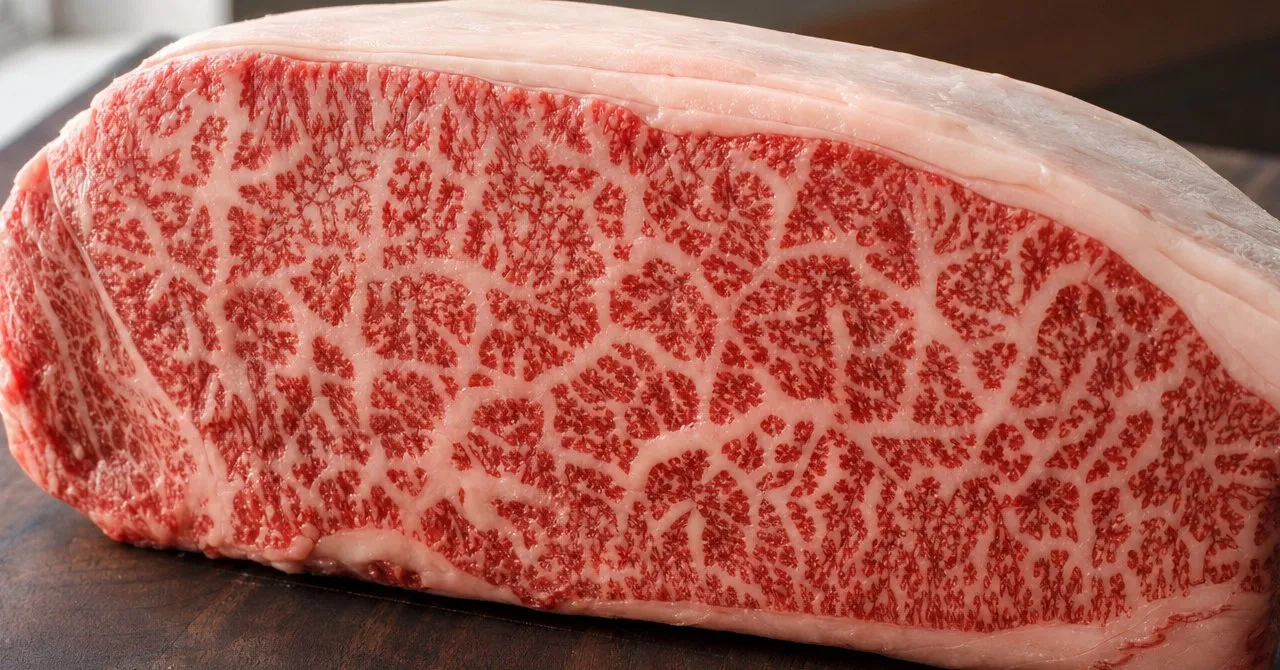
Menus and meat counters use “A5,” “wagyu” and “Kobe” as if they were three ways of saying the same thing: the most marbled, most prized beef there is. In Japan they are three different things, set by three different rulebooks.
The short version: A5 is a grade stamped on a carcass by the Japan Meat Grading Association. Wagyu is a breed category, defined by Japan’s agriculture ministry as four native breeds and the crosses among them. Kobe Beef is a protected regional name, registered as a Geographical Indication, with rules on bloodline, sex, age, weight, where the animal is raised and processed, and grade. Kobe Beef doesn’t have to be A5. And in the US, “Wagyu” on a label follows a different set of rules again.
The three terms at a glance
| Term | What it is | Who sets it |
|---|---|---|
| A5 | A carcass grade: yield grade A, meat quality grade 5 | Japan Meat Grading Association |
| Wagyu (washu breeds) | Beef from four Japanese breeds and their crosses | Japan’s Ministry of Agriculture, Forestry and Fisheries (MAFF) |
| Kobe Beef | A Geographical Indication for Tajima cattle raised in Hyogo Prefecture that meet a grade threshold | Registered with MAFF by the Kobe Meat Distribution Promotion Council |
Only one link runs in a fixed direction: all Kobe Beef is wagyu. Otherwise the terms are independent. A5 is a grade a carcass of any breed can, in principle, earn. Wagyu is a breed label. Kobe Beef is a name that only some wagyu can carry.
What “A5” means: two grades in one
Japanese beef carcasses are graded by the Japan Meat Grading Association, a public-interest corporation that grades at wholesale meat markets and meat processing centers around the country. The grade has two parts, written together. MAFF’s public magazine aff sums up the first part simply:
「アルファベットは「歩留等級」を表します。」 “The letter indicates the yield grade.” — MAFF, aff, August 2016
The number is the meat quality grade. Put together, the scale runs from A5 down to C1: 15 combinations in all.
The letter: yield, not quality
The letter (A, B or C) estimates how much usable meat the carcass will give once it’s broken down into cuts. The association calculates a yield score from measurements of the carcass: the area of the rib-eye muscle, the thickness of the belly (bara), the cold weight of the half carcass and the thickness of the fat under the hide. A score of 72 or more is A, 69 up to 72 is B, and below 69 is C.
One detail matters for wagyu. For the four Japanese beef breeds and their crosses, the association adds a fixed 2.049 points to the yield score. So the A in A5 says nothing about flavor or tenderness. It is a cutting-yield estimate, and the formula gives wagyu breeds a built-in boost.
The number: four things, and the lowest one wins
The number (5 down to 1) is the meat quality grade. Graders cut the carcass between the 6th and 7th ribs and judge four things on the cut surface:
- Marbling (BMS, Beef Marbling Standard): how much fat runs through the muscle, scored on 12 levels.
- Meat color and brightness (BCS)
- Firmness and texture of the meat
- Fat color, luster and quality (BFS)
Each of the four gets its own grade, and the carcass gets the lowest one. The association’s standard puts it this way:
「肉質等級の決定は、脂肪交雑、肉の色沢、肉の締まり及びきめ、脂肪の色沢と質の4項目について判定し、その項目別等級のうち、最も低い等級に決定して格付する。」 “The meat quality grade is decided by judging four items, marbling, meat color, firmness and texture, and fat color and quality, and grading the carcass at the lowest of those item grades.” — Japan Meat Grading Association
| Quality grade | Marbling (BMS) | Meat color (BCS) | Fat color (BFS) |
|---|---|---|---|
| 5 | No. 8–12 | No. 3–5 | No. 1–4 |
| 4 | No. 5–7 | No. 2–6 | No. 1–5 |
| 3 | No. 3–4 | No. 1–6 | No. 1–6 |
| 2 | No. 2 | No. 1–7 | No. 1–7 |
| 1 | No. 1 | Outside 2–5 | Outside 2–5 |
Firmness and texture aren’t scored by number. They’re graded by description; grade 5 is meat whose firmness is “quite good” and whose texture is “quite fine.”
So a carcass with top-level marbling (BMS 12) but meat color outside the grade 5 range doesn’t get a 5. Marbling alone doesn’t make the grade. The system also means “A5” can cover a range: a BMS 8 carcass and a BMS 12 carcass are both grade 5.
What A5 is, and what it isn’t
A5 is the top of Japan’s grading scale, and aff calls “A5 rank” a byword for premium beef. But note what’s not on the list. The grade measures yield, marbling, color, firmness, texture and fat. Nothing in the standard is a taste test. Breed comes up in only one place, the 2.049-point yield adjustment for the four Japanese breeds and their crosses. The quality grade itself doesn’t depend on breed, and carcasses of any breed are graded on the same scale. A5 tells you how a carcass scored, not what kind of animal it came from.
It’s also not rare among wagyu. Grading results for 2025, published by the Japan Meat Grading Association and summarized by the government’s Agriculture and Livestock Industries Corporation (ALIC), show that 71.7% of graded wagyu steer carcasses were A5. In 2021 the figure was 53.3%. Across all cattle graded in Japan in 2025 (936,561 head), A5 made up 36.6%.
The English-language food site Chowhound calls A5 “the absolute highest quality of an already high-quality meat.” That’s fair as a description of where A5 sits on the scale. It leaves out that A5 is the most common grade for wagyu steers in Japan, and that the scale doesn’t score eating quality directly.
What “wagyu” means in Japan
Wagyu (和牛) literally means “Japanese cattle,” but in Japan it’s a defined term. MAFF puts it in one sentence:
「「和牛」とは、牛の品種に着目した区分で、日本で長い時間をかけて品種改良されてきた黒毛和種などの4品種と、それらの交雑種のみです。」 “‘Wagyu’ is a category based on breed: only the four breeds, such as Japanese Black, developed in Japan over a long period, and crosses among them.” — MAFF, aff, August 2016
The four breeds:
| Breed | Japanese |
|---|---|
| Japanese Black | 黒毛和種 kuroge washu |
| Japanese Brown | 褐毛和種 akage washu |
| Japanese Shorthorn | 日本短角種 nihon tankaku shu |
| Japanese Polled | 無角和種 mukaku washu |
MAFF says anything else can’t be labeled wagyu. By that definition, a cross between a Japanese Black and a dairy breed is not wagyu in Japan, because the other parent isn’t one of the four.
MAFF’s 2016 article said more than 90% of wagyu raised in Japan was Japanese Black. It also notes something that gets lost in “ancient breed” marketing: Japanese Black was improved by crossing with foreign breeds in the Meiji era and was recognized as a native Japanese beef breed in 1944.
Since 2007, Japan’s labeling rules for wagyu go further than breed. The guideline text we could open is the version MAFF’s meat-labeling study group finalized on March 20, 2007 (still headed “draft”). It requires that the animal be born and raised in Japan, that its breed be provable through the national livestock registry system, and that both breed and history be checkable through Japan’s cattle traceability system, which gives each animal an individual ID number. JETRO, Japan’s trade agency, describes the same rule in force since 2007: wagyu sold in Japan must come from cattle born and raised in Japan, with breed provable and checkable through a 10-digit cattle ID. JETRO adds that foreign-produced beef can’t be brought back into Japan and sold as wagyu. The traceability piece is easy to see from the consumer side: Kumamoto Prefecture tells shoppers that looking up a package’s cattle ID number and checking its breed field is a way to verify a wagyu claim.
What Kobe Beef means
Kobe Beef is a narrower claim than wagyu. It’s protected under Japan’s Geographical Indication system as GI registration No. 3, registered on December 22, 2015. The registered producer group is the Kobe Meat Distribution Promotion Council, founded in 1983, which has maintained the Kobe Beef definition since then. The registered names are 神戸ビーフ, 神戸肉, 神戸牛 and KOBE BEEF.
The GI specification, updated April 1, 2026, sets these requirements:
| Requirement | Kobe Beef GI specification |
|---|---|
| Bloodline | Tajima cattle (Tajima-ushi), defined as cattle bred over generations only from Hyogo Prefecture’s own breeding bulls |
| Sex | Heifers that have never calved, or steers |
| Age | 28 to 60 months |
| Raised | Fattened in Hyogo Prefecture until shipped |
| Processed | At meat centers in Hyogo: Kobe, Kakogawa, Himeji, Nishinomiya, Sanda or Tajima (with exceptions such as livestock shows) |
| Grade | Yield grade A or B, quality grade 4 or higher |
| Marbling | BMS No. 6 or higher |
| Carcass weight | Heifers 270–499.9 kg (about 595–1,102 lb); steers 300–499.9 kg (about 661–1,102 lb) |
The specification describes Tajima cattle as a wagyu line kept pure of crosses with other prefectures’ wagyu, which is why all Kobe Beef is wagyu.
Kobe Beef can be B4
Look at the grade line again. The specification says “A or B, grade 4 or higher,” with BMS 6 or more. Since quality grade 4 covers BMS 5 to 7, a grade-4 carcass needs BMS 6 or 7 to qualify. That leaves four possible grades for Kobe Beef: A5, B5, A4 and B4.
So “Kobe Beef is always A5” is wrong, and “Kobe is a brand name for A4 and A5 beef” is incomplete. A Crowd Cow blog post from 2017 says the latter. It also gives a 470 kg weight limit and refers to the animal only as a steer. The 470 kg ceiling was the rule then: MAFF’s GI register shows it was raised to 499.9 kg on June 14, 2019, when the minimums also went up (heifers from 230 to 270 kg, steers from 260 to 300 kg). The current specification also names heifers and allows B grades.
The reverse is also true: most A5 wagyu is not Kobe Beef. An A5 Japanese Black carcass from outside Hyogo is graded on exactly the same scale, but it can’t be called Kobe Beef, because it isn’t Tajima cattle fattened and processed in Hyogo.
What “Wagyu” means on a US label
In the US, meat labels are approved by USDA’s Food Safety and Inspection Service (FSIS). FSIS treats “Wagyu” as a breed claim, in the same group as “Angus” or “Hereford.” Its August 2024 guideline on animal-raising claims lists “Wagyu” and “American Kobe” as examples and gives them no special rules.
To support a breed claim, the guideline asks for a signed, dated document backing the claim (such as a breed association certificate), a description of how the product is traced and kept separate, and support by phenotype (such as hide color) or genotype. For genotype, it describes animals “traceable to one registered parent or two registered grandparents with a breed association.”
What it doesn’t include is a minimum percentage of Wagyu genetics. The guideline is guidance, not a regulation, and it “strongly encourages” third-party certification. But as written, a “Wagyu” label in the US doesn’t tell you how much of the animal’s ancestry is Japanese.
The American Wagyu Association’s specifications, published by USDA’s Agricultural Marketing Service for programs that claim Wagyu influence, draw finer lines:
| AWA term | Wagyu genetics | Verification |
|---|---|---|
| Fullblood | 100% Wagyu | DNA parent-verified to both sire and dam through the AWA |
| Purebred | at least 93.75% Wagyu | DNA parent-verified to both sire and dam through the AWA |
| Wagyu influence / American Wagyu programs | traceable to at least one AWA-registered Fullblood or Purebred parent (no minimum percentage stated) | registration certificates, affidavits, etc. |
According to the AWA, Wagyu cattle were first brought to the US in 1975, and more came in the 1990s before Japan stopped exports of Wagyu genetics. Crossbreeding is part of the American picture; the AWA itself describes crossbreeding as a way to get easier calving and premium carcass quality in a single cross.
American Wagyu is legitimate beef with its own breeding programs. The point isn’t that it’s fake. It’s that “Wagyu” on a US label and wagyu in Japan are different claims, and “American Kobe” isn’t covered by Japan’s Kobe Beef GI.
USDA grades are a separate scale
US beef is graded on USDA’s own system (Prime, Choice, Select), not Japan’s. USDA describes Prime as having “abundant marbling” and Choice as having less. The two scales measure different things in different ways, and neither USDA’s grade descriptions nor the Japanese standard offers a conversion between A5 and Prime.
USDA-certified Wagyu programs can sit anywhere on that scale. One USDA-approved Wagyu program specification, G-144, accepts carcasses graded U.S. Prime, Choice or Select, with a minimum marbling score of “Slight.” So a certified Wagyu product isn’t automatically Prime, let alone A5.
How to read the label
- “A5” tells you a Japanese carcass grade: a yield score of 72 or more, BMS 8–12, and grade-5 ranges for color, firmness, texture and fat. It doesn’t tell you breed, region or BMS within that range. Ask for the BMS number if it matters to you.
- “Japanese wagyu” should mean one of four breeds or their crosses, born and raised in Japan. In Japan, wagyu is tied to a 10-digit individual cattle ID number under the traceability system; we haven’t confirmed whether or how that number appears on exported beef sold in the US.
- “Kobe Beef” should mean Tajima cattle meeting the GI specification. It can be A4, B4, A5 or B5.
- “Wagyu” or “American Wagyu” from the US means a breed claim approved by FSIS, with no set minimum percentage. Look for an AWA term (Fullblood, Purebred) or a named USDA program if the percentage matters to you.
For more on how English-language sources drift from Japanese definitions, see What English-language Japanese recipes get wrong.
FAQ
What does A5 wagyu mean?
A5 is a Japanese carcass grade from the Japan Meat Grading Association. “A” is the yield grade (an estimated cutting yield better than standard), and “5” is the top meat quality grade, which requires marbling of BMS 8–12 plus grade-5 ratings for meat color, firmness and texture, and fat. It’s a grade, not a breed.
Is all Kobe beef A5?
No. The Kobe Beef GI specification requires yield grade A or B, quality grade 4 or higher, and marbling of BMS 6 or more. That means Kobe Beef can be A5, B5, A4 or B4.
What’s the difference between Kobe beef and wagyu?
Wagyu is the broad category: four Japanese breeds and their crosses. Kobe Beef is a protected name for one subset, Tajima cattle fattened and processed in Hyogo Prefecture that meet set age, weight and grade requirements. All Kobe Beef is wagyu, but most wagyu isn’t Kobe Beef.
Is A5 rare?
Not among Japanese wagyu steers. In 2025, 71.7% of graded wagyu steer carcasses in Japan were A5, according to Japan Meat Grading Association data summarized by ALIC. Across all graded cattle, A5 was 36.6%.
Is American Wagyu real wagyu?
It’s real beef from cattle with Wagyu ancestry, but it’s not wagyu as Japan’s labeling rules define it: one of four Japanese breeds or their crosses, born and raised in Japan. In the US, FSIS guidance sets no minimum Wagyu percentage for the label. The American Wagyu Association uses “Fullblood” for 100% and “Purebred” for at least 93.75%.
How this article was researched
This article is based on Japanese-language primary sources: the Japan Meat Grading Association’s beef carcass standard, MAFF’s Geographical Indication register and Kobe Beef specification, MAFF’s aff magazine, the 2007 wagyu labeling guideline, ALIC’s annual grading results and a Kumamoto Prefecture consumer page, with JETRO’s export portal as a cross-check. US rules come from USDA FSIS and the USDA Agricultural Marketing Service, and from the American Wagyu Association. Japanese quotations were translated by us. The 2007 labeling guideline text available online is still headed “draft,” so we checked its rule against JETRO’s description. This site did not test or taste any beef for this article.
Sources
- 地理的表示 登録番号第3号 神戸ビーフ — MAFF, GI register entry for Kobe Beef
- 神戸ビーフ 明細書 — MAFF, Kobe Beef GI specification, updated April 1, 2026 (PDF)
- 神戸ビーフ 登録簿 — MAFF, Kobe Beef GI register with change history (PDF)
- 牛枝肉取引規格の概要 — Japan Meat Grading Association, beef carcass grading standard
- aff 2016年8月号 特集1 — MAFF, aff magazine feature on wagyu breeds
- aff 2016年8月号 特集2 牛肉(1) — MAFF, aff magazine feature on beef grading
- 和牛等特色ある食肉の表示に関するガイドライン(案) — MAFF meat-labeling study group, draft wagyu labeling guideline, March 2007 (PDF)
- 令和7年の牛および豚枝肉の格付結果 — ALIC, 2025 beef and pork carcass grading results
- 令和3年の牛および豚枝肉の格付結果 — ALIC, 2021 beef and pork carcass grading results
- 和牛 | 日本産食材ピックアップ — JETRO, export portal page on wagyu labeling rules
- 検索してみよう牛肉の個体識別番号 — Kumamoto Prefecture, checking a beef traceability ID
- FSIS Guideline on Substantiating Animal-Raising or Environment-Related Labeling Claims — USDA FSIS, August 2024 (PDF)
- Live Animal Specification: American Wagyu Association — USDA Agricultural Marketing Service, May 2025 (PDF)
- Agri Star Wagyu and Iowa Best Beef Wagyu G-144 Specification — USDA Agricultural Marketing Service, 2021 (PDF)
- What’s Your Beef – Prime, Choice or Select? — USDA
- What Is Wagyu Beef — American Wagyu Association
- Why is “Kobe Beef” so famous? — Crowd Cow, 2017
- What Does An A5 Beef Grading Mean For Wagyu And Kobe Cuts? — Chowhound