Japanese Vegetables in American Stores: Sizes, Names and Swaps
Japanese recipes count vegetables by the piece, but a Japanese onion, carrot or eggplant isn't a US one. Weights compared, plus negi, piman and yam names.
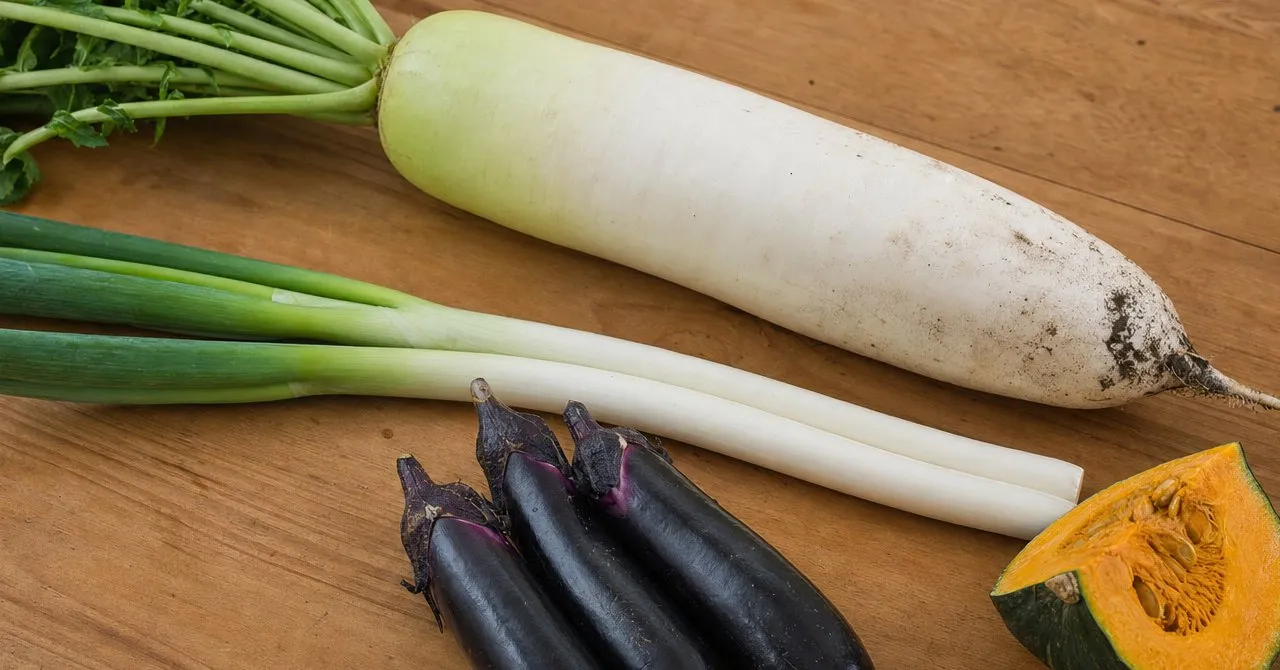
A Japanese recipe says 玉ねぎ1個 (one onion), にんじん1本 (one carrot), なす2本 (two eggplants), 大根1/3本 (a third of a daikon). It doesn’t give grams, because a Japanese home cook knows roughly what “one” looks like in a Japanese supermarket. You’re shopping in an American one, and the produce there is sized differently. Sometimes one American vegetable weighs as much as three or five of the Japanese ones the recipe had in mind.
The short answer: when a Japanese recipe counts vegetables by the piece, convert to weight and use a scale. Below, Japanese reference weights sit next to USDA’s standard weights. After that come the vegetables whose names cause trouble: negi versus scallions and leeks, and why the “yams” in a US store are sweet potatoes.
Why “one onion” isn’t a fixed amount
Japanese home recipes often list vegetables by count: 1個 (ikko, one piece) for round things like onions, 1本 (ippon, one long piece) for carrots, cucumbers, eggplants and negi, 1株 (hitokabu, one head) for napa cabbage. Sometimes a size is added, 中 (medium), 大 (large) or 小 (small). Sometimes the gram weight is in parentheses. Often it isn’t.
Even inside Japan, “medium” isn’t a standard. Vegetable weight guides and recipe sheets from three Japanese city governments give different numbers. Zushi and Kurashiki both say “medium onion” and still disagree by 50 g:
- The city of Zushi, Kanagawa, lists a medium onion at about 200 g, in a vegetable flyer that cites Japan’s national nutrition survey as its basis.
- A Kurashiki city health center recipe sheet writes “150 g (1 medium onion).”
- A weight guide posted by the city of Nagoya gives a small onion at 120 g, not far below Kurashiki’s medium.
Zushi is also clear about what its numbers include:
「※皮や種を取る前の重さです。」 “These are weights before removing skin or seeds.” — City of Zushi, vegetable weight flyer
So a Japanese “medium onion” can mean anything from about 150 to 200 g (5.3 to 7 oz). That range is your starting point for converting.
Japanese sizes vs US sizes
The US numbers below come from USDA FoodData Central, the federal food-composition database, using its standard reference (SR Legacy) entries. The Japanese numbers come from the three city guides above. The ratio column is our arithmetic from those figures.
| Recipe says | Japanese reference weight | USDA standard weight | Roughly |
|---|---|---|---|
| 玉ねぎ1個 (1 onion) | Medium about 200 g (Zushi); 150 g (Kurashiki); small 120 g (Nagoya) | Medium (2½” dia) 110 g; large 150 g; small 70 g | A Japanese medium onion ≈ 1⅓ to 1¾ US medium onions (or 1 to 1⅓ US large) |
| にんじん1本 (1 carrot) | Large about 150 g (Zushi); ⅓ medium = 50 g (Nagoya); Kurashiki recipes imply about 120–160 g | Medium 61 g; large (7¼”–8½”) 72 g | A Japanese carrot (about 150 g) ≈ 2½ US medium or 2 US large carrots |
| ねぎ1本 (1 negi) | Medium about 100 g (Zushi; type not specified) | Scallion, medium (4⅛”) 15 g; leek (bulb and lower leaves) 89 g | 1 negi ≈ 6 or 7 medium scallions by weight, or about 1 leek (white and lower leaves) |
| きゅうり1本 (1 cucumber) | Medium about 100 g (Zushi); ½ = 50 g (Nagoya) | 1 cucumber (8¼”) 301 g | 1 US cucumber ≈ 3 Japanese cucumbers |
| なす1本 (1 eggplant) | Medium about 100 g (Zushi); small 70 g (Nagoya) | 1 eggplant, unpeeled (about 1¼ lb) 548 g | 1 US globe eggplant ≈ 5 Japanese eggplants |
| ピーマン1個 (1 green pepper) | Large about 50 g (Zushi); small 20 g (Nagoya) | Green bell pepper, medium 119 g; small 74 g | 1 US medium bell pepper ≈ 2 to 6 Japanese peppers |
| 大根1本 (1 daikon) | Medium about 1.2 kg (Zushi); a 2 cm slice = 70 g (Nagoya) | We didn’t find a USDA standard weight | 大根1/3本 ≈ 400 g (14 oz) |
| かぼちゃ (kabocha) | ¼ squash about 560 g (Zushi); ½ medium = 400 g (Kurashiki) | Not compared | Fractions of a kabocha are unreliable; weigh |
| 白菜1/4株 (¼ napa cabbage) | About 300 g (Zushi) | Not compared | About 10½ oz |
In ounces: 100 g is about 3.5 oz, 200 g is about 7 oz, and 1 kg is about 2.2 lb.
One caveat: Zushi’s weights include skin and seeds, and we couldn’t confirm from the USDA records whether each portion weight is trimmed or whole. The eggplant entry is the exception: USDA gives it both ways, 548 g unpeeled and 458 g peeled.
What this means for you
- If the recipe gives grams, ignore the count and weigh. A digital kitchen scale that reads in 1 g steps with a tare button is the most useful tool here. Our guide to cooking Japanese recipes in an American kitchen covers the scale and the other conversions (cups, spoons, sugar).
- If it gives only a count, convert with the table, then use a little judgment. “1 Japanese onion” is about 1⅓ to 1¾ US medium onions, or 1 to 1⅓ US large onions (150 g each).
- Watch the long vegetables most. The gap is biggest for eggplants (about 5 to 1) and large for cucumbers and green peppers (about 3 to 1 or more). “Two eggplants” in a Japanese recipe is roughly 200 g (7 oz), well under half of one US globe eggplant.
Negi, scallions and leeks
Japan’s Agriculture and Livestock Industries Corporation (ALIC), a government-affiliated agency, divides negi into two groups: white negi (白ねぎ, also called 根深ねぎ, nebuka-negi; the Senju and Kaga groups) and green negi (青ねぎ, also called 葉ねぎ, ha-negi; the Kujō group).
- White negi (白ねぎ, shiro-negi), the thick long onion. Growers pile soil up around the stalk as it grows, which keeps out the light and blanches it. ALIC names Senju negi as a representative type and says it goes into hot pots, simmered dishes and much else.
- Green negi (青ねぎ, ao-negi), grown without that earthing-up; you mainly eat the green leaves. ALIC names two Kujō varieties: Kujō futo-negi (thick), mostly for hot pots, and Kujō hoso-negi (thin), mostly as a garnish.
ALIC describes white negi in one line:
「成長とともに土寄せを行い、日光を遮って白くした葉鞘部を主に食べます。」 “As it grows, soil is piled up around it, and you mainly eat the leaf-sheath part, kept white by blocking the sunlight.” — ALIC, on white negi
ALIC also says there’s a strong image of eastern Japan eating white negi and western Japan eating green, while noting that both are now eaten across the old east–west divide. It’s an impression, not a statistic, so treat a recipe’s region as a hint, not a rule. (Japan’s regional cooking differences show up in plenty of other dishes; see sukiyaki, Kantō style vs Kansai style, where, in Kikkoman’s 2024 survey of its own members, more than half said they put long green onion in sukiyaki.)
Which negi does a recipe mean?
We didn’t find a source that says which type a plain ねぎ in a recipe means, so read the clues. 白ねぎ or 根深ねぎ names the thick white type; 青ねぎ or 葉ねぎ names the green type. A small amount used as a garnish points to green negi. Hot pots don’t settle it: ALIC says Senju (white) negi goes into hot pots and simmered dishes, and so does the thick green Kujō type. Zushi’s 100 g per negi doesn’t say which type it means either.
What to buy in the US
English-language guides commonly suggest scallions or leeks. Just One Cookbook, for example, identifies negi as the Welsh onion (Allium fistulosum), calls it “longer and thicker,” and lists “scallions, leeks, garlic chives/Chinese chives, or spring onions” as substitutes. That’s reasonable advice. What the Japanese sources add is which part of the plant the recipe is built around:
| You need | Closest by part | Weight check (USDA vs Zushi) |
|---|---|---|
| White negi, cooked (hot pots, simmered dishes) | The white and pale green part of a leek, or the white parts of several scallions | 1 leek (bulb and lower leaves) 89 g (3.1 oz) ≈ 1 negi (about 100 g) |
| Green negi as a garnish | Scallion greens | 1 medium scallion 15 g (0.5 oz) |
We didn’t find a Japanese or US official source that sets a substitution ratio, so we don’t give one. Leeks and scallions aren’t the same plant as negi, and the weight figures only tell you how much to buy. (Our roundup of what English-language Japanese recipes get wrong has more on how substitutions and regional differences get lost in translation.)
Cucumbers and eggplants: small, thin and many
Eggplants show the largest size gap, and cucumbers are close behind.
Cucumbers. Japanese reference weights put a medium cucumber at about 100 g (3.5 oz). USDA’s standard cucumber, 8¼ inches long, is 301 g (10.6 oz). We didn’t find a USDA weight specific to English cucumbers. For a Japanese recipe that says “2 cucumbers,” weigh out about 200 g of whatever cucumber you have.
Eggplants. A Japanese nasu is about 100 g (3.5 oz) for a medium one and 70 g for a small one, by the city guides. USDA’s standard eggplant is about 1¼ lb (548 g) unpeeled. If you find slender eggplants, we didn’t find a USDA weight for those either. Either way, weigh: four Japanese eggplants is about 400 g (14 oz).
Daikon, kabocha and napa cabbage: buying a fraction
These three come huge, so Japanese recipes deal in fractions.
- Daikon (大根). Zushi puts a medium daikon at about 1.2 kg (2.6 lb). By that figure, the common 大根1/3本 is about 400 g (14 oz) and ½本 is about 600 g (1.3 lb). Nagoya’s guide gives a 2 cm (¾ inch) round at 70 g. US daikon vary a lot, and we didn’t find a USDA standard weight for a whole one, so weigh what you cut.
- Kabocha (かぼちゃ). This is where Japanese sources disagree most: Zushi lists ¼ kabocha at about 560 g (1.2 lb), while a Kurashiki recipe gives half a medium kabocha as 400 g (14 oz). If a recipe says “¼ kabocha,” that could mean either a few hundred grams or more than half a kilo. Look for a gram figure, or work from how many people it serves.
- Napa cabbage (白菜, hakusai). Zushi gives ¼ head at about 300 g (10½ oz).
Green peppers: piman vs bell peppers
The ピーマン (pīman) in Japanese recipes is a green pepper, but a small one: about 50 g for a large one in Zushi’s guide and 20 g for a small one in Nagoya’s. USDA’s medium green bell pepper is 119 g (4.2 oz), and its small one is 74 g. So “3 piman” in a Japanese recipe is roughly 60 to 150 g, often less than one US bell pepper. Use green bell pepper and weigh it.
Satsumaimo and the “yams” in US stores
Japanese recipes use satsumaimo (さつまいも), the sweet potato. US stores also sell “yams.”
The Library of Congress explains the naming. Unless you go looking for true yams, the “yams” in a typical US supermarket are sweet potatoes. Soft sweet potato varieties, the kind that turn moist when cooked, came to be called “yams” to tell them apart from the firm types. True yams belong to a different plant family, are grown mostly in Africa, and are usually sold in international markets.
So a US “yam” is a sweet potato, which is what satsumaimo means. Whether it cooks like the satsumaimo in a given recipe is a different question. Japanese varieties are bred for their own qualities. For example, Japan’s national agricultural research organization, NARO, describes its Beniharuka variety this way:
「「べにはるか」は糖度が高く、しっとりなめらかな食感が特長です。」 “Beniharuka is high in sugar, with a moist, smooth texture as its hallmark.” — NARO Kyushu Okinawa Agricultural Research Center
We didn’t find an official source comparing Japanese varieties with specific US ones, so we’re not going to tell you which US sweet potato “tastes like” satsumaimo. What we can say is that a US sweet potato labeled “yam” is still a sweet potato.
Names to know for the rest of the produce aisle
For these, we didn’t find an official per-piece weight in a Japanese source, or any official or manufacturer substitution guidance. Here are the names, without invented swaps:
| Japanese | Romanized | Common English name |
|---|---|---|
| しいたけ | shiitake | shiitake mushrooms |
| えのき | enoki | enoki mushrooms |
| しめじ | shimeji | shimeji or beech mushrooms |
| しそ / 大葉 | shiso / ōba | shiso, perilla leaves |
| 三つ葉 | mitsuba | mitsuba |
| ごぼう | gobō | burdock root |
| れんこん | renkon | lotus root |
If a Japanese recipe lists these by the piece or the pack, look for a gram figure in the recipe. The Kurashiki recipe sheet, for instance, lists gobō and renkon in grams, not by the piece.
FAQ
How big is a Japanese onion compared with an American one?
Japanese city guides put a medium onion at about 150 to 200 g (5.3 to 7 oz). USDA’s medium onion is 110 g (3.9 oz) and its large onion is 150 g. So one Japanese “medium onion” is about 1 to 1⅓ US large onions, or 1⅓ to 1¾ US medium ones.
Is negi the same as green onion?
Not exactly. Japan’s ALIC describes white negi (白ねぎ, also called 根深ねぎ) as grown with soil piled up to blanch it, and green negi (青ねぎ) as eaten for its green leaves. We didn’t find a source that says which type a plain ねぎ in a recipe means. Scallions are much smaller: 15 g for a medium one per USDA, against about 100 g for one negi in the city of Zushi’s guide. For cooked dishes, the white part of a leek is close in weight. For garnish, scallion greens work like green negi.
Can I use an English cucumber for a Japanese cucumber?
You can, but go by weight, not count. A Japanese cucumber is about 100 g (3.5 oz) in Japanese reference guides. USDA’s standard cucumber is 301 g, and we didn’t find a USDA weight specific to English cucumbers. Weigh out the amount the recipe means: about 100 g per Japanese cucumber.
How many globe eggplants equal Japanese eggplants?
By weight, one USDA standard eggplant (548 g, about 1¼ lb, unpeeled) equals about five medium Japanese eggplants at about 100 g each.
Are yams the same as Japanese sweet potatoes?
The “yams” in most US supermarkets are sweet potatoes, according to the Library of Congress, and satsumaimo is the Japanese word for sweet potato. True yams are a different plant. Japanese varieties such as Beniharuka are bred for their own sweetness and texture, and we didn’t find a source comparing them with specific US varieties.
How this article was researched
Japanese reference weights come from vegetable weight guides and recipe sheets published by three Japanese city governments (Zushi, Kurashiki and Nagoya). They disagree with one another, and we show those disagreements rather than picking one. Negi types come from two documents by Japan’s Agriculture and Livestock Industries Corporation, and the Beniharuka description comes from NARO. US weights come from USDA FoodData Central’s SR Legacy entries, and the explanation of US “yams” comes from the Library of Congress. Japanese quotations were translated by us, and the ratios in the tables are our own arithmetic from the cited weights. We didn’t find official substitution ratios for any of these vegetables, so this page doesn’t give any. Nothing here was kitchen-tested by this site.
Sources
Japanese official and public sources:
- 逗子市 福祉部国保健康課 野菜の目安量チラシ — City of Zushi, Kanagawa: vegetable flyer with piece weights, citing the FY2022 National Health and Nutrition Survey (PDF)
- 倉敷市保健所「野菜たっぷりメニュー」 — Kurashiki City Health Center: vegetable-rich recipes, January 2024 (PDF)
- 名古屋市「野菜の重さの目安」 — City of Nagoya: guide to vegetable weights (PDF)
- 農畜産業振興機構「おすすめ野菜」ねぎ — ALIC: white and green negi, December 2014 (PDF)
- 農畜産業振興機構「野菜情報」今月の野菜 ねぎ — ALIC: negi supply and variety groups, September 2018 (PDF)
- 農研機構「しっとり極甘 焼き芋に最適のサツマイモ」 — NARO: the Beniharuka sweet potato, 2014 (PDF)
- キッコーマン ニュースリリース「すき焼きは普段から食べられている!」 — Kikkoman: 2024 home sukiyaki survey
US official sources:
- USDA FoodData Central — Onions, raw (SR Legacy 170000)
- USDA FoodData Central — Carrots, raw (SR Legacy 170393)
- USDA FoodData Central — Onions, spring or scallions (includes tops and bulb), raw (SR Legacy 170005)
- USDA FoodData Central — Leeks, bulb and lower leaf-portion, raw (SR Legacy 169246)
- USDA FoodData Central — Cucumber, with peel, raw (SR Legacy 168409)
- USDA FoodData Central — Eggplant, raw (SR Legacy 169228)
- USDA FoodData Central — Peppers, sweet, green, raw (SR Legacy 170427)
- Library of Congress — Everyday Mysteries: What is the difference between sweet potatoes and yams?
English-language example: