What "100% Buckwheat" Soba Means in Japan
Japanese rules let soba contain wheat. What the fresh and dried noodle rules say, juwari vs. nihachi, gluten, buckwheat allergy and how to cook dried soba.
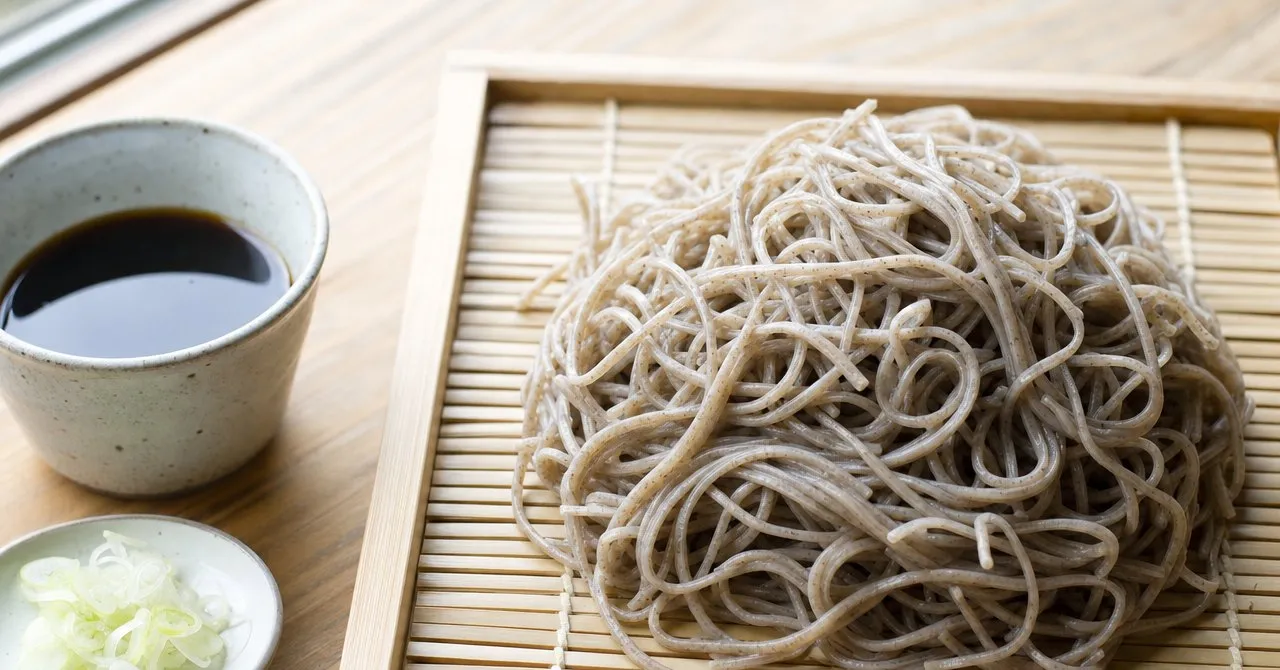
Soba is the Japanese word for buckwheat, and buckwheat contains no gluten. So it’s easy to assume soba noodles are gluten-free. Many aren’t. Wheat flour is a normal ingredient in soba, and Japan’s own labeling rules are written with that in mind.
In Japan, fresh noodles sold as soba under the noodle industry’s labeling code need only 30% buckwheat flour. Dried soba can contain less than that, as long as the package states how much buckwheat is in it. Noodles made only from buckwheat flour exist and have a name, juwari (十割, “ten tenths”), but they are one kind of soba, not the definition of it.
The short answer: if you need to avoid wheat, the word “soba” tells you nothing. The ingredient list and a gluten-free claim do.
The short answer
- Fresh soba in Japan: under the fair competition code for fresh noodles, soba means noodles made mainly from a blend of at least 30% buckwheat flour and no more than 70% wheat flour.
- Dried soba in Japan: any dried noodle that uses buckwheat flour counts as dried soba. If the buckwheat share is under 30%, the label must say so.
- Juwari means all buckwheat. Nihachi (二八, “two-eight”) is usually explained as 8 parts buckwheat to 2 parts wheat.
- Gluten: buckwheat isn’t a gluten-containing grain under FDA rules, but soba made with wheat flour can’t be labeled gluten-free in the US.
- Allergy: buckwheat is one of the allergens Japan requires on labels. It isn’t one of the nine major food allergens in the US.
Fresh soba: at least 30% buckwheat
Under Japan’s national Food Labeling Standards, fresh and boiled noodles (nama-men, 生めん) have no product-specific labeling items of the kind dried noodles have; they follow the general food labeling rules, according to a May 2025 labeling guide from Gunma Prefecture’s Food and Living Sanitation Division (食品・生活衛生課). On top of those general rules, makers that join a voluntary industry code, the Fair Competition Code for the Labeling of Fresh Noodles (生めん類の表示に関する公正競争規約), must label by it.
The National Federation of Noodle Manufacturers’ Cooperatives (全国製麺協同組合連合会), a trade group of fresh-noodle makers, quotes the code’s definition of soba:
「そば粉30%以上、小麦粉( 灰分が 0.8%以下のものに限る。)70%以下の割合で混合したものを主たる原料とし、これに水を加えて練り合わせた後製めんしたもの又は製めんした後加工したものをいう。」 “Noodles whose main raw material is a blend of at least 30% buckwheat flour and no more than 70% wheat flour (limited to flour with an ash content of 0.8% or less), mixed with water and kneaded, then made into noodles, or noodles processed after being made.” — National Federation of Noodle Manufacturers’ Cooperatives, quoting the fair competition code
Saitama Prefecture’s certification standard for fresh noodles uses the same 30%/70% definition.
Two things follow. First, wheat is allowed: a fresh soba can be up to 70% wheat flour and still be soba. Second, there is a floor: a maker following this code can’t sell a fresh noodle with only a trace of buckwheat as soba.
The code also has limits on what it covers. The federation’s page says it excludes dried noodles, instant noodles, noodles cooked for customers at restaurants, and noodles sold from vending machines. So the soba you order at a noodle shop in Japan isn’t covered by this definition at all.
Dried soba: the 30% line is about the label
Dried noodles (kanmen, 乾めん) are covered by Japan’s national Food Labeling Standards (食品表示基準). Gunma Prefecture’s May 2025 guide sets out the rules with their article numbers, and they work differently from the fresh-noodle code.
Dried soba (hoshi-soba, 干しそば) is defined this way:
「乾めん類のうち、そば粉を使用したものをいう。」 “A dried noodle that uses buckwheat flour.” — Food Labeling Standards, Appended Table 3, as quoted in Gunma Prefecture’s labeling guide
There is no minimum in that definition. What the standards add is a disclosure rule. The buckwheat share, defined as the weight of buckwheat flour as a share of all ingredients and additives other than salt, must be printed on dried soba with less than 30% buckwheat:
「干しそばのうち、そば粉の配合割合が 30%未満のものに表示します。」 “The buckwheat flour ratio is shown on dried soba whose ratio is under 30%.” — Gunma Prefecture, Food Labeling Guide: Soba and Udon (2025)
The guide explains how the number is written:
| Buckwheat share of a dried soba | What the Japanese label must show |
|---|---|
| 30% or more | No ratio required |
| 10% to under 30% | A figure no higher than the actual ratio, such as 「2割」 (2 tenths) or 「20%」 |
| Under 10% | 「1割未満」 (under 1 tenth) or 「10%未満」 (under 10%) |
The guide’s sample label reads 「そば粉の配合割合 10%未満」, meaning “buckwheat flour ratio: under 10%.” In other words, a dried soba in Japan can be mostly wheat, provided it says so.
Two cautions. These rules apply to products labeled for sale in Japan. A package sold in the US is labeled under US rules, so you may not see a buckwheat percentage at all. And on a Japanese dried soba package, no printed ratio tells you only that the buckwheat share is at least 30%, not that it is high.
The rule has its critics. In a 2015 written question to the government, House of Representatives member Takeshi Miyazaki objected that a dried noodle with 10% buckwheat or less can still be called dried soba, and said the 30% line had no particular basis. The Cabinet’s answer said the disclosure rule exists to help consumers choose, and that requiring a ratio on every dried soba would need careful study.
Juwari and nihachi
Neither the fresh-noodle code nor the dried-noodle rules, as described in the sources above, define juwari or nihachi. These are the trade’s own words, not legal categories.
Juwari (十割) means “ten tenths”: soba made from buckwheat flour alone. We didn’t find a legal definition of the term, so a “juwari” or “100% buckwheat” claim on a package is the maker’s own statement. The way to confirm it is the ingredient list: buckwheat flour (そば粉, soba-ko) and nothing else, apart from water used in making it.
Nihachi (二八) means “two-eight.” The usual explanation is 8 parts buckwheat flour to 2 parts wheat flour as a binder. Heibonsha’s World Encyclopedia records a second theory too: that the name came from the price, since 2 × 8 = 16 mon, an old unit of money. It lays out both and says the question is unsettled:
「結論は出ていない」 “No conclusion has been reached.” — 世界大百科事典 (old edition, Heibonsha), entry for ソバ (蕎麦), via Kotobank
Here is how the terms line up:
| Term | Buckwheat flour | What defines it |
|---|---|---|
| Juwari (十割) | All of the flour | Common usage; no legal definition found |
| Nihachi (二八) | Usually explained as 80% | Common usage; name’s origin disputed |
| Fresh soba, fair competition code | At least 30% | Industry code, for participating makers |
| Dried soba, Food Labeling Standards | Any amount; under 30% must be stated | National labeling rule |
By Japanese rules, nihachi soba and other wheat-blend soba are simply soba. Healthline, for example, calls juwari “the most authentic kind.” That’s a matter of taste. The Japanese definitions don’t support the idea that soba with wheat in it is a lesser copy.
Is soba gluten-free?
Soba is gluten-free only if it contains no wheat or other gluten grain and meets the US rules for the claim.
The FDA’s gluten-free rule (21 CFR 101.91) names wheat, rye and barley, and crossbreeds of them, as the gluten-containing grains. Buckwheat isn’t on the list. A food labeled gluten-free may not contain a gluten-containing grain as an ingredient, or an ingredient made from one, such as wheat flour, that hasn’t been processed to remove gluten. Any gluten that is unavoidably present must be below 20 parts per million.
Wheat flour is the very ingredient those Japanese definitions allow. A soba made with it fails the US gluten-free test before anyone measures anything. A juwari soba might qualify, but the word “juwari” isn’t a gluten-free claim. Cross-contact in the factory is a separate question, which is why Healthline’s article on soba advises checking “that the manufacturer has avoided cross-contamination from gluten-containing grains.”
This article is about labels, not medicine. If you avoid gluten for a medical reason, follow your doctor’s or dietitian’s advice. What the rules above support:
- Look for a “gluten-free” claim on the package. In the US it must meet the FDA definition.
- Read the ingredient list for wheat flour. On a Japanese label, wheat flour is 小麦粉 (komugiko) and buckwheat flour is そば粉 (soba-ko).
- Don’t rely on “soba,” “buckwheat noodles” or “juwari” alone.
- Check the dipping sauce too. If it’s made with soy sauce, note that Japan’s JAS standard for soy sauce defines ordinary koikuchi soy sauce as brewed from soybeans with a roughly equal amount of mugi, a word covering wheat and barley. See Is Tamari Gluten-Free? Not Always.
Buckwheat allergy: required on Japanese labels, not a US “major” allergen
Japan treats buckwheat as a major allergen. Its Consumer Affairs Agency (消費者庁) sets a short list of mandatory allergen items, tokutei genzairyō (特定原材料), that must be declared on packaged foods. A May 2026 agency presentation lists nine: shrimp, cashew nuts, crab, walnuts, wheat, buckwheat, egg, milk and peanuts. Cashew nuts were added in April 2026, with a two-year transition period. The agency explains how the list is chosen:
「全国実態調査における症例数や重篤度を踏まえ、特定原材料等を定めています。」 “We set the specified raw materials and related items based on the number of cases and their severity in nationwide surveys.” — Consumer Affairs Agency, Food Labeling Division, presentation to the Council for the Promotion of Allergic Disease Measures (May 2026)
Japanese labels may also carry a voluntary cross-contact warning. Gunma’s guide gives the example 「本品製造工場では、○○を含む製品を生産しています。」, meaning “This factory also makes products containing ○○.”
The US list is different. The FDA names nine major food allergens: milk, eggs, fish, crustacean shellfish, tree nuts, peanuts, wheat, soybeans and sesame. Buckwheat isn’t one of them. That doesn’t make it harmless. The FDA also says, “More than 160 foods have been identified to cause food allergies in sensitive individuals.”
The FDA says people with food allergies “should read labels and avoid the foods they are allergic to.” Because buckwheat isn’t a major allergen under US law, it won’t be flagged in a “Contains” statement, so read the full ingredient list. Ask your doctor or an allergist about what precautions to take.
How to cook dried soba
Adapted from Hakubaku’s published method for dried noodles. Hakubaku, a Japanese maker of dried noodles and grains, gives one method for all its dried noodles, soba included. It doesn’t give a water-to-noodle ratio or a cooking time, so follow the package for timing. This site has not kitchen-tested it.
- Bring a generous pot of water to a boil. Hakubaku says only “plenty” of water (たっぷりの水).
- Add the noodles loosely and stir gently with chopsticks. Adjust the heat so the pot doesn’t boil over, and cook for the time on the package.
- Drain in a colander and rinse quickly.
- For cold soba, drain well, put them in a serving dish, and serve with mentsuyu (noodle sauce) and condiments of your choice.
- For hot soba, dip the rinsed, cooled noodles briefly in hot water again, put them in a bowl, pour hot broth over them and add toppings of your choice. Hakubaku suggests cooking them a little shorter than usual when they’ll be served in hot broth.
Hakubaku states the rinse plainly:
「ゆで上がったらざるにとり、手早く水洗いしてください。」 “When the noodles are done, drain them in a colander and quickly rinse them with water.” — Hakubaku, “How to boil noodles”
For the broth and dipping sauce, see Dashi Is Not Fish Stock.
What Healthline gets right
Healthline’s article “Soba Noodles: Good or Bad?” handles most of this well. It says soba “can be made solely of buckwheat flour and water, but more commonly also contain wheat flour,” tells readers to check that the noodles are “truly gluten-free,” and warns that “a few packaged noodles are labeled soba though they contain little or no buckwheat flour.” It also notes that buckwheat is “a major food allergen in Japan and Korea.”
What it doesn’t cover is the Japanese framework: the 30% floor for fresh soba under the industry code, and the 30% disclosure line for dried soba. And its description of juwari as “the most authentic kind” is a value judgment. Under Japan’s own definitions, soba with wheat is still soba.
FAQ
Are soba noodles gluten-free? Only some. Buckwheat itself isn’t a gluten grain under FDA rules, but soba often contains wheat flour, and Japan’s fresh-noodle industry code allows soba to be up to 70% wheat flour. Look for a gluten-free claim on the package and check the ingredient list for wheat.
What is juwari soba? Soba made from buckwheat flour alone. Juwari (十割) means “ten tenths.” We found no Japanese legal definition of the term, so check that the ingredient list shows buckwheat flour and nothing else.
What does nihachi soba mean? Nihachi (二八) means “two-eight” and is usually explained as 8 parts buckwheat flour to 2 parts wheat flour. Another theory traces the name to a price of 16 mon; Heibonsha’s encyclopedia says the question is unresolved.
How much buckwheat is in soba in Japan? It depends on the type. Under the industry code for fresh noodles, soba must be at least 30% buckwheat flour. Dried soba can contain any amount, but a package with less than 30% must state the ratio, such as “under 10%.”
Is buckwheat a major allergen in the US? No. The FDA’s nine major food allergens are milk, eggs, fish, crustacean shellfish, tree nuts, peanuts, wheat, soybeans and sesame. In Japan, buckwheat is one of the mandatory allergen labeling items. Buckwheat allergy exists either way; ask a doctor if you’re concerned.
Should you rinse soba after cooking? Japanese noodle maker Hakubaku says to drain the noodles in a colander and rinse them quickly in water. For hot soba, it says to briefly reheat the rinsed noodles in hot water before adding broth.
How this article was researched
The Japanese side of this article relies on Japanese-language sources: Gunma Prefecture’s May 2025 labeling guide for soba and udon, which cites the national Food Labeling Standards by article; the fresh-noodle fair competition code as quoted by the National Federation of Noodle Manufacturers’ Cooperatives, with Saitama Prefecture’s fresh-noodle certification standard as a cross-check; a 2015 Diet written question and the Cabinet’s answer; a May 2026 Consumer Affairs Agency presentation on allergen labeling; Heibonsha’s World Encyclopedia via Kotobank; and Hakubaku’s published method for boiling noodles. We weren’t able to open the full text of the fresh-noodle code itself, so its definition is quoted as the trade federation gives it. The US side uses the FDA’s food allergy page and the eCFR text of 21 CFR 101.91. Japanese quotations are kept short and translated by us. The cooking method is adapted from Hakubaku and hasn’t been kitchen-tested by this site, and nothing here is medical advice.
Sources
Japanese sources:
- 食品表示の手引き ー そば・うどん編 ー(2025年5月改訂版)— Gunma Prefecture, food labeling guide for soba and udon (PDF)
- 全国製麺協同組合連合会 めんの知識 — National Federation of Noodle Manufacturers’ Cooperatives, definitions under the fresh-noodle fair competition code
- 消費者庁 公正競争規約 業種一覧 — Consumer Affairs Agency, list of fair competition codes by industry (includes fresh noodles)
- 食物アレルギー表示制度における消費者庁の取組(2026年5月)— Consumer Affairs Agency, presentation on food allergy labeling (PDF)
- コトバンク「二八そば」— Kotobank, mention of nihachi soba in the Heibonsha World Encyclopedia’s buckwheat entry
- はくばく「麺のゆで方」— Hakubaku, how to boil noodles
- 〔埼玉県ふるさと認証食品〕生めん類の認証基準 — Saitama Prefecture, certification standard for fresh noodles, a prefectural standard that restates the code’s soba definition (PDF)
- 日本そばの品質表示に関する質問主意書(2015)— House of Representatives, written question on dried soba labeling
- 同 答弁書(2015)— Cabinet’s answer to the written question
- 日本農林規格 しょうゆ(JAS 1703:2021)— MAFF, JAS standard for soy sauce (PDF)
US regulations and agencies:
English-language example:
More on Japanese labels and ingredients: Is Tamari Gluten-Free? Not Always, Japanese Soy Sauce Isn’t One Thing and What English-language Japanese recipes get wrong.