Dashi Isn't Fish Stock
Dashi is a gentle extraction, not a long simmer, and some versions use no fish at all. How Japanese makers do it, plus a vegetarian dashi.
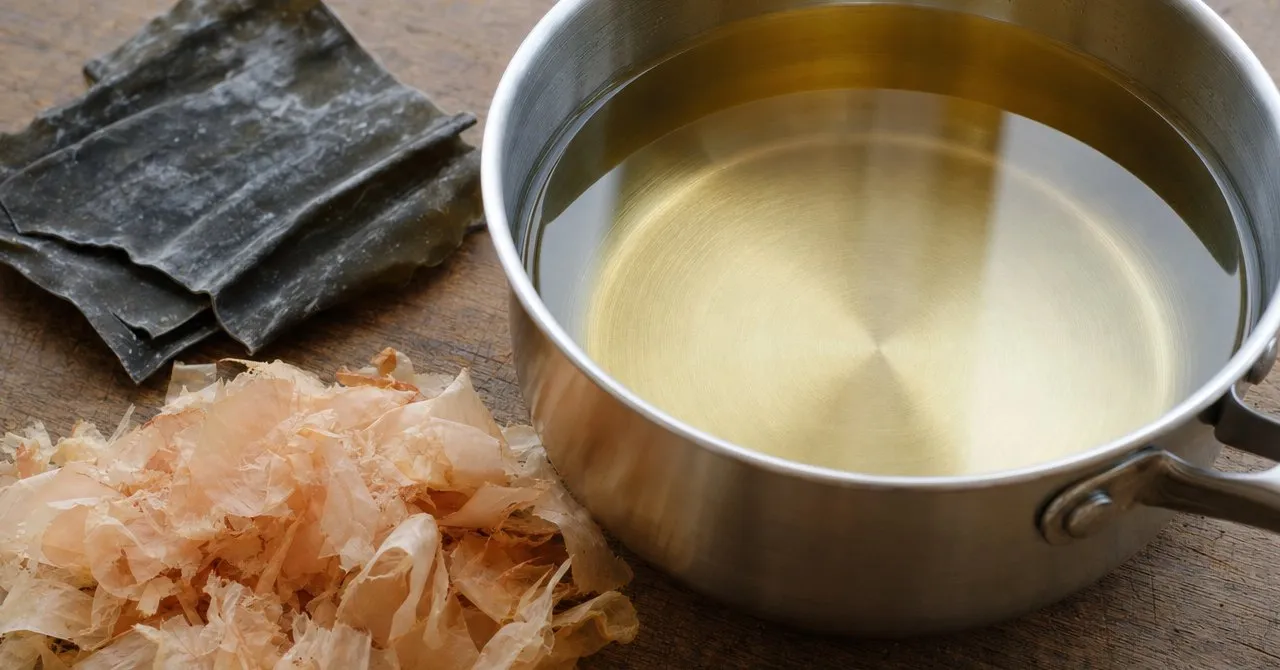
English-language recipes often translate dashi as “fish stock.” PBS Food’s recipe from chef Hiroko Shimbo carries the title “Dashi: Japanese Fish Stock.” The label is understandable, since the classic combined dashi uses katsuobushi (bonito flakes). It is also too narrow, and it hints at the wrong method.
Japanese sources describe dashi as a family of quick extractions. The classic version pairs kombu (kelp), rich in glutamate, with katsuobushi, rich in inosinate. There are also dashi made from kombu alone, from dried shiitake, and from plant ingredients only. And the standard home method from Japanese manufacturers soaks the kombu first, then the heating takes only minutes: the kombu comes out before the water boils, and the flakes steep off the heat for a minute or two.
The short answer
- Dashi is an extraction, not a long simmer. Ninben, Yamaki and Kikkoman all use about 1 liter of water, 10 g of kombu and 20 g of katsuobushi, steeping the flakes 1 to 2 minutes off the heat.
- Not all dashi contains fish. Kombu dashi, shiitake dashi and shōjin dashi (made only from plant ingredients) are all part of Japanese cooking.
- The flavor is umami, by design. Kombu supplies glutamate, katsuobushi inosinate, and dried shiitake guanylate. Glutamate combined with either inosinate or guanylate tastes far stronger than either alone.
- Instant granules are a different product. On Ajinomoto’s Japanese Hondashi label, the first ingredient is salt.
Why “fish stock” misleads
Merriam-Webster defines stock as “liquid in which meat, fish, or vegetables have been simmered that is used as a basis for soup, gravy, or sauce.” By that definition, a bonito dashi is loosely a fish stock. Calling all dashi “fish stock” still causes two problems.
First, it leaves out the dashi that use no fish. Heibonsha’s World Encyclopedia (as collected on Kotobank) gives the term for it:
植物性の材料のみを用いてとるだしは精進だしと呼ばれ — Dashi made using only plant ingredients is called shōjin dashi. — 世界大百科事典 (Heibonsha), via Kotobank
Second, “stock” suggests simmering. In the Japanese makers’ standard method, the kombu comes out before boiling, and the katsuobushi goes in after the heat is off.
None of this makes the PBS recipe wrong. Shimbo brings kombu almost to a boil and cooks it 10 minutes, then adds the flakes, turns off the heat and lets them stand 2 minutes. That is close to the simmered home method in Japanese sources, though longer (Fujicco holds kombu just below a boil for 2 to 3 minutes), and the Japanese makers turn the heat off before adding the flakes. Only the title is the issue.
Where the flavor comes from
Each of the main umami compounds is tied to a dashi ingredient. The Umami Information Center, a Japanese nonprofit, lays out the history:
| Compound | Main dashi source | Who identified it |
|---|---|---|
| Glutamate | Kombu | Kikunae Ikeda, starting from dried kombu (the center marks 2008 as the centennial) |
| Inosinate | Katsuobushi | Shintaro Kodama, 1913 |
| Guanylate | Dried shiitake | Akira Kuninaka of Yamasa, 1957; later shown to be shiitake’s umami compound |
Kuninaka also found a strong synergy between glutamate and inosinate or guanylate. The center states the size of the effect:
両者を混ぜると7-8倍うま味が強くなるのです。 — When the two are mixed, umami becomes 7 to 8 times stronger. — Umami Information Center
Here “the two” are MSG and IMP (inosinate). The center also notes that the effect depends on the mixing ratio: raising the share of IMP too far reduces it. The center’s dashi page applies this to the kitchen. It says ichiban dashi (kombu plus katsuobushi) has about twice the umami compounds of kombu dashi, yet is perceived as 7 to 8 times as strong as that concentration alone would suggest. So kombu plus katsuobushi gives more umami than either alone, and kombu plus dried shiitake applies the same principle without fish.
How Japanese makers make awase dashi
Awase dashi means “combined dashi”: kombu and katsuobushi together. Here is how the three makers write it, alongside the PBS recipe.
| Source | Water | Kombu | Katsuobushi | Kombu soak | Kombu comes out | Katsuobushi |
|---|---|---|---|---|---|---|
| Ninben | 1,000 mL | 10 g | 20 g | 30–60 min | When small bubbles rise from the bottom, about 176°F (80°C) | Bring to a boil, heat off, steep 2 min |
| Yamaki | 1 L | about 10 g | about 20 g | about 1 hour | Low heat, just before boiling | Bring to a boil, heat off, steep 1–2 min until the flakes sink |
| Kikkoman | 1,000 mL (listed as 5 kappu; we convert at the standard Japanese 200 mL measure) | 10 g | 20 g | 30 min | Medium heat, just before boiling | Bring to a boil, heat off, steep about 2 min |
| PBS (Hiroko Shimbo) | 2 quarts (about 1.9 L) | one 6-inch square | 1 cup, tightly packed | none | After about 10 min near a boil | Add, count to 10, heat off, stand 2 min |
The three makers agree on two points, and Ninben and Yamaki add a third:
- The kombu comes out before the water boils. Ninben warns that boiling the kombu lowers the flavor of the dashi.
- The katsuobushi steeps off the heat, briefly: about 1 to 2 minutes (Yamaki: until the flakes sink).
- Strain gently. Ninben and Yamaki both say to strain slowly. For its bonito-only dashi, Ninben adds:
えぐみが出てしまうので、鍋に鰹節を入れる時はかき混ぜず、こす時は鰹節を絞らないでください。 — Because it brings out harsh flavors, don’t stir the katsuobushi when you add it to the pot, and don’t squeeze it when you strain. — Ninben
Compare an American recipe. Chef Billy Parisi’s “Dashi Recipe,” whose description says it “makes an authentic, umami-rich Japanese stock,” says to “simmer over low to medium heat for 20 minutes” with the kombu. Then you remove it, add the bonito flakes, and “bring to a boil and then simmer over low heat for 5 minutes.” That is longer and hotter than the makers’ method for thin flakes.
Longer heating does have a place: Ninben simmers thick-cut katsuobushi (atsukezuri) for 15 to 20 minutes.
Recipe: Basic awase dashi (kombu and katsuobushi)
Adapted from Ninben’s published method for awase dashi. Makes about 800 mL (about 3⅓ US cups). Notes from other sources are set apart below the steps.
Weigh the katsuobushi if you can; English recipes measure it “tightly packed” in one and “loosely packed” in another. Japanese recipes that measure dashi in kappu mean 200 mL, not a 236.6 mL US cup (see Cooking Japanese Recipes in an American Kitchen).
Ingredients
- 1,000 mL water (about 4¼ US cups)
- 10 g dashi kombu (about ⅓ oz). Kikkoman describes 10 g as a strip about 3 × 25 cm (1¼ × 10 in).
- 20 g katsuobushi, thin flakes (about 0.7 oz)
Method (Ninben)
- Soak. Put the water and kombu in a pot and let it stand 30 minutes to 1 hour.
- Heat, and remove the kombu early. Heat the pot. When small bubbles start rising from the bottom, at about 176°F (80°C), turn off the heat and lift out the kombu.
- Bring to a boil, then turn off the heat. Reheat until it boils, turn the heat off, and add the katsuobushi.
- Steep 2 minutes.
- Strain slowly. Line a sieve with a paper towel or cloth and set it over a bowl. Pour the dashi through slowly, and let it drain for 1 minute.
Notes from other sources
- Before soaking (Yamaki, Fujicco): Yamaki wipes the kombu lightly with a damp, well-wrung cloth. Fujicco notes that the white powder on the surface is mannitol, a naturally sweet component, so you only need to remove dust or grit.
- Stirring and squeezing (Ninben, bonito-only dashi): Don’t stir the flakes or squeeze them (see the quote above).
- Steeping (Yamaki): Yamaki steeps for 1 to 2 minutes, until the flakes sink to the bottom.
Ichiban and niban dashi
Ichiban dashi (“first dashi”) is the first extraction: the dashi above, or Ninben’s bonito-only version. Niban dashi (“second dashi”) is made from the leftovers. Ninben says niban dashi has a somewhat weaker aroma but still holds umami the first extraction didn’t take out.
Ninben’s second dashi is written for the 30 g of spent flakes from its bonito-only first dashi (30 g katsuobushi in 1,000 mL water). Ninben doesn’t give amounts for reusing the 20 g left from awase dashi.
- Put the 30 g (about 1 oz) of spent katsuobushi in a pot with 500 mL water (about 2 US cups + 2 tbsp). Bring it to a boil, then simmer on low for 3 to 5 minutes and turn off the heat.
- Add 4.5 to 5 g (about ⅙ oz; weigh it) of fresh katsuobushi and let it stand 1 to 2 minutes.
- Strain, let it drain 1 minute, then squeeze lightly. Squeezing is fine here, unlike with ichiban dashi.
- Makes about 440 mL (a little under 2 US cups).
Ninben’s suggested uses, in short:
| Best for | |
|---|---|
| Ichiban dashi | Clear soups, miso soup, chawanmushi, soba and udon broth |
| Niban dashi | Simmered dishes, takikomi gohan (seasoned rice), hot pots |
If you are making miso soup, our guide to Japanese miso types covers which miso to pair with it.
Kombu-only dashi (no fish)
Japanese sources give three ways to make dashi from kombu alone.
The restaurant method: about 140°F (60°C) for 1 hour. The food maker Fujicco, in its educational material on kombu, describes this as the Kyoto ryōtei (traditional restaurant) way. A whole sheet of kombu goes into cold water in a large pot and is heated slowly at 140°F (60°C) for an hour, which Fujicco says gives the best dashi. The Umami Information Center and Mitsubishi Electric’s CME site give the same temperature and time. Mitsubishi Electric suggests 30 g (about 1 oz) of kombu per liter, warns that heating it too hot brings out sliminess, and says to stop heating if the temperature starts to climb, even before the hour is up. So you need a way to watch it, such as a kitchen thermometer.
The home simmered method. Fujicco uses 20 g (about 0.7 oz) of kombu per 1 liter of water. Soak it 30 minutes to an hour, then heat. Just before it boils, lower the heat and cook 2 to 3 minutes, skimming. Take the kombu out before it boils. Fujicco explains why:
沸騰させると、えぐみ(苦味・渋み・雑味)の原因になり、風味が損なわれます。 — Boiling it causes harsh flavors (bitterness, astringency, off-notes) and spoils the flavor. — Fujicco
Not every Japanese source agrees on this. Kikkoman’s kombu dashi brings 15 to 20 g of kombu (about ½ to ¾ oz) in about 1,000 mL of water (5 kappu) to a boil, then simmers it 7 to 8 minutes over slightly lower heat. Kikkoman simmers kombu only in this kombu-only dashi; in its bonito-and-kombu dashi, it too removes the kombu just before boiling.
Cold brew. Fujicco simply puts 20 g (about 0.7 oz) of kombu in 1 liter of water in the refrigerator. Kikkoman leaves it overnight and says to take the kombu out after one night at most, or the dashi turns cloudy.
Vegetarian dashi: kombu and shiitake
For a plant-only dashi with the umami synergy, pair kombu (glutamate) with dried shiitake (guanylate).
Adapted from Nahomi Edamoto’s recipe on NHK’s Minna no Kyō no Ryōri. Her recipe adds 4 g of dried sardines (niboshi) “if you have them.” This version leaves them out.
Ingredients
- 4 to 5 dried shiitake
- 1 piece kombu, about 7 cm (2¾ in) square
- About 800 to 1,000 mL water (about 3⅓ to 4¼ US cups; listed as 4 to 5 kappu, converted at 200 mL)
Method
- Put the water, shiitake and kombu in a clean container and refrigerate overnight.
- Use the liquid as dashi. If the flavor is too strong, dilute it with water.
Why cold water? In an interview on Mitsubishi Electric’s CME site, the Ōita shiitake growers’ cooperative explained that as dried shiitake rehydrates, one enzyme produces guanylate and another breaks it down, and in lukewarm or room-temperature water the second one wins out. They recommend a cold soak in the refrigerator:
時間の目安は12~24時間。 — Allow about 12 to 24 hours. — Ōita Prefecture Shiitake Agricultural Cooperative (interview, Mitsubishi Electric CME)
About instant dashi granules
Japanese label (Ajinomoto’s product page): salt; sugars (sugar, lactose); flavor ingredients (bonito powder, bonito extract); yeast extract; fermented yeast-extract seasoning; and chōmiryō (amino-san tō), “seasoning (amino acids, etc.).” Ajinomoto lists 0.40 g of salt equivalent per 1 g serving, the amount it gives for one bowl of miso soup. The allergen listed is milk.
US market: A US retail listing (H-E-B) shows monosodium glutamate as the second ingredient, after salt. We could not confirm this on an Ajinomoto US page.
What this means in the kitchen:
- Granules add salt. Homemade dashi made by the methods above has no added salt. If you swap in granules, taste before adding all the soy sauce, salt or miso. Our guide to Japanese soy sauce types explains why light-colored usukuchi is not lower in salt.
- Hondashi is not vegetarian. It contains bonito, and also lactose (milk).
- MSG is labeled by name in the US. The FDA considers added MSG “generally recognized as safe” (GRAS) and requires it to appear on the ingredient list as “monosodium glutamate.”
Formulas differ by product and market, so check your package.
FAQ
Is dashi fish stock? Some dashi is made with fish, and some isn’t. Awase dashi uses katsuobushi (bonito), so it contains fish. Kombu dashi, shiitake dashi and shōjin dashi use no animal ingredients. In the Japanese makers’ standard method, even the bonito version steeps briefly off the heat rather than simmering like a Western stock.
Is there a vegetarian dashi? Yes. Kombu dashi alone, or kombu plus dried shiitake soaked overnight in the refrigerator. Japanese sources call dashi made only from plant ingredients shōjin dashi. Instant granules such as Hondashi contain bonito, so they aren’t vegetarian.
Can I boil kombu? Japanese sources disagree. Fujicco and Ninben say to take it out before the water boils, to avoid harsh flavors (Fujicco) or a loss of flavor (Ninben). Kikkoman’s kombu-only dashi simmers for 7 to 8 minutes after boiling, though its bonito-and-kombu dashi removes the kombu just before boiling.
What’s the difference between ichiban and niban dashi? Ichiban dashi is the first extraction, for clear soups and miso soup. Niban dashi simmers the leftover flakes again (Ninben adds a little fresh katsuobushi) and suits simmered dishes and hot pots.
How this article was researched
The methods, ratios and times in this article come from Japanese-language sources: the katsuobushi makers Ninben and Yamaki, Kikkoman, the food maker Fujicco, Mitsubishi Electric’s CME site, the Umami Information Center, a Heibonsha encyclopedia entry on Kotobank, and an NHK recipe. Ajinomoto’s label data comes from its Japanese product page; the US ingredient order is from a US retailer’s listing and was not confirmed on a US Ajinomoto page. US labeling rules come from the FDA. Quotations from Japanese sources are kept short and translated by us. The recipes are adapted from Ninben and from Nahomi Edamoto’s NHK recipe and have not been kitchen-tested by this site. Japanese recipes that list kappu without a mL value are converted at the standard 200 mL. Where Japanese sources disagree, as on whether kombu should boil, we say so.
Sources
Japanese manufacturers:
- にんべん「本物のだしの取り方とレシピ」 — Ninben: how to make dashi (awase, ichiban, niban, thick-cut)
- にんべん「一番だしと二番だしって何が違うの?」 — Ninben: ichiban vs niban dashi
- ヤマキ「合わせだしの取り方」 — Yamaki: how to make awase dashi
- キッコーマン「かつお昆布だしの取り方」 — Kikkoman: bonito and kombu dashi
- キッコーマン「昆布だしの取り方」 — Kikkoman: kombu dashi
- フジッコ 食育資料(昆布) — Fujicco: kombu education material
- 三菱電機 CME「沢煮椀」 — Mitsubishi Electric CME: kombu dashi at 60°C
- 三菱電機 CME 干ししいたけ(大分県椎茸農業協同組合) — Mitsubishi Electric CME: interview with the Ōita shiitake cooperative
- 味の素「ほんだし®」 — Ajinomoto: Hondashi product page
Umami science, reference and recipes:
- うま味インフォメーションセンター「だしのお話」 — Umami Information Center: about dashi
- うま味インフォメーションセンター「核酸系うま味物質と相乗作用の発見」 — Umami Information Center: discovery of inosinate, guanylate and synergy
- コトバンク「精進だし」(世界大百科事典) — Kotobank: shōjin dashi (Heibonsha World Encyclopedia)
- みんなのきょうの料理(NHK)「干ししいたけの戻し方&だしのとり方」枝元なほみ — NHK: rehydrating dried shiitake and making dashi, Nahomi Edamoto
US and English-language sources:
- FDA — Questions and Answers on Monosodium Glutamate (MSG)
- Merriam-Webster — stock
- PBS Food — Dashi: Japanese Fish Stock (Hiroko Shimbo)
- Billy Parisi — Dashi Recipe
- H-E-B — Ajinomoto Hondashi Bonito Soup Stock
This is part of our series on what English-language Japanese recipes get wrong — and why.