Miso Isn't One Thing: Rice, Barley and Soybean Miso
Japan sorts miso by koji, taste and color. Why sweet white miso has half the salt of red, what US "white miso" can mean, and why miso soup isn't boiled.
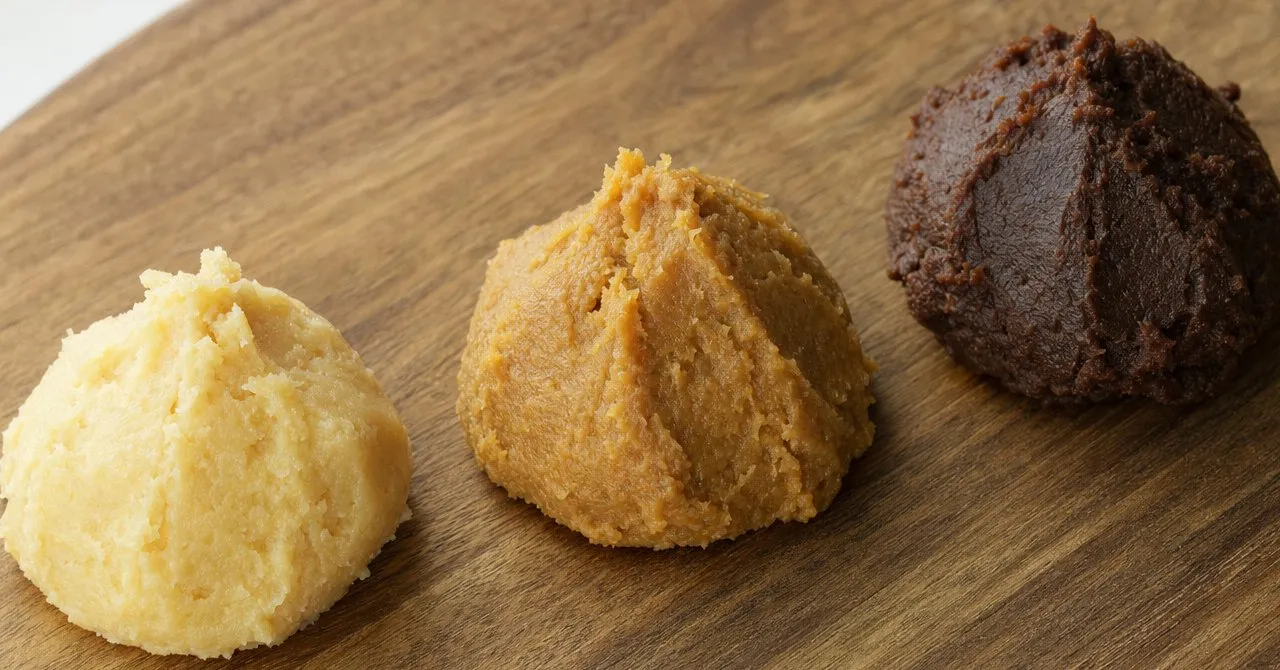
English-language recipes tend to call for “white miso” or “red miso.” Japanese sources don’t stop at color. They start with the koji, the mold-grown grain or bean that drives the fermentation, then describe each miso by how sweet or salty it is and how pale or dark it is. Color is only one of the three.
The spread matters. In Japan’s food composition tables, sweet rice miso has about 6 g of salt per 100 g, and red salty rice miso about 13 g. A US jar labeled “white miso” may sit much closer to the salty end than the name suggests. Know the koji, know whether it’s sweet or salty, and treat color as a clue, not a rule.
The short answer
- By koji, Japan has four types: rice, barley, soybean and blended miso. Rice miso is about 85% of production (MAFF, 2020).
- By taste, Japanese makers use three terms: ama (sweet), amakuchi (mildly sweet) and karakuchi (salty).
- By color: white, light-colored (tanshoku) and red. Color comes mainly from the Maillard reaction during fermentation and aging, shaped by how the soybeans were cooked. It doesn’t tell you the salt level.
- Salt varies about twofold: 6.1 g per 100 g for sweet miso, 12.4 g for light-colored salty miso, 13.0 g for red salty miso.
- Hikari Miso, a Japanese maker, says not to boil miso soup once the miso is in, because the flavor fades. A 2009 Japanese study found that long heating strips the aroma.
Four types by koji
Every miso is built on soybeans and salt. What changes is the koji. A 2022 briefing from Japan’s agriculture ministry (MAFF), prepared for a proposed JAS standard for miso, lays out the process: rice miso is soybeans plus rice koji and salt; barley miso is soybeans plus barley koji and salt; soybean miso is soybean koji and salt, with the koji grown on the soybeans themselves. Everything else is “blended”:
「…米みそ、麦みそ及び豆みそ以外のみそを総称して「調合みそ」という。」 ”…Miso other than rice, barley and soybean miso is collectively called ‘blended miso.’” — MAFF, briefing on establishing a JAS standard for miso, February 2022
That covers awase miso (finished misos mixed together) and miso made with koji from other grains. MAFF counts barley miso as miso made from ōmugi or hadaka-mugi barley, so wheat-koji miso falls under blended. Japan’s production in 2020, per the same briefing (data from the Food Supply and Demand Research Center):
| Type | Japanese | Production, 2020 | Share |
|---|---|---|---|
| Rice miso | 米みそ (kome miso) | 404,717 t | 85% |
| Blended miso | 調合みそ (chōgō miso) | 28,805 t | 6% |
| Soybean miso | 豆みそ (mame miso) | 24,712 t | 5% |
| Barley miso | 麦みそ (mugi miso) | 16,466 t | 4%* |
| Total | 474,700 t |
*Shares as printed by MAFF. Barley miso works out to 3.5% of the tonnage.
Sweet, mild or salty: the taste scale
Japanese makers describe taste on a three-step scale: 甘 (ama, sweet), 甘口 (amakuchi, mildly sweet) and 辛口 (karakuchi, salty). Kara here means salty, not spicy.
The main lever is the koji-to-soybean ratio. The Miso Health Promotion Committee, an industry group, says in its Q&A booklet that salty miso uses slightly less koji than soybeans and runs around 12% salt, while sweet miso uses a lot of koji and usually runs 6–7%. It puts the mildly sweet barley misos of Kyushu and the Seto Inland Sea area at around 10%.
White, light or red: what the color means
The same booklet attributes color to the Maillard reaction, the browning reaction between sugars and amino acids. Three things push a miso darker or keep it pale:
- How the soybeans are cooked. For white miso, the beans are boiled rather than steamed, which washes out water-soluble sugars. Steaming at high temperature for a long time gives a deeper red.
- How long and how warm it ages. Higher temperatures and longer aging both darken miso.
- The type and koji ratio. Hikari Miso says soybean miso is generally classed as red-type, and rice miso and high-koji misos as white-type.
Color and salt often travel together, but they aren’t the same thing:
| Miso (MEXT category) | Salt per 100 g | Sodium per 100 g | Sodium in 1 tbsp (18 g)* |
|---|---|---|---|
| Sweet miso (rice) 甘みそ | 6.1 g | 2,400 mg | ~430 mg |
| Barley miso 麦みそ | 10.7 g | 4,200 mg | ~760 mg |
| Soybean miso 豆みそ | 10.9 g | 4,300 mg | ~770 mg |
| Light-colored salty miso (rice) 淡色辛みそ | 12.4 g | 4,900 mg | ~880 mg |
| Red salty miso (rice) 赤色辛みそ | 13.0 g | 5,100 mg | ~920 mg |
Source: Standard Tables of Food Composition in Japan, 8th edition, 2023 supplement (MEXT). *The per-tablespoon column is our arithmetic, using the 18 g tablespoon on Hikari Miso’s US nutrition label. Real tablespoons vary with packing.
Sweet miso has about half the salt of the salty rice misos, and soybean miso, a red-type miso, has less salt than light-colored salty rice miso. Color alone doesn’t give you the salt level.
A map of Japan’s regional misos
| Name | Koji | Taste / color | Region | Notes from Japanese sources |
|---|---|---|---|---|
| Shinshu miso 信州みそ | Rice | Salty, light-colored | Nagano | Hikari: 「淡色で辛口」, light-colored and salty. The Miso Health Promotion Committee puts it at about 40% of rice miso production. |
| Sendai miso 仙台みそ | Rice | Salty, red | Miyagi | Marukome: a red salty miso handed down from the time of the feudal lord Date Masamune. |
| Saikyo / Kyoto white miso 西京白みそ | Rice | Sweet, white | Kyoto, Kansai | High koji ratio, low salt, short aging. |
| Edo ama-miso 江戸甘みそ | Rice | Sweet | Tokyo | Listed by Marukome as a sweet rice miso. |
| Hatcho miso / Tokai soybean miso 八丁味噌・豆味噌 | Soybean | Red-brown, firm | Aichi, Mie, Gifu | Soybeans and salt only, long-aged. |
| Kyushu barley miso 九州麦みそ | Barley | Mostly mildly sweet | Kyushu, Shikoku, Chugoku | The committee: relatively short-aged, light-colored or red. Marukome also lists salty versions. |
Saikyo miso: the sweet white one
Saikyo white miso is certified in the Agency for Cultural Affairs’ “100-Year Food” program (FY2022). Its database entry, listed with the Kyoto Prefecture Miso Industry Cooperative, says:
「米麹を大豆の約2倍使用し」 “It uses about twice as much rice koji as soybeans…” — Agency for Cultural Affairs, 100-Year Food database entry, “Saikyo white miso”
The entry puts salt at about 5%, with a short fermentation. (That figure is from a different data set than the table above.) The name dates from the Meiji era, when Kyoto was for a time also called Saikyō, the “western capital.” MAFF’s traditional-food guide adds that Kyoto white miso ages one week to ten days, is a yellowish white “like custard cream,” and goes into Kyoto-style zōni (kyō-zōni), dengaku, pickles and sweets such as kashiwa-mochi. Its low salt has a cost:
「塩の比率が低いため、他地域の味噌よりも日持ちはしない。」 “Because its salt ratio is low, it doesn’t keep as long as miso from other regions.” — MAFF, Nippon Traditional Foods guide, “White miso”
Hatcho miso: the soybean one
A case study of Kakukyu (Gōshi-gaisha Hatchō Miso), an Okazaki maker, posted on Aichi Prefecture’s website, describes a miso of soybeans and salt alone. It is packed with brine into large cedar vats, river stones are stacked in a cone on top, and it matures for about two summers and two winters. The result is firm and reddish brown.
Kyushu barley miso
Barley miso is only about 3–4% of national production, concentrated in Kyushu, Shikoku and Chugoku, per Marukome. Food-culture researcher Yuka Utsunomiya, writing for ALIC, a government-affiliated agriculture corporation, notes that Kyushu sits in a barley-miso region, and that barley miso is sweeter and less salty than rice miso. She offers this as context for the region’s sweet palate; see Kyushu’s Sweet Soy Sauce. For the same kind of regional split in soy sauce, see Japanese Soy Sauce Isn’t One Thing.
What “white miso” means on a US shelf
In the Japanese sources above, 白みそ (shiro miso, “white miso”) means the sweet, pale, low-salt misos of Kyoto and the Kansai and Seto Inland Sea areas. On US shelves, the term can mean something else. We looked at US product pages from two Japanese makers:
- Hikari Miso’s Organic White Miso calls itself “the traditional Shinshu-style miso made from organic rice and soybeans.” Its page lists 820 mg of sodium per 1 tbsp (18 g), about 4,560 mg per 100 g. That is close to the 4,900 mg for light-colored salty miso in the food composition tables, and nearly twice the 2,400 mg for sweet miso.
- Hikari’s Shinshu Miso White is described as “mildly sweet and light-colored.” In Japan, the same company calls Shinshu miso 辛口, salty.
- Marukome USA’s White Organic Miso (the page we found is a 22 lb food-service pack made in the US) is described as “light brown” and “mild and smooth.” The page doesn’t say which regional style it is, and its sodium line has no clear serving basis, so we haven’t used it.
So for Hikari’s products, at least, “white miso” means a pale Shinshu-style rice miso, which Japan classes as salty, not sweet Saikyo miso. We haven’t surveyed every brand. Chef JA Cooks, an English-language Japanese cooking site, draws the same line, separating everyday “Shinshu-style” white miso from sweeter Saikyo types.
What to do: If a recipe was written for sweet white miso, look for 西京 (Saikyō) or 甘 on the label, or compare sodium. By the food composition tables, sweet miso has about half the sodium of light-colored salty miso.
Miso soup: why Hikari Miso says not to boil it
English-language warnings against boiling miso give varying reasons. A 2024 Tasting Table piece quotes a cookbook author saying boiling makes miso “taste bitter,” and also mentions “good” bacteria. This article leaves the health side aside; the Japanese sources we found talk about flavor and aroma.
Hikari Miso’s basic method has you turn off the heat, wait for the bubbling to stop, dissolve the miso, then reheat without boiling:
「風味が落ちるので決して沸騰させないでください。」 “Never let it boil, because the flavor will suffer.” — Hikari Miso, “Basics of dashi and miso soup”
Hikari names the target moment niebana (煮えばな): the instant just before the boil, when the aroma and flavor are at their best.
A lab study adds context. Etsuko Sugawara and Yukiko Hosaka of Iwate University’s Faculty of Education heated a 20% miso suspension and analyzed its aroma (Journal of Home Economics of Japan, 2009). In a preliminary screening, they heated it at 140°F, 158°F, 176°F and 208°F (60, 70, 80 and 98°C) for 15 or 30 minutes. With 15 minutes of heating, sweet aroma notes increased up to 158°F (70°C), but:
「80℃以上では未加熱味噌懸濁液の香気はかなり消失し」 “At 176°F (80°C) and above, much of the aroma of the unheated miso suspension was lost…” — Sugawara and Hosaka, Journal of Home Economics of Japan 60(5), 2009
In the same 15-minute screening, the original aroma was barely detectable at 208°F (98°C). After 30 minutes at 208°F (98°C), key aroma compounds had dropped sharply and sour, harsh odors appeared. The authors note that 98°C for 30 minutes is far from real cooking conditions, and that the setup could not track the most volatile aroma compounds.
By our reading, the study shows that long, hot heating (15 minutes or more at 176°F/80°C or above) strips miso’s aroma. It does not measure what a brief boil costs, and it can’t tell “just below boiling” from “boiling.” (For their tasting panel, the authors used the method most common in Japanese home-economics textbooks, which turns off the heat after one brief boil once the miso is in.) Hikari’s rule is the cautious version: add the miso off the heat and stop at niebana.
Basic miso soup with tofu and wakame (serves 2)
Adapted from Hikari Miso’s published basic method. This site has not kitchen-tested it.
Ingredients
- 400 mL (about 1⅔ US cups) dashi (see Dashi Isn’t Fish Stock)
- 150 g (about 5¼ oz) tofu
- 20–30 g (about ¾–1 oz) salted wakame (enzō wakame)
- ¼ naganegi (Japanese long onion)
- 2 tbsp miso
Method
- Rinse the wakame briefly, soak it in water for 2–3 minutes, and cut it about 3 cm (1¼ in) wide. Cut the tofu into 1.5 cm (⅝ in) cubes. Slice the naganegi thinly.
- Heat the dashi in a pot, add the tofu and wakame, and bring to a boil.
- When the ingredients are heated through, turn off the heat.
- Once the bubbling settles, dissolve in the miso. Return the pot to the heat without letting it boil.
- At niebana, just before boiling, add the naganegi, stir briefly and turn off the heat.
That is 1 tbsp of miso to 200 mL (about ¾ cup + 1 tbsp) of dashi per serving; the Miso Health Promotion Committee puts a serving at about 15 g. Japanese and US tablespoons are effectively the same size (see Cooking Japanese Recipes in an American Kitchen). By the table above, the same amount of sweet white miso carries about half the salt, so adjust to taste.
Storing miso
- Keep it cool and out of direct sunlight, opened or not, says Hikari Miso; refrigerating is fine.
- Limit air contact. The Miso Health Promotion Committee recommends pressing plastic wrap onto the surface and refrigerating after opening. It calls the freezer the best option.
- Expect it to darken. Miso slowly darkens over time through the Maillard reaction, per Hikari, and faster in warm weather, per the committee.
- White specks are crystals of tyrosine, an amino acid formed as soybean protein breaks down, according to Hikari.
- Kyoto white miso keeps less well than other regional misos because of its low salt, per MAFF’s guide.
FAQ
What’s the difference between white miso and red miso? Color comes mainly from how the soybeans are cooked and how long and warm the miso ages. In Japan it doesn’t define the type; koji and taste do. Red salty rice miso has about 13 g of salt per 100 g, light-colored salty rice miso about 12.4 g, sweet white miso about 6 g.
Is white miso the same as Saikyo miso? Not necessarily. Saikyo is Kyoto’s sweet white miso, about 5% salt. The US “white miso” products we checked from Hikari Miso are Shinshu-style, with sodium close to Japan’s light-colored salty miso.
Can you boil miso soup? Hikari Miso says not to: never boil it once the miso is in, because the flavor suffers. A 2009 Iwate University study found that heating miso for 15 minutes at 176°F (80°C) or above drove off much of its aroma. The study did not test a brief boil.
Is darker miso saltier? Not reliably. Soybean miso, a red-type miso, has 10.9 g of salt per 100 g in Japan’s food composition tables, less than light-colored salty rice miso at 12.4 g. Check the sodium on the label.
How this article was researched
This article is built on Japanese-language sources: MAFF’s 2022 briefing on a miso JAS standard and its traditional-food guide, the Agency for Cultural Affairs’ 100-Year Food database, MEXT’s food composition database, the Miso Health Promotion Committee’s Q&A booklet, a case study of a Hatcho miso maker posted on Aichi Prefecture’s website, pages from Marukome and Hikari Miso, and a peer-reviewed 2009 study on heating and miso aroma. US product details come from Hikari Miso’s and Marukome USA’s websites as of October 2026; labels change, so check your own jar. Japanese quotations are kept short and translated by us. The miso soup recipe is adapted from Hikari Miso’s published method. This site has not tasted or tested any of these misos.
Sources
Japanese primary sources:
- 農林水産省「みその日本農林規格の制定について」(2022年2月7日)— MAFF, briefing on a JAS standard for miso: production by type, 2020; definition of blended miso (PDF)
- 文部科学省 食品成分データベース — 甘みそ / 淡色辛みそ / 赤色辛みそ / 麦みそ / 豆みそ (MEXT food composition database)
- 農林水産省 にっぽん伝統食図鑑「白味噌」— MAFF traditional foods guide, Kyoto white miso
- 文化庁 100年フード 西京白みそ — Agency for Cultural Affairs, 100-Year Food database entry for Saikyo white miso (PDF)
- 文化庁 100年フード 京都府の認定一覧 — Agency for Cultural Affairs, Kyoto list: Saikyo white miso, traditional category, certified FY2022, Kyoto Prefecture Miso Industry Cooperative
- 同 データベース掲載資料(農林水産省近畿農政局サイトの写し)— Copy of the same entry on MAFF Kinki’s site (PDF)
- 愛知県ウェブサイト掲載資料(カクキュー事例)— Case study of Kakukyu, a Hatcho miso maker, posted on Aichi Prefecture’s website; title and issuer not stated (PDF)
- みそ健康づくり委員会「みそ知り博士のQ&A 50」— Miso Health Promotion Committee, Q&A booklet on types, color, salt, storage and serving size (PDF)
- マルコメ「味噌の種類と地域性」— Marukome, miso types and regions
- ひかり味噌 よくあるご質問(味噌)— Hikari Miso FAQ: types, storage, color change
- ひかり味噌「教えて!だしと味噌汁のキホン」— Hikari Miso, basic miso soup method
- 菅原悦子・保坂由貴子「加熱による味噌汁の香気成分の変化」日本家政学会誌 60(5), 2009 — Sugawara and Hosaka, effect of heating on miso soup aroma (PDF)
- 宇都宮由佳「山口・九州地方における甘いしょうゆの歴史としょうゆと砂糖の関係」alic 砂糖類情報(2022年9月)— ALIC, Yuka Utsunomiya on the history of sweet soy sauce in Yamaguchi and Kyushu
US product pages:
- Hikari Miso — Organic Miso White Miso
- Hikari Miso — Shinshu Miso White
- Marukome USA — White Organic Miso
English-language examples:
- Tasting Table — The Key Mistake To Avoid When Making Miso Soup (2024)
- Chef JA Cooks — What Is White Miso Paste
More on Japanese pantry basics: Japanese Soy Sauce Isn’t One Thing, Dashi Isn’t Fish Stock and What English-language Japanese recipes get wrong.