Thin-Sliced Meat: How Japanese Stores Sell It, and What to Buy in the US
Japanese meat is labeled by dish and by cut: shabu-shabu, sukiyaki, kiriotoshi, komagire. What the labels mean, and how to find or slice thin meat in the US.
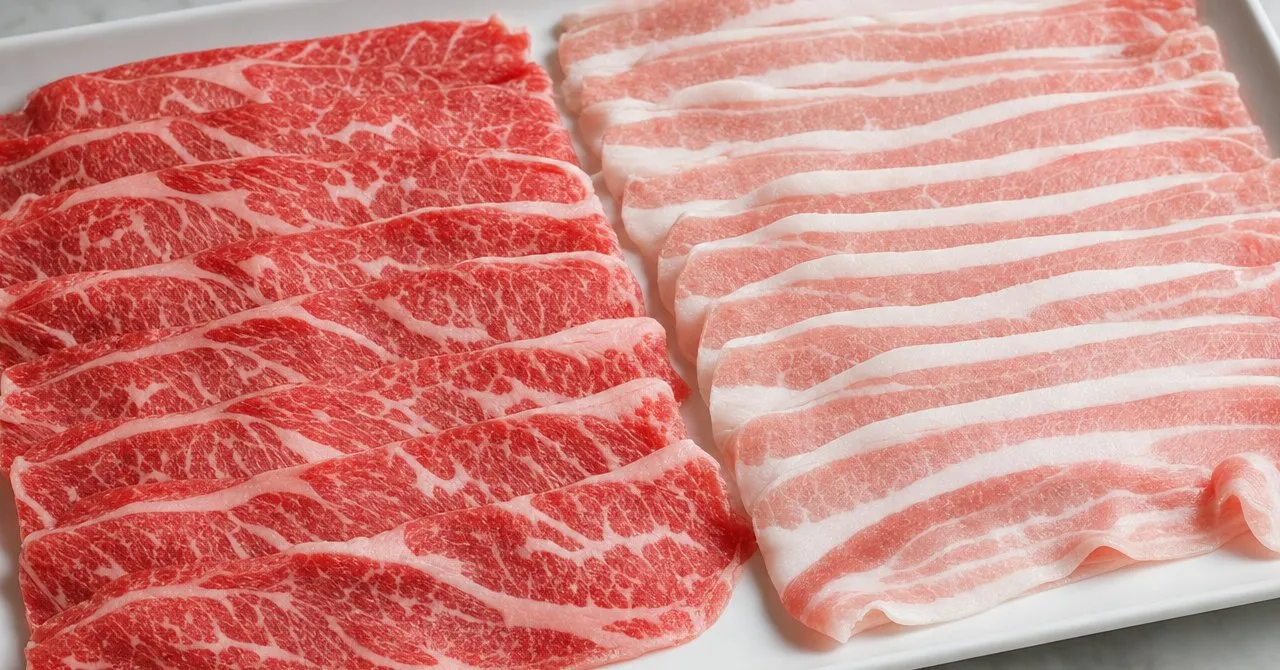
Japanese recipes can name meat by what it’s for. The Tokyo sukiyaki recipe on the website of Japan’s Ministry of Agriculture, Forestry and Fisheries (MAFF) lists 牛肉(すき焼き用)200~250g: 200 to 250 grams (7 to 9 oz) of beef for sukiyaki. A garlic rice recipe on the Japanese recipe site Delish Kitchen calls for 牛切り落とし肉, beef kiriotoshi. Both are written for a Japanese meat case, where the intended use and the way the meat is cut go on the label.
American meat names work differently. They’re built around the cut: pork belly, pork loin, pork shoulder, names that match the ones in USDA’s purchasing specifications. A few American names do point to a use, like “stew meat,” and you may see a package of “shaved steak.” But American names don’t usually lead with what a Japanese label leads with: how thin the meat is cut and which dish it’s for.
The short answer: Japanese stores label meat by use (sukiyaki, shabu-shabu) and by form (kiriotoshi, komagire, thin slices, ground). We found no government thickness standard behind those labels; the use labels fall under the meat trade’s labeling code (a “fair competition code”). In the US, look for pre-sliced packs at Japanese or Korean grocery stores, try shaved steak at a regular supermarket, or slice a partly frozen piece at home.
The short answer
| Japanese label | Reading | What it means | US starting point |
|---|---|---|---|
| しゃぶしゃぶ用 | shabu-shabu-yō | For shabu-shabu. One Japanese appliance maker describes it as sliced 1–2 mm thick | Pre-sliced packs at Japanese or Korean grocery stores; slice at home |
| すき焼き用 | sukiyaki-yō | For sukiyaki. Thin slices; no official thickness found | Same as above; shaved steak as a fallback |
| 薄切り | usugiri | Thin-sliced | Shaved steak; slice at home |
| 切り落とし | kiriotoshi | Offcuts from slicing one specific cut; even thickness, irregular size | Shaved steak; trimmings from slicing your own |
| こま切れ | komagire | Scraps from various cuts, mixed thicknesses and sizes; MAFF says it’s mainly for stir-fries | Shaved steak; trimmings from slicing your own |
| 焼肉用 | yakiniku-yō | For yakiniku (tabletop grilling). One appliance maker groups it with stir-fry meat at about 2 mm or thicker | Asian grocery stores; slice at home |
| 豚バラ薄切り | buta bara usugiri | Thin-sliced pork belly | Pork belly, sliced thin |
| 生姜焼き用 | shōgayaki-yō | Pork for ginger pork (shōgayaki) | Slice at home |
| 合いびき | aibiki | Ground meat from more than one kind of meat, such as beef and pork | Mix ground beef and ground pork yourself |
For none of these labels did we find a published thickness from a government body or industry association. The only figures in the table come from one manufacturer’s appliance pages.
Japanese meat is labeled by what you’ll cook
On a Japanese meat label, the dish can be part of the description. The Osaka Prefectural Government’s guide to fresh-food labeling explains which rules cover it:
部位、用途(すき焼き用等)、冷凍又は解凍品の表示、…:「食肉の表示に関する公正競争規約」による規定 — Cut, use (for sukiyaki, etc.), frozen or thawed labeling, …: set by the “Fair Competition Code for Meat Labeling.” — Osaka Prefectural Government, Fresh food labeling: livestock products
In other words, labels like “for sukiyaki” are governed by the meat trade’s labeling code (kōsei kyōsō kiyaku), not by a thickness standard we could find anywhere. We weren’t able to open the code itself, so we can’t tell you exactly how it words these labels or whether it sets any dimensions.
The same Osaka page notes that mixed ground meat (aibikiniku), such as a beef-and-pork blend, is classified as a processed food, not fresh meat, so it carries processed-food labeling. We didn’t confirm how the beef-to-pork ratio has to be shown.
Kiriotoshi vs. komagire
Both words describe what’s left over when meat is cut. The difference is which cut, and how evenly it’s sliced.
MAFF explained the distinction in a 2020 feature on meat trivia in its public magazine aff. Komagire (こま切れ), it says, generally means a product made by collecting the scraps of various cuts produced while trimming meat. Kiriotoshi (切り落とし) comes from a single, specific cut:
「切り落とし」は特定の部位の肉をスライスした際に出る切れ端の商品を指します。 — “Kiriotoshi” refers to a product made from the offcuts produced when meat from a specific cut is sliced. — MAFF, aff, September 2020
MAFF adds that kiriotoshi is uniform in thickness but irregular in size, and that it’s mainly used for dishes such as sukiyaki and shabu-shabu. Komagire, by contrast, varies in both thickness and size, and MAFF says it’s mainly used in dishes like yakisoba and stir-fried vegetables.
MAFF introduces its komagire definition with “generally” (一般的に). This is a description of common usage, not a legal definition, and we couldn’t check how the industry code words either term.
What this means for you: kiriotoshi, by MAFF’s description, is evenly sliced meat from a single cut, the kind used for sukiyaki and shabu-shabu. Komagire is a mixed bag of thicknesses and cuts, suited to stir-fries. (The garlic rice recipe in our hibachi fried rice article, adapted from Delish Kitchen, uses beef kiriotoshi.)
How thin is “shabu-shabu” meat?
We didn’t find a thickness standard from a Japanese ministry or meat industry body. The clearest numbers we found come from a manufacturer. Hitachi’s pages for its microwave ovens, which have automatic defrost programs for different kinds of meat, define the targets this way:
- Shabu-shabu meat: the program is for meat “厚さ1~2mmにスライスされた” (sliced 1–2 mm thick), about 0.04 to 0.08 inch.
- Thin-sliced meat (usugiri-niku): a separate program, which Hitachi describes as defrosting meat for stir-fries and yakiniku (いため物用・焼き肉用) sliced about 2 mm (about 0.08 inch) or thicker.
Those are one company’s definitions for its own appliance settings, not an industry rule. Still, they give a sense of scale: by Hitachi’s definitions, shabu-shabu meat is thinner than stir-fry and yakiniku meat.
Hitachi groups shabu-shabu and sukiyaki meat together for freezing and defrosting, so we can’t pull a separate sukiyaki figure from its pages. Its 2 mm-or-thicker figure covers stir-fry and yakiniku meat together, so it’s a floor rather than a yakiniku spec. We didn’t find published thicknesses for shōgayaki or thin-sliced pork belly.
What US stores sell instead
Cuts named by the animal, thickness left to the buyer
American meat is organized around named cuts. USDA’s Institutional Meat Purchase Specifications (IMPS), federal specifications for institutional meat buyers, show the logic. The fresh pork series lists items like “Pork Belly” (with a separate skinless version), “Pork Loin” and “Pork Shoulder, Butt, Bone-In,” which it notes may also be called the “Boston Butt” or “Blade.”
For portion cuts like chops and cutlets, IMPS leaves thickness to the buyer: “The purchaser shall specify the portion weight and/or thickness desired.” Where it does attach a thickness, the figure can be large. A boneless center-cut loin chop may be called “America’s Cut” only when it’s 3.2 to 3.8 cm (1¼ to 1½ inches) thick.
These are purchasing specs, not rules for supermarket shelves, but they show the American starting point: name the cut first, leave the slicing to the buyer.
Shaved steak
A regular US supermarket may carry shaved steak, the nearest widely sold match to Japanese thin-sliced beef. A Chowhound explainer describes it as “sliced ultra-thin” and “commonly found on grocery store shelves,” and says it “can come from many parts of the cow, such as the flank, sirloin, ribs, plate, and round.” In other words, the name describes a way of cutting, not one specific cut. Chowhound mentions uses such as Philly cheesesteaks and bulgogi, and cautions that leaner versions, lacking marbling, “won’t do as well for bulgogi.”
We didn’t find a USDA definition of “shaved steak,” and Chowhound doesn’t give a thickness. Because the cut varies, read the package for the cut if it’s listed. For more on what Japanese beef grades mean, see What A5 Wagyu and Kobe Beef Actually Mean.
Asian grocery stores
Just One Cookbook puts it plainly: “If you’re lucky enough to live near a Japanese or Korean grocery store, you can find convenient pre-sliced packages of thinly sliced meat.” Labels may be in Japanese or Korean, so the table above can help. For a sukiyaki recipe to use the beef in, see Sukiyaki: Kanto Warishita vs. Kansai Style.
How to slice meat thin at home
We didn’t find a Japanese official or manufacturer source on slicing meat thin at home, so this section draws on two English-language sources. Both say to firm the meat in the freezer first:
- Penn State Extension, in its guide to making jerky, advises: “Partially freeze the meat for ease of slicing.” (Its jerky strips are about 6 to 10 mm, or ¼ to ⅜ inch, thick, far thicker than shabu-shabu, but the reason for freezing is the same.)
- Just One Cookbook gives the steps below.
Just One Cookbook’s method:
- Halve a large steak. For a ribeye or other large steak, it says to cut it in half into two smaller pieces.
- Wrap each piece tightly in plastic wrap.
- Freeze on a metal tray until firm, about 1½ to 2 hours for pieces of about 450 g (1 lb).
- Slice against the grain using a gentle sawing motion, about 3 mm (⅛ inch) thick.
- Refrigerate the slices until you use them, up to 3 days.
This method is Just One Cookbook’s, summarized here. It hasn’t been kitchen-tested by this site.
Freezing and thawing thin-sliced meat
Hitachi’s microwave pages give a Japanese manufacturer’s approach to freezing thin-sliced meat: divide the meat into single-use portions of 200–300 g (about 7–10½ oz) and freeze shabu-shabu and sukiyaki meat in a flat pack about 1 cm (⅜ inch) thick. Other meat and fish go into a flat block 2–3 cm (about ¾–1⅛ inches) thick, and long, thin pieces should be folded to that thickness so they don’t start cooking while the microwave defrosts them.
For thawing, follow USDA’s Food Safety and Inspection Service (FSIS). Its defrosting guide lists three safe ways: in the refrigerator, in cold water, or in the microwave. It says perishable food should never be thawed on the counter or in hot water. According to FSIS:
- Ground meat and poultry thawed in the refrigerator “should remain safe and good quality for an additional day or two before cooking”; for red meat cuts such as roasts, chops and steaks, FSIS gives 3 to 5 days. Food thawed in the refrigerator can be refrozen without cooking, though there may be some loss of quality.
- For cold water, keep the meat in a leak-proof package or bag, change the water every 30 minutes, and cook it immediately once it’s completely thawed. Food thawed this way should be cooked before refreezing.
- Food thawed in the microwave should be cooked immediately after thawing.
Japanese labels flag frozen meat too. The Osaka guide lists frozen or thawed (解凍, kaitō) labeling among the items covered by the meat trade’s labeling code, so a Japanese package of previously frozen meat may say so.
Other cuts you’ll see in Japanese recipes
Pork belly (豚バラ, buta bara). Bara is the belly, USDA’s “Pork Belly.” Japanese recipes may call for it thin-sliced (buta bara usugiri). If you can’t find it pre-sliced, slice a piece of pork belly after partial freezing, as above. We didn’t find a Japanese source giving a standard thickness.
Ginger pork cuts (生姜焼き用, shōgayaki-yō). A label for pork meant for shōgayaki, pan-fried ginger pork. We didn’t find a source that defines the cut or thickness, so we aren’t giving one.
Mixed ground meat (合いびき, aibiki). Ground meat from more than one kind of meat, such as beef and pork. As noted above, Japanese labeling treats it as a processed food. In the US, buy ground beef and ground pork and mix them, following the ratio your recipe gives. We didn’t confirm a standard Japanese ratio, so we don’t give one.
Chicken thigh (鶏もも肉, tori momo-niku). We couldn’t find an official Japanese source describing how chicken thigh is typically sold in Japan, so we won’t claim a standard. Check the recipe: 皮つき (kawatsuki) means skin-on and 皮なし (kawanashi) means skinless.
FAQ
What is kiriotoshi? Kiriotoshi (切り落とし) is a Japanese label for offcuts produced when one specific cut of meat is sliced. Japan’s agriculture ministry describes it as uniform in thickness but irregular in size, and mainly used for dishes like sukiyaki and shabu-shabu.
What’s the difference between kiriotoshi and komagire? Both are scraps from cutting meat. According to Japan’s agriculture ministry, kiriotoshi comes from slicing a single cut, while komagire generally collects scraps from various cuts made while trimming. MAFF says komagire varies in thickness and is mainly used in stir-fries, while kiriotoshi is evenly thick and used for sukiyaki and shabu-shabu.
How thin is shabu-shabu meat? We didn’t find an official Japanese standard. Hitachi’s microwave defrost pages describe shabu-shabu meat as sliced 1–2 mm (about 0.04–0.08 inch) thick, and its separate “thin-sliced meat” setting, for stir-fry and yakiniku meat, covers slices about 2 mm or thicker.
Can I use shaved steak for sukiyaki or shabu-shabu? It’s the nearest option a regular supermarket may carry. Shaved steak describes a thin-slicing style, and it can come from several cuts, so fat and tenderness vary; Chowhound notes that leaner versions lack marbling. Look for thin, even slices, or buy pre-sliced sukiyaki or shabu-shabu beef at a Japanese or Korean grocery store.
How do I slice meat thin at home? Partially freeze it first, as Penn State Extension and Just One Cookbook both advise. Just One Cookbook suggests about 1½–2 hours for a 450 g (1 lb) piece, then slicing against the grain about 3 mm (⅛ inch) thick.
How should I thaw frozen thin-sliced meat? In the refrigerator, in cold water, or in the microwave, according to USDA’s Food Safety and Inspection Service. Don’t thaw it on the counter. Cook meat thawed in cold water or the microwave right away.
How this article was researched
The Japanese labeling information comes from Japan’s Ministry of Agriculture, Forestry and Fisheries and the Osaka Prefectural Government, and the thickness figures from Hitachi’s appliance pages. All are Japanese-language sources. We couldn’t open the meat trade’s fair competition code and found no official thickness standard, so we say so instead of giving numbers. US information comes from USDA’s meat purchasing specifications, Penn State Extension and USDA’s Food Safety and Inspection Service. Just One Cookbook and Chowhound, both English-language cooking sites, are cited by name for home-slicing tips and for what “shaved steak” means. Japanese quotations are short and translated by us. The home slicing method is Just One Cookbook’s and has not been kitchen-tested by this site.
Sources
Japanese sources:
- 誰かに話したくなる お肉の豆知識 — MAFF, aff magazine, September 2020: meat trivia, including kiriotoshi vs. komagire
- 生鮮食品の表示:畜産物 — Osaka Prefectural Government, fresh-food labeling for livestock products
- うちの郷土料理 すき焼き 東京都 — MAFF, Tokyo sukiyaki recipe (lists beef “for sukiyaki”)
- しゃぶしゃぶ用肉の解凍 — Hitachi, microwave defrost page for shabu-shabu meat (MRO-W1A)
- しゃぶしゃぶ用肉 — Hitachi, microwave defrost page for shabu-shabu meat (MRO-S8Z)
- 薄切り肉 — Hitachi, microwave defrost page for stir-fry and yakiniku meat (MRO-S8Z)
- 大満足!ガーリックライス — Delish Kitchen, garlic rice recipe using beef kiriotoshi
US sources:
- Institutional Meat Purchase Specifications: Fresh Pork, Series 400 — USDA Agricultural Marketing Service (PDF)
- The Big Thaw — Safe Defrosting Methods — USDA Food Safety and Inspection Service
- Drying Jerky — Penn State Extension
English-language cooking sources (attributed in the text; not official guidance):