Sukiyaki: Kanto Warishita vs. Kansai Style
Kanto sukiyaki simmers in premixed warishita; Kansai sears the beef first with sugar and soy. A Japanese survey, the history, and a Kanto recipe.
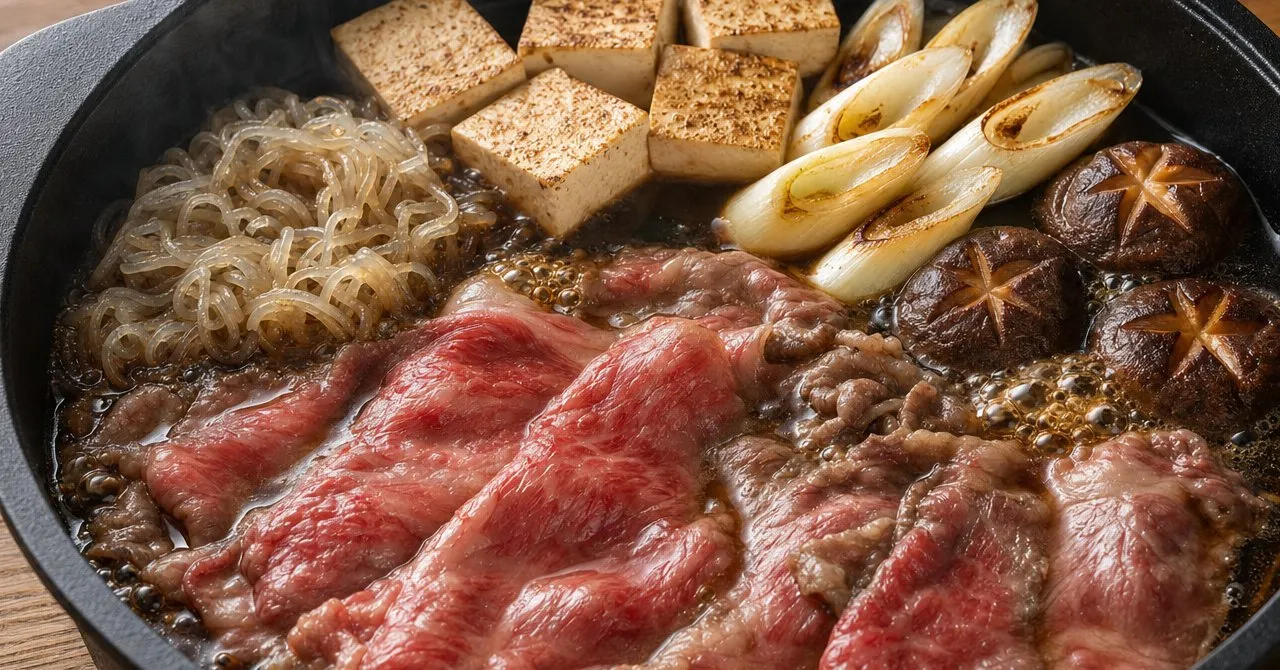
Many English-language sukiyaki recipes start the same way: mix soy sauce, mirin, sugar and sake into a “sukiyaki sauce,” pour it into the pan, and simmer the beef and vegetables in it. That is a real Japanese method, and many Japanese home cooks make sukiyaki exactly that way. It just isn’t the only one.
Japan has two broad styles. Kanto (Tokyo and the east) cooks everything in a premixed sauce called warishita (割り下). Kansai (Osaka, Kyoto, Kobe and the west) starts by searing the beef in the pan and seasoning it there, with sugar and soy sauce in some accounts and with warishita added after searing in others. In a 2024 Kikkoman survey of its own online members, more than 30% of respondents in most regions said they make warishita. In the Kinki region around Osaka and Kyoto, only 11% did.
So when an English recipe calls warishita “sukiyaki sauce,” it’s describing the Kanto style. That’s a perfectly good way to make sukiyaki. Below: the survey, the history, and a Kanto-style recipe adapted from Japan’s agriculture ministry.
The short answer
| Kanto style | Kansai style | |
|---|---|---|
| Sauce | Premixed warishita: soy sauce, mirin, sugar, sake, sometimes dashi | Sugar and soy sauce added in the pan (KIIFC, Kikkoman); some MAFF sources have warishita added after searing |
| First step | Warishita goes into the pan (some cooks, and specialty restaurants, sear the beef first) | Beef is seared in the pan |
| Character | A simmered dish | Starts as a seared dish, then becomes a simmered one |
| Name traditionally associated* | Gyūnabe (牛鍋, “beef pot”) | Sukiyaki |
*This is KIIFC’s general naming split. KIIFC also notes that Fukuzawa Yukichi frequented gyūnabe shops in late-Edo Osaka, so the word wasn’t exclusive to Kanto.
Japanese sources describe dipping the cooked ingredients in beaten raw egg. In the US, use an egg pasteurized in the shell (see the safety note below).
One caution: Japanese sources don’t draw the line in exactly the same place. Treat the table as two ends of a spectrum, not two rulebooks.
What the Kikkoman survey found
In September 2024, Kikkoman ran an online survey of 1,158 members of its Kikkoman Plus membership program about how they cook sukiyaki at home, and published the results on October 24, 2024. The question allowed more than one answer. The respondents were members of a soy-sauce maker’s program, not a random sample of Japanese households, and the release doesn’t give sample sizes by region. Read the figures as indicative.
The survey defines the two styles this way:
「関東風」:たれを「割り下」の状態にして、肉を少し焼いた後、食材とたれを入れて煮ながら食べる — “Kanto style”: make the seasoning into warishita, sear the meat briefly, then add the other ingredients and the sauce and eat them as they simmer. — Kikkoman, News Release 24043
Its Kansai style is different from the first bite: the beef is cooked and seasoned in the pan and eaten before the vegetables and tofu go in.
Here is the share who answered that they make warishita from soy sauce, mirin, sugar and other seasonings:
| Region | Make warishita |
|---|---|
| Hokkaido | 39% |
| Tohoku | 35% |
| Hokuriku | 37% |
| Northern Kanto | 34% |
| Southern Kanto (incl. Tokyo) | 44% |
| Tokai (incl. Nagoya) | 32% |
| Kinki (incl. Osaka, Kyoto) | 11% |
| Chugoku | 40% |
| Shikoku | 22% |
| Kyushu | 31% |
Kikkoman’s own summary: outside Kinki and Shikoku, more than 30% make warishita. In Kinki, the most common answer, at 57%, was using soy sauce, mirin, sugar and other seasonings directly, which the published table appears to group under Kansai style. Answers could overlap.
These figures aren’t “Kanto style vs. everyone else.” Respondents could also choose bottled sukiyaki sauce. But the warishita number drops sharply in Kinki (11%) and is also low in Shikoku (22%). Kikkoman suggests the Tokai region, between Tokyo and Osaka, may be “a loose boundary” between the two styles, and it found that respondents who cook Kansai style are concentrated from Kinki westward.
The same survey found that more than half of respondents use beef, long green onion, grilled tofu, shirataki, shiitake, enoki, shungiku (edible chrysanthemum) and napa cabbage.
Where the two styles came from
Kansai: a grilled dish
Japan’s Ministry of Agriculture, Forestry and Fisheries (MAFF) gives the traditional explanation of the name on its Tokyo sukiyaki page. In mid-Edo-period Kansai, seafood was grilled on a suki (鋤, a spade or plow) used in place of an iron griddle. Cooking beef the same way is said to have given the dish its name, suki-yaki. MAFF hedges this (“とされる,” “it is said”), so treat it as the traditional account rather than a documented fact. (A separate MAFF pamphlet simply dates sukiyaki to the Meiji era, when meat-eating became fashionable.)
Officially, beef had been off the menu since an edict MAFF dates to 675, which the ministry ties to the value of cattle and horses as working animals. Some beef was still eaten by the late Edo period, and eating it became openly permitted after the Meiji Restoration. Kikkoman’s food-culture research center (KIIFC) adds a famous example: the writer and educator Fukuzawa Yukichi, a great fan of beef, often went to beef-pot shops in Osaka in the last years of the shogunate.
Kanto: gyūnabe, the Yokohama–Tokyo beef pot
In the east, the dish grew up under another name. MAFF’s page on Kanagawa’s gyūnabe traces it to Yokohama, which opened as a treaty port in 1859 and took up meat-eating early under Western influence. According to that page, the owner of a Yokohama tavern, 伊勢熊 (MAFF gives no romanized reading), is said to have opened the first gyūnabe shop in 1862. MAFF also names Ōta Nawanoren, founded in Meiji 1 (1868), as an old gyūnabe restaurant it describes as still in business. MAFF’s Tokyo page adds that, as demand for beef grew, beef-pot shops became fashionable in Tokyo.
Early gyūnabe didn’t taste like today’s sukiyaki. KIIFC is direct about it:
そもそもこの牛鍋、明治の初めは味噌仕立てだった。 — In the early Meiji years, this gyūnabe was in fact a miso-based dish. — KIIFC
MAFF explains the miso as a way to mask the smell of the meat. According to KIIFC, the only other ingredient at first was green onion; around 1887, shirataki and tofu came into the pot. As beef quality improved, MAFF says, cooks moved to a sauce of soy sauce, sugar and sake.
KIIFC frames the original contrast as a matter of verbs. Gyūnabe was a true pot dish built on a generous pour of warishita. Sukiyaki, in its telling, was something you grilled:
一方の「すき焼き」は焼く料理で、鍋で肉を砂糖と共に炒め、そのあとに具を入れ、最後に醤油で味を調える。 — Sukiyaki, by contrast, is a grilled dish: the meat is cooked in the pan with sugar, the other ingredients follow, and soy sauce adjusts the seasoning at the end. — KIIFC
How Tokyo started saying “sukiyaki”
MAFF’s Tokyo page links the change to the Great Kanto Earthquake of 1923, which hit many gyūnabe restaurants hard. After that, the Kansai name spread east and became standard. (KIIFC’s page doesn’t mention the earthquake, so treat this as MAFF’s account.)
The name changed; the method mostly didn’t. KIIFC notes that even though Kanto now says “sukiyaki,” it still uses warishita.
What the styles look like in a Japanese kitchen today
Japanese sources split the two styles in slightly different ways:
- MAFF, Tokyo page: Kansai cooks brown the beef and only then add warishita and vegetables. Kanto restaurants that specialize in sukiyaki do the same. Kanto home cooks, by contrast, usually bring the warishita to a boil and put the meat and vegetables in together.
- A MAFF pamphlet on Japanese cuisine: It also has Kansai cooks searing first and then adding a mirin-and-soy warishita, while its Kanto version skips the searing and simmers everything in warishita.
- Kikkoman’s survey: Its Kanto definition includes a brief sear before the warishita. Its Kansai definition seasons the seared beef in the pan with sugar and soy sauce.
- MAFF, Nara page: Nara’s kashiwa no sukiyaki (chicken sukiyaki, traditionally served at Tenmangū shrine autumn festivals) sears the chicken, adds the vegetables, then pours in a pre-cooked warishita of sake, mirin, soy sauce and sugar.
What they agree on: Kansai starts by searing the meat. Whether the sugar and soy go in separately or as a warishita varies by source. What sets Kanto apart is that the meat and vegetables cook in a premixed warishita, often poured in at the very start at home; in Kansai, the first round of beef is seasoned in the pan.
What English recipes call “sukiyaki sauce”
Major English-language sites have been fair to both styles. MasterClass, RecipeTin Japan and Japanese Taste all describe both. Just One Cookbook names its method outright:
“In my recipe below, I use the Kanto-style sukiyaki method because it’s a lot easier for beginner cooks to follow.”
The same page calls the warishita “sukiyaki sauce.”
Other recipes don’t name a style. A Sudachi recipe titled “Beef Sukiyaki with Authentic Japanese Sauce” mixes a warishita first and adds the beef straight into the simmering sauce without searing it. That matches the Kanto home method on MAFF’s Tokyo page, so “authentic” is fair. It’s simply one of Japan’s two styles. If a recipe premixes a sauce and simmers everything in it, you’re making Kanto sukiyaki.
How much warishita ratios vary
| Source | Serves | Soy | Mirin | Sake | Dashi/water | Sugar |
|---|---|---|---|---|---|---|
| MAFF Tokyo page (recipe by Sapporo Breweries) | 5 | 100 mL | 100 mL | 100 mL | 100 mL dashi | 3 tbsp (about 27 g jōhakutō) |
| MAFF Nara page (chicken) | 4 | 180 mL | 180 mL | 360 mL | — | 80 g sanontō (a light-brown Japanese sugar) |
| Just One Cookbook | 2 | ½ US cup (about 118 mL) | ½ US cup | ½ US cup | Kombu dashi (2 US cups water + 5 g kombu), added in the pan as needed | 3 tbsp |
| Sudachi | not recorded | 3 tbsp (about 44 mL) | 3 tbsp | 3 tbsp | 3 tbsp water + 5 g kombu | 2 tbsp |
In all four, soy sauce and mirin are equal. The differences are in how much sake, dashi or water stretches the sauce (Just One Cookbook thins it with kombu dashi in the pan as needed), and how much sugar goes in. For more on why dashi isn’t a generic stock, see Dashi Isn’t Fish Stock.
Recipe: Kanto-style sukiyaki with warishita
Adapted from the Tokyo sukiyaki recipe on MAFF’s Uchi no Kyōdo Ryōri (regional home cooking) site, provided by Sapporo Breweries. MAFF notes that recipes vary by region and household. The amounts below are the source’s; the US conversions and the pasteurized-egg note are ours.
Serves 5, per the source. That works out to 40–50 g (about 1½ oz) of beef per person. If you want more, scale everything up; the warishita ratio stays the same.
Warishita
- 100 mL (about ⅓ cup + 1½ tbsp) soy sauce
- 100 mL (about ⅓ cup + 1½ tbsp) sake
- 100 mL (about ⅓ cup + 1½ tbsp) mirin
- 100 mL (about ⅓ cup + 1½ tbsp) dashi
- 27 g sugar (the source’s 3 tbsp of Japanese jōhakutō; about 2¼ tbsp US granulated)
The source lists each liquid as ½ kappu, half of a Japanese 200 mL measuring cup. That’s 100 mL, less than half a US cup (about 118 mL). See Cooking Japanese Recipes in an American Kitchen.
Pot
- 200–250 g (7–9 oz) beef sliced for sukiyaki
- ⅙ head napa cabbage
- ½ bunch shungiku (edible chrysanthemum greens)
- ½ package enoki mushrooms
- 1 negi (Japanese long green onion)
- ½ block grilled tofu (yaki-dōfu)
- 4 knots of shirataki
- 2 eggs, for dipping (in the US, use pasteurized in-shell eggs; see below)
Method (the source’s three steps)
- Prep the pot ingredients: cut the cabbage and grilled tofu into bite-size pieces, trim the base off the shungiku and enoki, slice the negi on an angle into pieces about 1 cm (⅜ inch) wide, and give the shirataki a quick blanch.
- Combine everything for the warishita.
- Heat the warishita in a sukiyaki pan. Once it’s boiling, lay the ingredients in. Eat them when they’re done to your liking, dipped in beaten egg.
Notes from this site, not from the source: the recipe gives no heat level or cooking time and doesn’t say what the sukiyaki pan (sukiyaki-nabe) is made of. The egg note follows USDA and FDA guidance (below). For what Japanese beef grades and labels mean, see What A5 Wagyu and Kobe Beef Actually Mean.
The Kansai method, described
We aren’t giving amounts for Kansai style, because the Japanese sources we used describe the method without a full recipe. In outline, from KIIFC and Kikkoman:
- The beef goes into the hot pan first and is seared with sugar (KIIFC).
- It’s seasoned in the pan with soy sauce and similar seasonings, and in Kikkoman’s definition this first round of beef is eaten on its own.
- The other ingredients follow and cook in the pan, part grilled and part simmered. KIIFC has soy sauce used at the end to adjust the seasoning.
Two MAFF sources, the Tokyo page and a pamphlet, instead describe Kansai cooks adding warishita after the beef is seared, and MAFF’s Nara chicken sukiyaki uses one too.
The raw egg: a US safety note
In the Japanese sources above, sukiyaki is eaten dipped in beaten raw egg. MAFF’s Tokyo recipe ends with it, and a MAFF pamphlet describes beating a raw egg in a bowl and coating the meat in it.
US agencies take a different line. USDA’s Food Safety and Inspection Service advises everyone against eating raw or undercooked eggs, and says “in-shell eggs that have been pasteurized may be used safely without cooking.” The FDA likewise advises using shell eggs “treated to destroy Salmonella” for dishes where the egg stays raw. Both identify children (FSIS specifies infants and young children), older adults, pregnant women and people with weakened immune systems as being at higher risk.
So in a US kitchen: use pasteurized in-shell eggs, labeled as such on the carton. Nara’s MAFF recipe offers a soft-cooked onsen tamago as an alternative, but USDA guidance also advises against undercooked eggs, so it isn’t a substitute for pasteurization in the US. If you can’t get pasteurized eggs, skip the dip.
Why Japanese eggs are sold for raw eating, and what a Japanese carton date means, is covered in Raw Eggs and Tamago Kake Gohan.
FAQ
What is warishita? A premixed simmering sauce for sukiyaki. MAFF gives its base as soy sauce, sugar and sake; recipes usually add mirin, and some add dashi or water. English recipes often call it “sukiyaki sauce.”
What’s the difference between Kanto and Kansai sukiyaki? Kanto style cooks the beef and vegetables in premixed warishita. Kansai style sears the beef first and seasons it in the pan. Sources differ on whether that seasoning is sugar and soy sauce or a warishita added after searing.
Is “sukiyaki sauce” authentic Japanese? Yes, as Kanto style. In Kikkoman’s 2024 survey of its members, more than 30% of respondents in most regions said they make warishita at home. It’s less common around Osaka and Kyoto: only 11% of Kinki respondents did.
Is sukiyaki the same as gyūnabe? They’re closely related. Gyūnabe, the beef pot of late-Edo and Meiji Yokohama and Tokyo, simmered beef in sauce from the start, at first a miso-based one. According to MAFF, Tokyo adopted the Kansai name after the 1923 Great Kanto Earthquake.
Can I eat the raw egg dip in the US? US agencies advise against eating raw eggs unless they’re pasteurized. Use pasteurized in-shell eggs, or skip the dip.
How this article was researched
The survey figures come from a 2024 news release in which Kikkoman, a soy-sauce maker, surveyed its own members; it is not a random sample. The history and the recipe come from Japan’s agriculture ministry (MAFF), with more history from Kikkoman’s food-culture research center (KIIFC). All are Japanese-language sources. US egg-safety guidance comes from USDA FSIS and the FDA. Quotations from Japanese sources are kept short and translated by us. The recipe is adapted from a named MAFF recipe, not developed or kitchen-tested by this site. We couldn’t access Kikkoman’s own published warishita ratio, so it isn’t included. Where sources disagree, as on whether Kansai cooks use warishita, we’ve noted it.
Sources
Japanese primary sources:
- 農林水産省 うちの郷土料理 — すき焼き 東京都 (MAFF: sukiyaki, Tokyo)
- 農林水産省 うちの郷土料理 — 牛鍋 神奈川県 (MAFF: gyūnabe, Kanagawa)
- 農林水産省 うちの郷土料理 — かしわのすき焼き 奈良県 (MAFF: chicken sukiyaki, Nara)
- 農林水産省 外食向けパンフレット(日本語版 pp.30–33, しゃぶしゃぶ・すき焼き)(MAFF pamphlet, untitled PDF)
- キッコーマン — すき焼き調査(ニュースリリース 24043, 2024年10月24日)(Kikkoman sukiyaki survey of its members)
- キッコーマン — ニュースリリース 24043 PDF(地域別の表)(survey PDF with regional tables)
- キッコーマン国際食文化研究センター — 牛肉の普及 牛鍋から牛丼まで (KIIFC: from gyūnabe to gyūdon)
US food-safety guidance:
English-language examples (cited as examples of English content, not as evidence):
- Just One Cookbook — Sukiyaki
- Sudachi — Beef Sukiyaki with Authentic Japanese Sauce (print view)
- MasterClass — Sukiyaki recipe
- RecipeTin Japan — Sukiyaki
- Japanese Taste (retailer’s blog) — Kanto sukiyaki
- Japanese Taste (retailer’s blog) — Kansai sukiyaki
This is part of our series on what English-language Japanese recipes get wrong — and why.