Japanese Soy Sauce Isn't One Thing — Koikuchi, Usukuchi, Tamari and More
Japan's standard defines five soy sauces. Why usukuchi is light in color but saltier, how it differs from Chinese light soy, and which bottle to use.
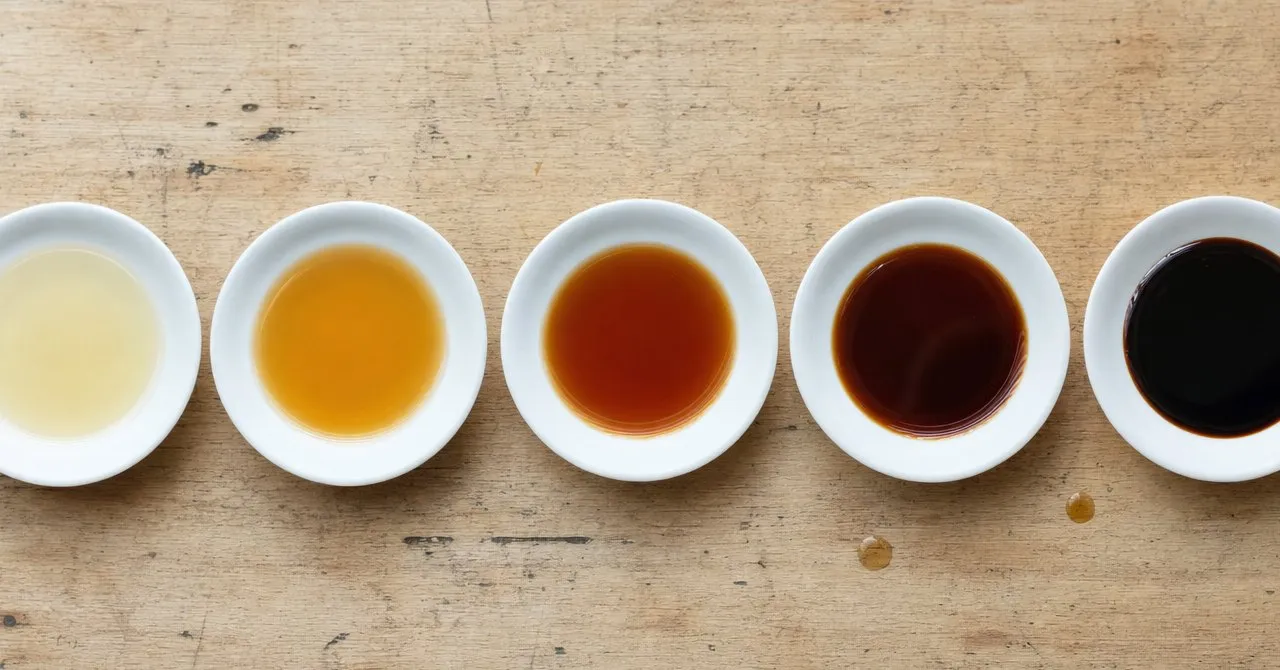
An English-language recipe says “soy sauce,” and you reach for whatever bottle is in the fridge. A Japanese recipe may be more specific: koikuchi, usukuchi, tamari. A Chinese recipe may ask for “light” and “dark” soy sauce, which sounds like the same idea in English. It isn’t.
Japan’s national product standard recognizes five types of soy sauce. They differ in what goes into the koji, how much the color is held back, and in one case what liquid the mash is brewed in. The one that trips up English speakers is usukuchi, usually translated as “light soy sauce.” It is light in color. It is not light in salt. By weight, Japan’s official food composition tables list it as the saltiest of the five.
The short answer
- Japan defines five types: koikuchi, usukuchi, tamari, saishikomi and shiro. Koikuchi is the default, about 84% of soy sauce shipped in Japan.
- Usukuchi is paler but saltier. It contains about 10% more salt than koikuchi, according to Japan’s soy sauce industry. Figures in the national food composition tables work out to the same.
- Chinese light and dark soy sauce are a separate system. “Light soy sauce” in a Chinese recipe means the everyday seasoning soy, not usukuchi.
- Reduced-salt soy sauce is its own label category (genen or usujio in Japan, “less sodium” in the US). For sodium, read the Nutrition Facts panel, not the color.
Japan’s five official types
Soy sauce in Japan is covered by a Japanese Agricultural Standard, JAS 1703, revised in 2021. Its definitions turn on the ratio of soybeans to wheat in the koji, whether the brewer suppresses darkening, and, for saishikomi, brewing in soy sauce instead of brine. Salt appears in none of the definitions.
| Type | Koji ingredients (JAS) | What sets it apart | Associated region | Approx. national share |
|---|---|---|---|---|
| Koikuchi (こいくち, 濃口) | Soybeans with roughly equal wheat | The baseline type | Nationwide | ~84% |
| Usukuchi (うすくち, 淡口) | Same as koikuchi (wheat gluten also allowed) | Darkening held back | Born in Kansai | ~13% |
| Tamari (たまり) | Soybeans, or soybeans with a small amount of wheat | Little or no wheat | Mainly Chubu | ~2% |
| Saishikomi (さいしこみ, 再仕込み) | Soybeans with roughly equal wheat | Brewed in soy sauce instead of brine | Yanai, Yamaguchi; San’in to northern Kyushu | ~1% |
| Shiro (しろ, 白) | A small amount of soybeans with wheat | Darkening strongly held back | Hekinan, Aichi | Under 1% |
Koikuchi and usukuchi shares are shares of shipments, from Japan’s Soy Sauce Information Center. The other three are shares of production, from Kikkoman’s FOOD CULTURE journal (its text says shiro is under 1%; its chart rounds to 1%). Neither source gives a year.
What sets usukuchi apart in its JAS definition is one clause:
「製造工程において色沢の濃化を抑制したもの」 “One in which the darkening of color during production has been held back.” — JAS 1703:2021, from the definition of usukuchi (3.10)
Shiro’s color clause adds one word, 強く (“strongly”). Shiro also starts from a different koji, with only a little soybean and mostly wheat. JAS also sets color limits on a numbered scale where higher means paler: No. 22 or above for the top two grades of usukuchi, No. 46 or above for shiro.
Saishikomi, “brewed again,” mixes the mash with raw soy sauce (kiage) instead of brine.
How each type is used in Japan
Per the Soy Sauce Information Center, the Japanese industry’s public information site:
| Type | Typical uses |
|---|---|
| Koikuchi | Cooking and the table alike. The center calls it a true all-purpose seasoning (「まさに万能調味料」). |
| Usukuchi | Simmered dishes such as takiawase and fukumeni, where the ingredients’ own color should stay bright. |
| Tamari | Sushi and sashimi at the table. It turns an attractive red when heated, so it also goes into teriyaki-style cooking, tsukudani and rice crackers. |
| Saishikomi | Mostly at the table: sashimi, sushi, chilled tofu (hiyayakko). |
| Shiro | Clear soups (suimono), chawanmushi, rice crackers and pickles. Amber, paler than usukuchi, mild but notably sweet. |
(If tamari’s role in teriyaki surprises you, see Teriyaki Is Not a Sauce.)
“Light” means light in color, not in salt
Why is the pale one saltier? The Soy Sauce Information Center explains that usukuchi is brewed with about 10% more salt than koikuchi. The extra salt slows fermentation and maturation, which helps keep the color light. The center names the confusion directly:
「うすくちしょうゆというと、塩分も低いと思われがちですが、実際はやや高めです。」 “People tend to assume usukuchi is lower in salt as well, but it is actually a little higher.” — Soy Sauce Information Center (soysauce.or.jp)
Two Japanese sources give salt figures, in different units. By weight, from Japan’s official food composition tables (MEXT, 8th edition, 2023 supplement):
| Type | Salt equivalent per 100 g | Sodium per 100 g |
|---|---|---|
| Usukuchi | 16.0 g | 6,300 mg |
| Koikuchi | 14.5 g | 5,700 mg |
| Shiro | 14.2 g | 5,600 mg |
| Tamari | 13.0 g | 5,100 mg |
| Saishikomi | 12.4 g | 4,900 mg |
| Koikuchi, reduced-salt (for comparison) | 8.3 g | 3,300 mg |
By volume, the Soy Sauce Information Center gives grams of salt per 100 mL: about 18 g for usukuchi and 16 g for koikuchi (written as 18% and 16%).
Don’t compare the 18 with the table’s 16.0; one is per 100 mL, the other per 100 g, and we don’t convert between them. What the two sources agree on is the ratio: 16.0 ÷ 14.5 ≈ 1.10 by weight, 18 ÷ 16 ≈ 1.13 by volume. Either way, usukuchi carries roughly 10% more salt than koikuchi. By weight, every other type comes in below koikuchi, though shiro only barely, and tamari and saishikomi clearly.
A 2014 research summary published by Higashimaru Shoyu, a Japanese soy sauce maker, makes the same point:
「淡口醤油は濃口醤油と比べて食塩濃度が高く設定されており」 “Usukuchi soy sauce is formulated with a higher salt concentration than koikuchi…” — Higashimaru Shoyu research summary, 2014
The summary adds that some salt-conscious consumers wrongly avoid usukuchi, and reports that in the company’s tests of simmered fish and vegetables, the usukuchi versions were rated best at a lower finished salt concentration. It is one company’s summary of its own studies, without published methods, so read it with that in mind.
The name was unclear in Japan, too. A 2015 study by a Higashimaru researcher looked at 93 cookbooks from the Meiji era to early Showa. It found that usukuchi was once called usu-shōyu, and suggested that the vagueness of that name led to the change to usukuchi.
Three different “lights” on American shelves
In English, “light soy sauce” can point to three unrelated products.
1. Japanese usukuchi. Light in color, slightly higher in salt, as above.
2. Chinese light soy sauce (生抽, shēngchōu). The sources below describe China’s two main types by role, not by koji recipe. Nami Fukutome, writing in Kikkoman’s FOOD CULTURE journal:
「生抽は、色が薄く、塩辛さが真っ先に感じられ、主に塩味をつけるために使われる。」 “Shengchou is pale in color, its saltiness is the first thing you taste, and it is used mainly to add saltiness.” — Nami Fukutome, FOOD CULTURE No. 27
She describes dark soy (老抽, lǎochōu) as thick and black, with a faint sweetness and strong caramel bitterness. The sauce maker Lee Kum Kee, on its UK site, calls its light soy “golden brown” and “ideal as a marinade, dressing, sauce mix and table condiment.” Its dark soy gets a “deep rich dark brown colour enriched from the added caramel” and is “mainly used for adding colour to dishes”; the Premium Dark Soy Sauce lists caramel color and sugar.
So the everyday bottle is koikuchi in Japan and shengchou in China. A Chinese recipe that says “light soy sauce” was built around shengchou, not usukuchi. Fukutome notes that in Japanese, shengchou is called “Chinese koikuchi” (中国濃口しょうゆ) and laochou “Chinese tamari” (中国たまりしょうゆ). These are names, not substitution advice.
3. “Lite” as in reduced sodium. In the US, reduced-sodium soy sauce has at times been called “light” or “lite.” A 2002 Straight Dope forum post mentions “light soy sauce (labelled 40% less sodium),” and a US grocery retailer’s website lists Kikkoman’s less-sodium bottle as “Kikkoman Lite Soy Sauce.” We could not confirm whether Kikkoman itself ever used “Lite” as an official name.
Food writing mixes these up too. A 2023 Daily Meal article says light soy sauce “does typically feature less sodium,” while also noting it “is often also saltier than dark soy sauce.” America’s Test Kitchen states that light soy sauce is not low-sodium and that usukuchi has more sodium than Japanese dark soy sauce.
Reduced-salt soy sauce is a separate category
In Japan:
- 減塩 (genen, “reduced salt”): no more than 9 g of salt per 100 g of soy sauce (3,550 mg sodium or less), with the required nutrition labeling. Kikkoman cites the Food Labeling Act; the same figure appears in a 2009 agriculture ministry proposal to revise the soy sauce labeling standard. It is an absolute ceiling, not a percentage cut. The industry loosely describes it as “about half” the salt; MEXT lists reduced-salt koikuchi at 8.3 g per 100 g against 14.5 g for regular.
- うす塩 (usujio), あさ塩, あま塩 (“lightly salted”): salt at 80% or less of the regular version, per the same 2009 proposal; the Soy Sauce Information Center gives 80% or less and at least 50%. Under current nutrient-claim rules, a “reduced” claim normally needs a 25% cut, but soy sauce has an exception at 20% (that is, 80% or less), according to an Osaka City public health guide. We have not read the current regulation’s own text on these terms, so treat this as the best available summary.
Note the trap: usukuchi and usujio both start with “usu,” but one is defined by color and the other by salt.
In the US, Kikkoman USA’s Less Sodium Soy Sauce has 590 mg of sodium per 15 mL (1 tbsp). Kikkoman says that is 38% less than its regular Soy Sauce, whose label lists 960 mg per 15 mL. Kikkoman says it removes about 40% of the salt after fermentation and aging. Its US soy sauce lineup has no product named “usukuchi,” “light color” or “lite.”
How it’s made and graded, briefly
JAS recognizes three production methods:
- 本醸造 (honjōzō, fully brewed): the mash is fermented and matured.
- 混合醸造 (kongō jōzō, blended brewing): amino acid liquid or a similar broken-down seasoning liquid is added to the mash, which is then fermented and matured.
- 混合 (kongō, blended): amino acid liquid or similar is simply mixed in. JAS defines amino acid liquid as plant protein, such as soy, broken down with acid.
There are also three grades: 特級 (tokkyū, special), 上級 (jōkyū, upper) and 標準 (hyōjun, standard), set by sensory character, color, total nitrogen (a measure of umami amino acids) and dissolved solids other than salt (plus reducing sugars for shiro). No grade sets a salt limit. For fully brewed koikuchi, total nitrogen must be at least 1.50% for special, 1.35% for upper and 1.20% for standard. At 1.65% or more, a bottle can say 特選 (tokusen), per the Soy Sauce Information Center. Special grade must be fully brewed for every type except saishikomi, whose special grade may also be blended-brewed.
Where each type comes from
- Usukuchi was born in Kansai, per the Soy Sauce Information Center. JAL’s in-flight magazine, quoting Higashimaru’s head of research, names Tatsuno in Hyogo, and uses the phrase 「東の濃口、西の淡口」: “koikuchi in the east, usukuchi in the west.”
- Tamari is mainly made in the Chubu region. Yuka Utsunomiya, writing in FOOD CULTURE, describes the area around Ise Bay and Mikawa Bay (Aichi, Gifu and Mie) as tamari country. One Chita Peninsula maker she interviewed makes about 80% tamari. Tamari goes into regional dishes such as the sauce for Aichi’s hitsumabushi and Mie’s Ise udon.
- Saishikomi originated around Yanai in Yamaguchi Prefecture and has long been made from the San’in coast to northern Kyushu. Kikkoman USA’s Double Fermented Shoyu, made in Japan, is made “by using Kikkoman Traditionally Brewed Soy Sauce instead of salt water at the second fermentation.” That is the saishikomi method, though the label doesn’t use the word.
- Shiro was born in Hekinan, Aichi Prefecture.
Kyushu’s sweet soy sauce
Kikkoman researchers comparing regional soy sauces found Kyushu’s “overwhelmingly” sweeter than any other region’s, close to twice the runner-up. They measured sweetness as sugars plus glycyrrhizin from licorice. Levulinic acid levels showed that soy sauces made with amino acid liquid, blended or blended-brewed, are in use in Kyushu, as well as in Hokuriku, Tohoku and Chugoku. The full story is in our companion piece, Kyushu’s Sweet Soy Sauce.
Which bottle to use for what
- For everyday cooking and the table: koikuchi. Kikkoman USA likewise calls its standard Soy Sauce an “all-purpose seasoning.”
- For pale simmered dishes where a Japanese recipe names usukuchi: use usukuchi. Look for うすくち or 淡口 on the label.
- For sushi and sashimi dipping: tamari or saishikomi.
- For very pale dishes such as chawanmushi or clear soup: shiro.
- For a Chinese recipe: buy what it names. “Light” means shengchou, the everyday seasoning soy. “Dark” means laochou, which Lee Kum Kee says is mainly for color.
- To cut sodium: buy a bottle labeled reduced or less sodium, and compare the sodium line per 15 mL on the Nutrition Facts panel. Don’t go by color.
If the recipe says usukuchi and you only have koikuchi
We found no published guidance from Kikkoman, Yamasa or Higashimaru, in the materials we could access, on substituting one for the other, or on amounts. What the sources establish is that usukuchi is made to keep ingredients’ colors bright and carries about 10% more salt than koikuchi. Based on those figures, koikuchi in its place will give a darker dish and, at the same amount, slightly less salt, not more. The reverse swap gives a paler, slightly saltier result. These are inferences from the published numbers, not manufacturer instructions. (Japanese tablespoons are 15 mL, effectively the same as US ones. See Cooking Japanese Recipes in an American Kitchen.)
FAQ
Is light soy sauce lower in sodium? It depends which “light.” Usukuchi has about 10% more salt than koikuchi. Chinese light soy (shengchou) is the standard seasoning soy, not a reduced-sodium product. Bottles sold as “lite” or “less sodium” are reduced: Kikkoman USA’s Less Sodium has 590 mg per 15 mL against 960 mg for its regular. Check the Nutrition Facts panel.
What’s the difference between usukuchi and koikuchi? Both start from soybeans and roughly equal wheat. Usukuchi is made so its color darkens less, is used where ingredients’ colors should stay bright, and is slightly saltier. Koikuchi is the all-purpose default, about 84% of Japanese shipments.
Is tamari gluten-free? Not by definition. JAS defines tamari’s koji as soybeans, or soybeans with a small amount of wheat, so wheat is allowed. Kikkoman USA’s Tamari Soy Sauce, for example, lists “Water, Soybeans, Salt, Wheat, Alcohol, Glucose” and states “Contains: Soy, Wheat”; the company sells a separate gluten-free tamari. If you need to avoid gluten, check each bottle’s label for a gluten-free claim and its ingredient list.
Is Chinese light soy sauce the same as usukuchi? No. China divides light and dark by role (seasoning versus color, with caramel in the dark). Japan divides its five types by koji ingredients and how much the color is held back. A Chinese recipe’s “light soy sauce” was written for shengchou.
What does “honjozo” mean on a label? 本醸造 (honjōzō) means fully brewed: the mash was fermented and matured, with no amino acid liquid added. Under JAS, special grade of every type except saishikomi must be made this way.
How this article was researched
This article is built on Japanese-language primary sources: the JAS standard for soy sauce, MEXT’s food composition tables, the Soy Sauce Information Center, labeling documents from the agriculture ministry and Osaka City, and research published by Kikkoman and Higashimaru Shoyu. US product details come from Kikkoman USA’s website as of October 2026. Formulations and labels change, so check your own bottle. Japanese quotations are kept short and translated by us. This site has not tasted or tested these soy sauces. The substitution notes are labeled as inferences from published figures, because we found no manufacturer guidance on swapping types.
Sources
Japanese primary sources:
- 日本農林規格 しょうゆ(JAS 1703:2021)— MAFF, JAS standard for soy sauce (PDF)
- しょうゆ情報センター しょうゆの種類 — Soy Sauce Information Center, types, uses, salt and shipment shares
- しょうゆ情報センター しょうゆのJAS — Soy Sauce Information Center, JAS grades
- 文部科学省 食品成分データベース — こいくちしょうゆ / うすくちしょうゆ / たまりしょうゆ / さいしこみしょうゆ / しろしょうゆ / こいくちしょうゆ 減塩 (MEXT food composition database)
- 農林水産省 しょうゆ品質表示基準 改正案(2009年2月9日)— MAFF, proposal to revise the soy sauce labeling standard: reduced-salt and lightly salted criteria (PDF)
- 大阪市保健所 栄養強調表示の解説(2023年)— Osaka City, guide to nutrient content claims, soy sauce 20% exception (PDF)
- キッコーマン ニュースリリース(2024年6月19日)— Kikkoman, news release citing the reduced-salt criterion (PDF)
- ヒガシマル醤油研究所 論文(2014年10月)— Higashimaru Shoyu, research summary on usukuchi and salt (PDF)
- 牛尾公平「「うすしょうゆ」の特性,および,「うすくちしょうゆ」とのつながりに関する研究」— Journal of Cookery Science of Japan 48(1), 2015
- 福留奈美「日本におけるアジアのソイソース利用」— Kikkoman FOOD CULTURE No. 27, on Chinese light and dark soy (PDF)
- 宇都宮由佳 FOOD CULTURE No. 28 — Kikkoman, production shares by type; tamari in the Tokai region (PDF)
- 大友ほか FOOD CULTURE No. 26 — Kikkoman R&D, regional differences in soy sauce sweetness (PDF)
- JAL SKYWARD+ — JAL in-flight magazine feature on udon, usukuchi and Tatsuno
US and other product pages:
- Kikkoman USA — Less Sodium Soy Sauce
- Kikkoman USA — Soy Sauce (Non-GMO)
- Kikkoman USA — All soy sauces
- Kikkoman USA — Tamari Soy Sauce
- Kikkoman USA — Double Fermented Shoyu
- Lee Kum Kee UK — Light vs dark soy sauce
- Lee Kum Kee UK — Premium Dark Soy Sauce
- Town & Country Markets — “Kikkoman Lite Soy Sauce” listing
English-language examples:
- America’s Test Kitchen — Light vs. dark soy sauce
- The Daily Meal — Light vs. dark soy sauce
- Straight Dope Message Board — “Light soy sauce” (2002)
More on how Japanese ingredients get lost in translation: What English-language Japanese recipes get wrong, Rice Vinegar Is Not a Mirin Substitute and Teriyaki Is Not a Sauce.