How to Cook Japanese Rice — and Why It Isn't "Sticky Rice"
Japanese rice is non-glutinous japonica, not glutinous "sticky rice." How to buy, wash, soak, measure and cook it in a rice cooker or on the stove.
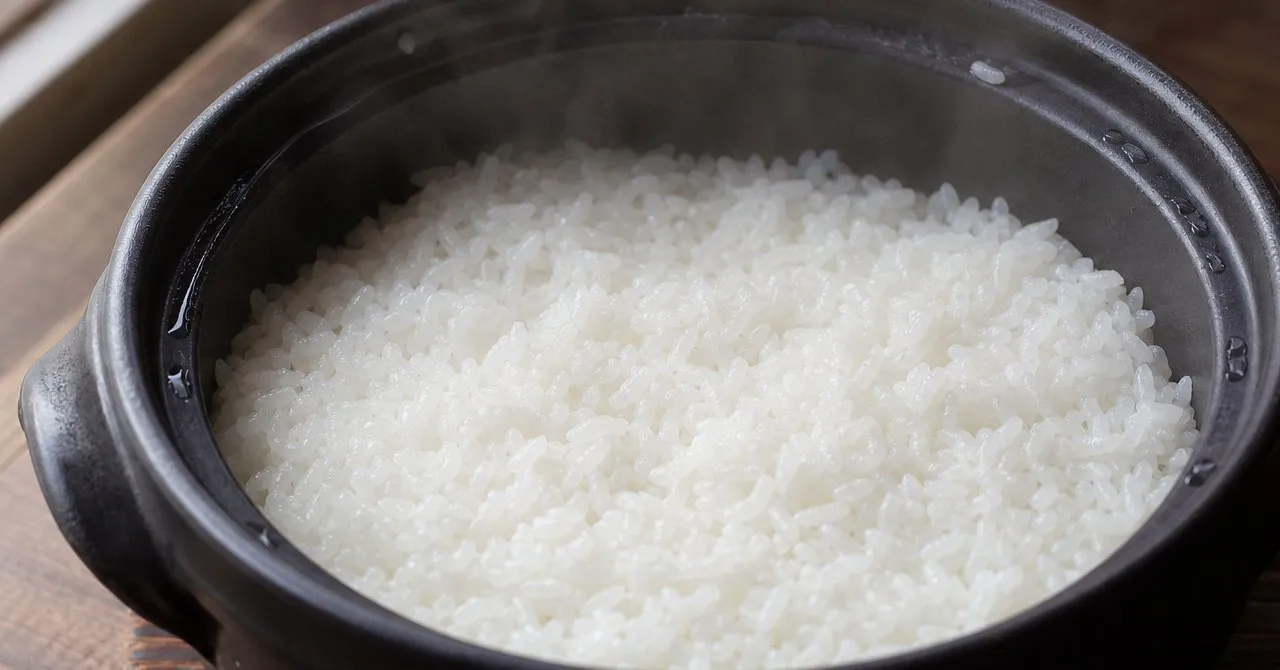
Search for Japanese rice in English and you’ll quickly run into the phrase “sticky rice.” A UK meal-kit company’s guide is titled “How To Cook Japanese Sticky Rice,” and a Chowhound article calls sushi rice “a type of short-grain sticky rice” without separating it from glutinous rice. It sounds harmless, but in the US “sticky rice” names a different grain: glutinous rice, the kind used for mochi. Buy a bag labeled that way for a weeknight bowl of rice and you’ll end up with a much stickier, chewier grain than the everyday rice Japanese recipes mean.
The rice Japanese people eat every day is called uruchimai (うるち米). It’s moist and its grains cling together, which may be why it picks up the “sticky” label. It still isn’t sticky rice, and it isn’t hard to cook well once you know what Japanese sources tell home cooks to do.
The short answer
- Japanese everyday rice is uruchimai: non-glutinous, short- or medium-grain japonica rice. It is not “sticky rice.”
- In the US, “sticky rice” means glutinous rice (Japanese mochigome). The USA Rice Federation’s own definition reads: “Sweet rice, also known as glutinous or sticky rice…”
- Rinse quickly. Drain the first cloudy water right away, then rinse gently with 2–3 changes of water. Skip this step for musenmai (rinse-free rice).
- Soak at least 30 minutes, about 50–60 minutes in winter. Micom, induction and pressure rice cookers build the soak into the cycle.
- Measure water by the rice cooker’s own cup and lines. On the stove, use about 1.2 times the rice’s volume in water.
- Rest, then fluff. Leave the lid on for about 10 minutes after cooking, then turn the rice over gently so the excess steam can escape.
Uruchimai vs. mochigome: the starch makes the difference
Rice starch comes in two forms: amylose, a long straight chain of glucose, and amylopectin, a branched one. How much of each a rice contains largely decides how it behaves when cooked.
Japan’s Ministry of Agriculture, Forestry and Fisheries (MAFF) puts the amylose-to-amylopectin ratio of ordinary polished uruchimai at about 2:8. By contrast, it says, 「精白米(もち米)のでんぷんはほぼ100%がアミロペクチンです。」 (“The starch in polished glutinous rice is almost 100% amylopectin.”) The same page explains the effect: the lower the share of amylose, the stickier the rice, and the less it hardens as it cools.
The Japan Rice Stable Supply Support Organization (Komenet) gives about 20% amylose for japonica uruchimai, and Japan’s national agricultural research body, NARO, lists Koshihikari at about 17% (16.8% and 17.5% in two tables). “Low-amylose” varieties such as Milky Queen (9.2%, per NARO) sit in between.
| Uruchimai (ordinary Japanese rice) | Mochigome (glutinous / “sticky” / sweet rice) | |
|---|---|---|
| Amylose | About 17–20% | Virtually none (starch is almost all amylopectin, per MAFF) |
| Cooked texture | Moist, soft, grains cling but stay distinct | Very sticky and chewy; grains glue together |
| Use in Japan | The everyday staple rice, per Komenet | Mochi and sekihan (red-bean rice), per Komenet |
| Calories per 100 g, polished, uncooked | 342 kcal | 343 kcal |
Calorie figures are from MAFF, citing Japan’s Standard Tables of Food Composition. Nutritionally, the two are nearly identical; the difference is texture.
So why does Japanese rice cling at all? Because about four-fifths of its starch is still amylopectin. USA Rice describes US short-grain rice as “soft and stickier than other varieties with a slight springiness,” but lists sweet rice as a separate category whose cooked grains “stick together due to their glutinous consistency.” Clingy is a texture; glutinous is a different kind of rice.
What to buy in the US
Look for short-grain or medium-grain japonica rice. On US shelves that usually means one of two things:
- Calrose. USA Rice describes it as “a medium-grain specialty type of Japonica rice exclusively grown in California.” It was released in 1948, developed by Jenkin Jones and Loren Davis, and the name is now a trade name for California medium-grain rice. USA Rice lists sushi, poke bowls and stir-fries among its uses.
- Short-grain japonica, sometimes sold under Japanese variety names such as Koshihikari, grown in California or imported from Japan.
USA Rice defines medium grains as two to three times as long as they are wide; short grains are “short, plump, almost round.”
About “sushi rice” labels. America’s Test Kitchen reports that “most of the so-called ‘sushi rice’ in America is a variety called Calrose,” and that “short grain” and “medium grain” are “both terms are used but not regulated” (ATK’s point; we have not confirmed it in US regulations). Treat “sushi rice” on a US bag as a sales name, not a separate kind of grain, and check the grain type.
What not to buy for everyday Japanese rice: anything labeled sweet rice, glutinous rice or sticky rice. Save it for mochi.
Washing: quick and gentle
Japanese sources explain washing as removing the thin layer of bran left on polished rice. Komenet warns that if you wash slowly, the rice picks up a bran smell (ぬか臭くなる), which is why the first water goes straight down the drain. Zojirushi’s US site gives a different reason, saying rinsing “helps remove excess starch, making the rice fluffier, whiter,” but the method is the same.
Don’t scrub hard. Panasonic’s cooking site says older milling left enough bran that it had to be scrubbed off, but 「現代では精米技術の進歩により、糠や汚れがほとんど残らない状態のため、それほど念入りに研ぐ必要はありません。」 (“Thanks to advances in milling, rice now has almost no bran or dirt left on it, so it doesn’t need to be scrubbed that thoroughly.”) Forceful scrubbing, it adds, breaks the grains. MAFF likewise says to wash gently rather than “polish” (研ぐ) the rice.
The method, drawn from Komenet, MAFF and Zojirushi:
- Put the measured rice in a bowl or the cooker’s inner pot. Add plenty of cold water, swirl briefly, and drain immediately.
- Add a little fresh water and stir the rice gently with your fingers spread, about 10–20 turns.
- Rinse and drain. Repeat with 2–3 changes of water in total. MAFF suggests keeping the washing to about 3 minutes or less.
- Stop when the water is only lightly cloudy. Panasonic’s cue is that you can faintly see the rice through it. It doesn’t need to run clear. Drain well.
Musenmai (rinse-free rice): don’t wash it
Musenmai (無洗米) is rice processed so the bran layer is already removed. MAFF dates it to 1991; Zojirushi’s US site calls it “rinse-free rice.” Don’t wash it. Instead, correct the measurement, because without the bran a cup of musenmai holds slightly more actual rice:
- Use the musenmai cup if your cooker came with one. Mitsubishi Electric’s manual lists a musenmai cup of about 170 mL (about 147 g), next to the standard 180 mL cup (about 150 g). Hitachi supplies a dedicated cup as well.
- Or use the musenmai water line or course if the inner pot has one.
- No special cup or line? Zojirushi US says to “remove 1 heaping teaspoon of rice for each rice measuring cup.” MAFF notes that the usual Japanese approach is to add a little more water instead. Both fix the same problem.
Soaking: let the water reach the center
Komenet says to soak the rice for at least 30 minutes so it cooks up plump with no hard core, and longer in winter: 「冬場は水温が低いので50~60分浸すとよい」 (“In winter the water is cold, so 50–60 minutes of soaking is good.”). MAFF gives 30 minutes to an hour for pot cooking, or 2 hours in a storage container in the refrigerator.
If you use a rice cooker, you can usually skip this. Panasonic says microcomputer (“micom”) rice cookers, which it calls the mainstream type, build a water-absorption phase into the cycle. Zojirushi’s US site says the same for its Micom, induction-heating and pressure induction-heating models: “Soaking and steaming pre-programmed and NOT required.” Only conventional cookers, heated by a single bottom plate, need you to soak the rice yourself; Zojirushi’s FAQ gives about 30 minutes.
Water: let the cup and the lines do the work
In a rice cooker
Use the cup that came with the cooker. It holds about 180 mL, one gō (合), roughly ¾ US cup. Fill it level, then fill the water to the line with the same number for the course you’re using. Zojirushi notes that the standard lines are “designed for short/medium grain white rice,” and that different rice types and courses have their own lines.
Don’t measure the rice with a US measuring cup (about 236.6 mL), or the water lines will be off. Our guide to Japanese recipes in an American kitchen has the full cup-size breakdown.
On the stove
Komenet’s standard is 1.2 times the rice’s volume in water, measured before washing, or 1.1 times for moister new-crop rice (shinmai). Other sources are close:
| Source | By volume | By weight |
|---|---|---|
| Komenet | 1.2× (1.1× for new-crop rice) | — |
| Panasonic | 1.2× (its example: around 200 mL water per 180 mL gō) | — |
| MAFF | — | About 1.33× (200 mL water per 150 g gō) |
| City of Osaka | About 1.2× (210 mL per 180 mL gō) | About 1.4× (210 mL water per 150 g gō) |
Together these come to roughly 200–216 mL of water per gō of rice. In US terms, Komenet’s 1.2× is about 1 cup plus 3 tablespoons of water for every cup of dry rice. Musenmai takes a little more water.
Recipe: Stovetop Japanese rice (2 gō)
Adapted from the stovetop guidance of Komenet (Japan Rice Stable Supply Support Organization), using Komenet’s 1.2× water ratio. Timings depend on your pot and burner; treat them as a starting point.
Ingredients
- Rice: 2 gō = 360 mL (about 1½ US cups), about 300 g (10½ oz) short- or medium-grain japonica rice
- Water: 430 mL (about 1¾ US cups + 1 tbsp), or 430 g if you weigh it. For new-crop rice, use about 400 mL (about 1⅔ US cups). The other sources above give a little less: 420 mL by the City of Osaka’s figure, 400 mL by MAFF’s.
Equipment: a heavy-bottomed pot with a tight-fitting lid.
Method
- Wash. Rinse the rice quickly as described above: drain the first water at once, then 2–3 gentle rinses. Drain well.
- Soak. Put the rice and the measured water in the pot. Soak for at least 30 minutes, or 50–60 minutes in winter.
- Bring to a boil (about 10 minutes). Cover the pot. Start over medium heat and raise it to high, so the water comes to a boil in about 10 minutes.
- Boil (about 5 minutes). Once it boils, turn the heat down to medium and keep it at a steady boil for about 5 minutes.
- Steam over low heat (10–15 minutes). Turn the heat to low and cook until the water is absorbed.
- Rest (10 minutes). Turn off the heat and leave the lid on for about 10 minutes. Komenet says resting evens out the moisture in each grain, and MAFF says flatly: 「蒸らしの途中で蓋を開けるのは禁物。」 (“Never open the lid while the rice is resting.”)
- Fluff right away. Cut a cross through the rice with a paddle. Then, one quarter at a time, slide the paddle down the side of the pot and turn the rice over from the bottom, as MAFF and Zojirushi both describe. Don’t press or mash it. Komenet says this lets the excess steam escape; MAFF says rice left unfluffed gets crushed at the bottom.
The phases and heat levels follow a chart in Komenet’s rice book. The City of Osaka’s simpler version says two gō cooks in about 20 minutes.
Rice-cooker version
- Measure the rice level with the cooker’s cup and wash it (skip washing for musenmai).
- Put it in the inner pot and add water to the line matching the number of cups (the musenmai line, if you’re using musenmai and have one).
- Start the white-rice course. With a micom, induction or pressure cooker there’s no need to soak first. With a conventional cooker, soak about 30 minutes before you switch it on.
- When the cycle ends, fluff right away. Komenet notes that resting is already built into an electric cooker’s cycle.
Storing cooked rice safely
Keep-warm: a quality limit
Zojirushi’s US FAQ says, “For most rice cookers, 12 hours is the maximum”; models with an extended keep-warm feature go longer. On its high setting, about 165°F (74°C), Hitachi recommends no more than 12 hours. Panasonic says some models can hold rice for 24 hours or more but doesn’t recommend it, warning of odor, yellowing, drying out or spoilage. Komenet recommends freezing over long keep-warm.
These limits are mostly about flavor and texture. They are not a license to leave rice in a cooker that has been switched off, or on the counter.
Freezing
Komenet and Panasonic describe the same method: while the rice is still warm, wrap single portions of about 150 g (5¼ oz), about one Japanese rice bowl, spreading each flat in plastic wrap without squashing it. Let them cool to about body temperature, then freeze. Panasonic suggests setting them on an aluminum tray so they freeze quickly. Reheat in the microwave in the wrap.
Food safety: follow USDA
For safety, follow the USDA Food Safety and Inspection Service (FSIS):
- Refrigerate leftovers within 2 hours of cooking, or of taking them out of an appliance that kept them warm. FSIS shortens this to 1 hour when the temperature is over 90°F.
- Divide large amounts into shallow containers so they cool quickly.
- Use refrigerated leftovers within 3–4 days, or freeze them. FSIS gives 3–4 months for frozen leftovers; they stay safe longer but lose moisture and flavor.
- Reheat leftovers to 165°F (74°C), checked with a food thermometer.
Rice deserves extra care because of a bacterium called Bacillus cereus. Japan’s Food Safety Commission says grains and grain products, including cooked rice and fried rice, are the most common cause of the vomiting type of B. cereus food poisoning. According to its fact sheet:
- The bacterium’s spores resist heating at 194°F (90°C) for 60 minutes. MAFF’s risk profile says they are not killed under normal cooking conditions.
- It grows between about 50 and 122°F (10–50°C).
- The vomiting toxin it produces, cereulide, is not inactivated even after 90 minutes at 259°F (126°C), so ordinary reheating won’t destroy it once it has formed.
MAFF’s risk profile is blunt: never eat fried rice or pilaf that has been left at room temperature for a long time. To prevent B. cereus food poisoning, Japan’s health ministry (MHLW) advises cooking food thoroughly, not leaving it at room temperature, and either refrigerating it promptly in small portions or holding it at 149°F (65°C) or above, keeping storage time as short as possible.
Note: Zojirushi’s US blog allows up to 5 days in the refrigerator. That’s longer than USDA’s 3–4 days, so we use the USDA figure.
Choosing a rice cooker
You don’t need a rice cooker to make good Japanese rice, but it removes most of the timing. Zojirushi’s US site groups rice cookers by how they heat:
| Type | How Zojirushi describes it | Soaking and resting |
|---|---|---|
| Conventional | “A bottom plate heating element warms the inner pan.” | You do it yourself |
| Micom (microcomputer) | “A microchip judges the amount of rice, then surrounds the pan with controlled heat.” | Built in |
| Induction heating (IH) + Micom | “Induction heating uses the cooking pan as a conductor, generating higher temperatures which result in fluffier rice.” | Built in |
| Pressure + IH + Micom | “Combination of pressure and high heat enhances flavor and improves the texture of the rice.” | Built in |
The claims about fluffier rice and better flavor are Zojirushi’s own. Panasonic adds that micom cookers often include a gentle preheating stage that lets water soak into the center of the grain.
What to look for: built-in soaking (any micom, induction or pressure model); water lines or courses for the rice you plan to cook, including musenmai and sushi rice; the manufacturer’s stated keep-warm limit; and capacity, remembering it’s counted in 180 mL gō, not US cups. We don’t recommend specific models.
FAQ
Is Japanese rice the same as sticky rice?
No. Everyday Japanese rice is uruchimai, a non-glutinous japonica with about 17–20% amylose. In the US, “sticky rice” means glutinous rice (mochigome), whose starch is almost all amylopectin.
Is sushi rice the same as sticky rice?
No. On US labels, “sushi rice” is a sales name, and America’s Test Kitchen says it is usually Calrose, a non-glutinous medium-grain japonica. In Japan, sushi-meshi is cooked rice seasoned with vinegar. NHK’s cooking site says to cook it a little firmer, with less water, using the cooker’s sushi-rice line or an equal volume of water to rice.
Can I use a US measuring cup in a rice cooker?
Not if you go by the water lines. The lines assume the cooker’s 180 mL cup; a US cup holds about 236.6 mL, so you’d get too little water for the rice. If you’ve lost the rice cup, ¾ US cup is a close substitute. See our measurement guide.
How long can cooked rice stay in the rice cooker?
Zojirushi and Hitachi give about 12 hours on keep-warm, mainly to protect flavor. Rice taken out of the cooker should be refrigerated within 2 hours (1 hour above 90°F), per USDA, and eaten within 3–4 days, or frozen.
Is Calrose “real” Japanese rice?
It’s a japonica rice, the same type as Japanese rice, bred in California and released in 1948. A Japanese agricultural consultant writing in Toyo Keizai describes its cooked texture as looser and less sticky than Japanese short-grain rice, suited to fried rice, pilaf and risotto. It cooks well with the method above. For the short-grain type standard in Japan, look for short-grain japonica.
How this article was researched
This article is built mainly on Japanese-language official and industry sources, including MAFF, Komenet (the Japan Rice Stable Supply Support Organization), NARO, Japan’s Food Safety Commission and health ministry, the City of Osaka, and the rice-cooker makers Panasonic, Hitachi and Mitsubishi Electric. US sources include the USA Rice Federation, USDA FSIS and Zojirushi’s US site. Japanese quotations are short and translated by us. The stovetop recipe combines Komenet’s heat phases and water ratio with other sources, and this site has not kitchen-tested it. Komenet’s chart lists the times 10, 5, 10–15 and 10 minutes in sequence without labeling each one, so we matched them to the phases by their order.
Sources
Japanese primary sources:
- 農林水産省「米と栄養」 — MAFF: rice and nutrition (amylose/amylopectin, composition)
- 農林水産省 aff「今日からできる!お米のおいしい食べ方」 — MAFF: washing, soaking, water and fluffing
- 農林水産省「お米のおいしさがアップする炊き方と保存法」 — MAFF: how to cook and store rice
- 農林水産省 消費者の部屋「無洗米」 — MAFF consumer Q&A on musenmai
- 農林水産省 リスクプロファイルシート(セレウス菌) — MAFF risk profile: Bacillus cereus (PDF)
- 米穀安定供給確保支援機構『お米・ごはんBOOK』p.4–5 — Komenet: uruchimai and mochigome (PDF)
- 米穀安定供給確保支援機構『お米・ごはんBOOK』p.12–13 — Komenet: cooking rice (PDF)
- 米ネット「炊飯」 — Komenet: washing, soaking and water ratios (PDF)
- 農研機構『新しい米を創る ‘09』 — NARO: rice variety data, including amylose content (PDF)
- 食品安全委員会 ファクトシート「セレウス菌食中毒」 — Food Safety Commission of Japan: Bacillus cereus fact sheet (PDF)
- 厚生労働省「厚生労働」2024年8月号 — MHLW magazine: food poisoning prevention
- 大阪市「ごはんの炊き方」 — City of Osaka: cooking rice in a pot (PDF)
- パナソニック UP LIFE「正しいお米の研ぎ方(洗い方)は?」 — Panasonic: how to wash rice
- パナソニック UP LIFE(炊飯器の保温) — Panasonic: keep-warm and freezing rice
- 日立 Q&A(保温温度) — Hitachi: keep-warm temperature and time
- 日立 Q&A(無洗米) — Hitachi: cooking musenmai
- 三菱電機 IHジャー炊飯器 NJ-KE10/KE18 取扱説明書 — Mitsubishi Electric rice-cooker manual: 180 mL and 170 mL cups (PDF)
- みんなのきょうの料理(NHK)「すし飯」 — NHK cooking: sushi rice
US primary sources:
- U.S. Rice Varieties — USA Rice Federation
- Annual California Field Day Heralds 70th Anniversary of Calrose — USA Rice Daily
- Leftovers and Food Safety — USDA Food Safety and Inspection Service
- Rice Cookers: A Closer Look — Zojirushi America
- How to Cook Delicious Rice — Zojirushi America
- Rice Cooker FAQ — Zojirushi America
- Tips on How to Store Rice Before and After Cooking — Zojirushi America blog
Secondary sources: