Onigiri Isn't Made with Sushi Rice
Japanese onigiri is plain cooked rice shaped with salted hands, not vinegared sushi rice. What Japanese sources say, plus a basic salted onigiri recipe.
Some English-language onigiri recipes start by making sushi rice: cook short-grain rice, then stir in rice vinegar, sugar and salt. USA Rice, the US rice industry’s trade association, publishes a tuna onigiri recipe that does exactly that. So does the tinned-fish brand Fishwife.
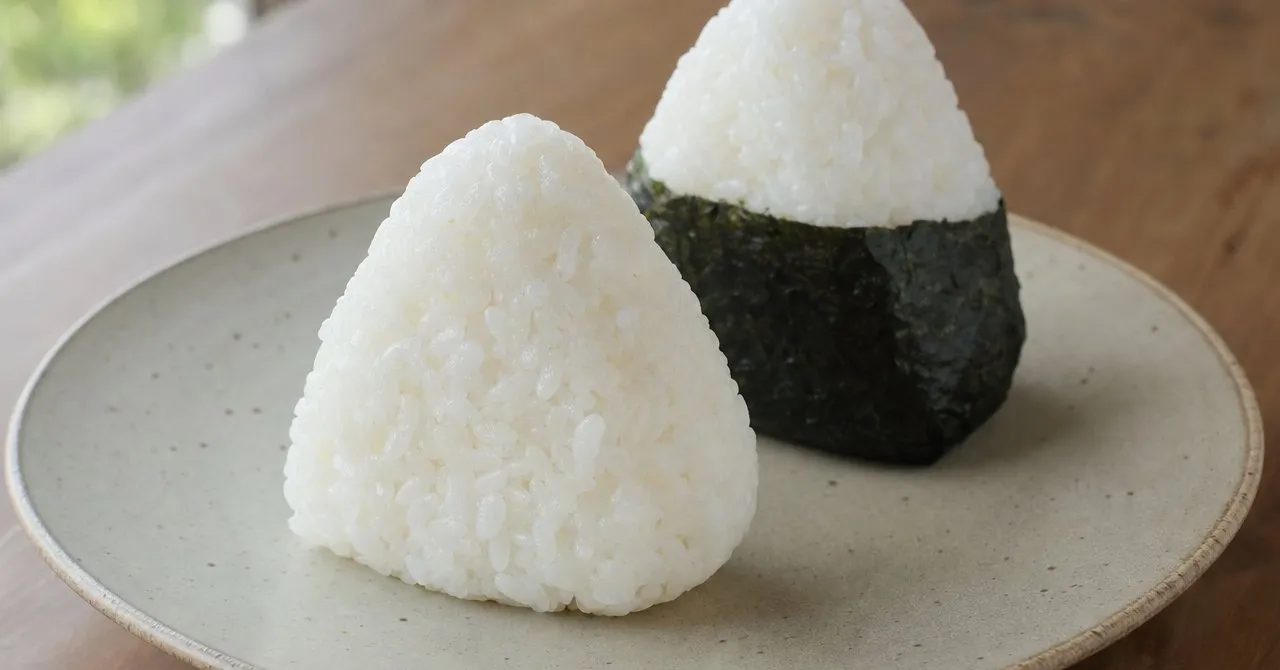
Japanese sources describe something simpler. Onigiri is plain cooked rice, shaped by hand, usually with salt rubbed on the palms. No vinegar, no sugar. Sushi rice (sushi-meshi) is a separate preparation made for sushi.
The grain itself isn’t the issue. A bag labeled “sushi rice” in a US store is fine for onigiri. The difference is the vinegar seasoning, and it changes the dish.
The short answer
- Onigiri is unseasoned cooked rice, pressed into a triangle, round or bale shape. Japanese dictionaries define it as rice pressed firm by hand, with no mention of vinegar.
- The salt goes on your hands, not into the rice. Japanese recipes wet the palms, rub on a pinch of salt and then shape the warm rice.
- Press lightly. Japanese cooks say to hold the rice together without crushing the grains.
- Nori is optional, and timing is a choice. Wrap it just before eating if you want it crisp. That idea is behind Japan’s film-wrapped convenience-store onigiri.
- Food safety matters more than usual with hand-shaped rice. Japanese public-health pages list onigiri among the typical sources of Staphylococcus aureus food poisoning. Tokyo’s food-safety officials advise shaping it through plastic wrap.
What Japanese sources say onigiri is
Japan’s Ministry of Agriculture, Forestry and Fisheries (MAFF) runs a database of regional home cooking called Uchi no Kyōdo Ryōri (“Our Local Dishes”). It has entries for both dishes, which makes a direct comparison possible.
- Bakudan onigiri (“bomb onigiri,” Shimane Prefecture) calls for cooked rice, a sheet of iwanori (rock laver) and a little soy sauce. Two bowls of rice are shaped into two large, round “bomb” balls. The toasted nori is cut in half, brushed with soy sauce on one side, and wrapped soy-side-in around each ball. Vinegar doesn’t appear anywhere on the page.
- Nigirizushi (Tokyo) cooks 2 gō of rice (about 360 mL) with sake and kombu. Then the hot rice is quickly cut-mixed with a sushi vinegar made from 4 tbsp akazu (red vinegar), or ordinary vinegar if you don’t have it, plus ½ tsp sugar and 1 tsp salt, and fanned to cool.
Japanese dictionaries say the same. In the entries for nigirimeshi (握り飯, the older word for onigiri) collected on Kotobank, Digital Daijisen describes rice pressed firm by hand, often with umeboshi inside or nori wrapped around it. Nihon Daihyakka Zensho (Nipponica) says the same food goes by the names onigiri, omusubi and otsukune. None of these definitions calls for vinegar. Heibonsha’s World Encyclopedia names the seasoning:
ふつう塩をつけて三角形,丸形,俵形などににぎり — Usually shaped with salt into a triangle, a round, a bale shape or the like. — 改訂新版 世界大百科事典 (Heibonsha’s World Encyclopedia, revised edition), via Kotobank
Side by side
| Onigiri (Japanese sources) | Nigirizushi rice (MAFF, Tokyo) | Tuna onigiri (USA Rice) | |
|---|---|---|---|
| Rice | Warm, freshly cooked, unseasoned | 2 gō rice cooked with sake and kombu | About 355 mL (1½ US cups) uncooked “short grain sushi rice” |
| Vinegar | None | 4 tbsp red vinegar (or ordinary vinegar) | 2 tbsp rice vinegar |
| Sugar | None | ½ tsp | 1 tbsp |
| Salt | Usually a pinch on the hands per ball (MAFF’s bakudan uses soy-brushed nori instead) | 1 tsp, in the vinegar mix | ½ tsp, in the vinegar mix |
| How it’s seasoned | Salt from the palms coats the outside | Vinegar mix folded through all the rice | Vinegar mix folded through all the rice |
Being fair to the English recipes
Rice seasoned with vinegar, pressed into a triangle and wrapped in nori is a perfectly good thing to eat. USA Rice’s and Fishwife’s tuna versions are their own recipes and don’t need to be anything else. What doesn’t match is the Japanese definition: Japanese dictionaries and recipes describe onigiri as plain rice, and vinegar seasoning is what makes rice sushi-meshi.
Not every English source does this. Just One Cookbook says onigiri “starts from a base of plain steamed rice.” It separates that from sushi rice, “steamed rice seasoned with vinegar, salt, and sugar.”
It doesn’t help that in US stores, “sushi rice” is a sales name. America’s Test Kitchen reports that it’s usually Calrose, a japonica variety grown in California. Buy it and cook it plain, and you have rice that works for onigiri. Our guide to how to cook Japanese rice covers choosing the rice, washing, soaking and measuring.
Salt goes on the hands
Every Japanese salted-onigiri recipe consulted for this article seasons the rice the same way: through the hands.
- Kobayashi Katsuyo (NHK’s Minna no Kyō no Ryōri): lightly wet clean hands, then spread a two-finger pinch of salt across both palms before picking up the rice.
- Panasonic (in a guide supervised by cooking researcher and registered dietitian Kenmizaki Satomi): wet the hands with salt water at about 3% concentration, then rub a pinch of salt over the whole palm.
- Nozaki Hiroyuki (NHK): wet both the shaping bowl and your hands with salt water.
- DELISH KITCHEN (a Japanese recipe platform whose recipes are supervised by registered dietitians): rub a pinch of salt onto the palms for each ball.
Most Japanese recipes leave the salt on the hands to a “pinch.” Panasonic says to adjust the salt to taste, and Kobayashi lists it only as “an appropriate amount.” The numbers they do give are for the hand water: about 3% salt (Panasonic), or 1 tsp salt in ½ Japanese cup, 100 mL (about 7 tbsp), of water (Nozaki). DELISH KITCHEN’s nutrition panel works out to about 1 g of salt for each 100 g ball.
Light pressure
The Japanese recipes consulted agree on this. Nozaki’s main point:
ギュッと握らずに、空気を含ませるようにふっくらとまとめます。 — Don’t squeeze hard; bring the rice together loosely, so that it holds air. — Nozaki Hiroyuki, Minna no Kyō no Ryōri (NHK)
Kobayashi presses the rice gently two or three times so the grains stick, shapes a triangle with light pressure, and finishes by rolling the ball in her palm about three times to round the corners. She notes that the triangle is the classic shape but round and bale shapes are fine too. For beginners, Nozaki suggests shaping the rice inside a small bowl until you get the feel for it.
Nori: when to wrap it
You can wrap onigiri in nori two ways, and Japanese practice includes both.
Wrapped ahead, soft. MAFF’s bakudan onigiri wraps the whole ball in soy-brushed nori, and the page says it’s sold in local shops and supermarkets on the Oki Islands and in the Izumo area.
Wrapped at the last minute, crisp. Just One Cookbook’s advice is to “wrap the nori right before you serve” if you want it crisp. Japanese convenience stores turned this into packaging. According to a 2018 President Online article, in 1978 Seven-Eleven Japan introduced a temaki onigiri that kept the rice and nori apart with a film, so the buyer wrapped the nori just before eating. We could not confirm the date on Seven-Eleven’s own pages, and the article doesn’t say who invented the film.
At home, you can do the same thing by packing the nori separately and wrapping it at the table.
Fillings
Japanese dictionaries mention a short list of classic fillings: umeboshi (salt-pickled ume), salted salmon and tarako (salted pollock roe). Nipponica notes that umeboshi does two jobs: it helps keep the rice from spoiling, and it serves as the side dish.
Popularity surveys from 2021 and 2023 add a modern favorite. These are informal polls from Japanese web media, and neither one explains how respondents were recruited:
| Survey | Top results |
|---|---|
| All About News, 2021 (500 respondents; vote totals exceed 500) | 1. salmon, 2. tuna-mayo, 3. spicy mentaiko, 4. tarako, 5. umeboshi; the headline says kombu came 6th |
| TOINK press release, 2023 (about 2,000 respondents) | 1. tuna-mayonnaise (about 20%); 2. salmon; mentaiko and umeboshi also in the top 5 (the release doesn’t give the full order); plain salted rice about 10% |
Tuna-mayo is canned tuna mixed with mayonnaise. A 2018 President Online history of the filling calls it, in its headline, “the undisputed champion of onigiri.”
To add a filling, put a small amount in the middle of the rice before you shape it. The dictionaries describe the filling as going inside.
A little history
Rice pressed by hand is old in Japan. Nipponica says that in the Heian period it was used as soldiers’ food and called tonjiki (屯食), and the World Encyclopedia also gives tonjiki as the old name. Nihon Kokugo Daijiten’s earliest cited example of nigirimeshi is a 1698 ukiyo-zōshi novel, and Nipponica notes that Edo-era rice balls were round or triangular, with triangles more common.
Recipe: Shio musubi (salted onigiri) — makes 4
Adapted from DELISH KITCHEN’s shio musubi (rice weight and salt per ball). The hand-wetting step follows Panasonic’s salt-water method, the shaping cues come from Nozaki Hiroyuki and Kobayashi Katsuyo on NHK’s Minna no Kyō no Ryōri and from DELISH KITCHEN, and the nori timing follows Just One Cookbook. This combined method has not been kitchen-tested by this site.
Ingredients
- 400 g (about 14 oz) warm, freshly cooked Japanese short- or medium-grain rice, unseasoned (how to cook it)
- 4 pinches salt (DELISH KITCHEN’s nutrition panel puts it at about 1 g salt per ball)
- For hand water: salt water at about 3% concentration (Panasonic’s figure; Panasonic doesn’t give a batch size)
- Optional: nori, cut into strips or half sheets, and a filling such as umeboshi or flaked salted salmon
Method
- Portion the rice. Divide it into four 100 g (3½ oz) portions. A kitchen scale makes this easy. Japanese recipes often count one rice bowl per ball instead. Panasonic puts one bowl at about 150 g, so a bowl-size ball is larger than these.
- Prepare your hands. Wash your hands. Dip your fingertips in the salt water and spread it over your palms, then rub a pinch of salt over both palms.
- Shape. Put one portion on your palm (add a filling to the center now if using). Press gently two or three times so the grains hold together. Then form a triangle with light pressure, turning the ball as you go (DELISH KITCHEN).
- Round it off. Roll the ball in your palm about three times to soften the corners. Repeat with the remaining rice, re-wetting and re-salting your hands each time.
- Nori. Wrap a strip around each ball right away for soft nori, or pack it separately and wrap just before eating for crisp nori.
Plastic-wrap version (the method Tokyo’s food-safety guidance advises). Panasonic’s method: sprinkle the salt on a sheet of plastic wrap instead of your palm, put the rice on top and shape lightly without crushing the grains. DELISH KITCHEN’s recipe author wore disposable gloves, another option.
For converting Japanese spoon and cup measures, see Japanese Recipes in an American Kitchen.
Food safety: hand-shaped rice and Staph aureus
Chiba Prefecture’s food-sanitation office lists onigiri among the main foods behind Staphylococcus aureus food poisoning. Chiba notes the bacterium is common on people, especially in infected cuts, the nose and throat, and hair. Symptoms such as nausea, vomiting, abdominal pain and diarrhea start 1 to 6 hours after eating (about 3 hours on average), according to the same page.
The danger is the toxin, not just the bacteria:
エンテロトキシンは熱に強く100℃30分の加熱でも分解されません。 — Enterotoxin is heat-resistant and is not broken down even by heating at 212°F (100°C) for 30 minutes. — Chiba Prefecture, Health and Welfare Department
In other words, ordinary cooking or reheating won’t break down toxin that has already formed. What Japanese officials advise:
- Shape through plastic wrap. A food-poisoning prevention handout from Tokyo’s Metropolitan Government, posted on Japan’s Ministry of Health, Labour and Welfare (MHLW) website, says it directly: 「「おにぎり」は、ご飯をラップの上から握りましょう。」 (“Shape onigiri with the rice inside plastic wrap.”)
- Don’t handle food with a cut or sore on your hands. Both Chiba and Tokyo give this warning.
- Wash and sanitize your hands thoroughly, per Chiba.
- Keep food cold. Chiba and Tokyo both give 50°F (10°C) or below for refrigerated storage.
Leftovers: US guidance
For US kitchens, the USDA Food Safety and Inspection Service (FSIS) sets out basic guidance for leftovers:
- Refrigerate within 2 hours of cooking, or within 1 hour if it’s over 90°F (32°C), as at a summer picnic.
- Leftovers keep 3 to 4 days in the refrigerator, or 3 to 4 months in the freezer for best quality (FSIS says frozen food stays safe longer).
- Reheat leftovers until they reach 165°F (74°C) on a food thermometer.
- Hot food can go straight into the refrigerator. Split large amounts into shallow containers so they cool faster.
Reheating kills bacteria but, per Chiba Prefecture, won’t break down staph toxin that has already formed, so it can’t rescue onigiri left out too long. Follow the 2-hour rule.
For onigiri that means: if you won’t eat them within that 2-hour window, refrigerate them. For longer storage, Japanese rice sources such as Panasonic recommend freezing cooked rice flat in plastic wrap, about 150 g (a bowl’s worth) at a time, rather than holding it on keep-warm for hours. Our rice guide covers the method. That advice is for plain cooked rice; we did not find Japanese official guidance specific to freezing finished onigiri.
FAQ
Can I use sushi rice to make onigiri? Yes, if you mean the grain. Rice sold as “sushi rice” in the US is usually Calrose, a japonica rice, according to America’s Test Kitchen, and japonica rice is what onigiri needs. Just cook it plain and skip the vinegar, sugar and salt mixture. The salt goes on your hands instead.
Is onigiri a kind of sushi? Not in Japanese usage. Sushi uses rice seasoned with vinegar. Onigiri uses plain rice seasoned with salt on the outside, and Japanese dictionaries define it simply as rice pressed into shape by hand.
What’s the difference between onigiri and omusubi? None in the food itself. Japanese dictionaries treat onigiri, omusubi and nigirimeshi as names for the same thing.
How much salt goes in onigiri? Japanese recipes mostly say “a pinch” and leave it to taste. DELISH KITCHEN’s nutrition panel puts it at about 1 g of salt per 100 g ball.
Can I make onigiri ahead and refrigerate it? For safety, follow USDA: refrigerate within 2 hours and eat within 3 to 4 days. Shaping through plastic wrap, as Tokyo’s food-safety officials advise, also keeps your hands off the rice.
How this article was researched
The definitions, recipes and safety guidance in this article come from Japanese-language sources: MAFF’s regional-cuisine database, Japanese dictionaries and encyclopedias on Kotobank, prefectural and metropolitan food-safety pages, Panasonic, and recipes published by NHK and DELISH KITCHEN. US food-safety guidance comes from USDA FSIS. Examples of English-language recipes were checked on the publishers’ own pages. Quotations from Japanese sources are kept short and translated by us. The recipe combines rice and salt amounts from DELISH KITCHEN with methods from Panasonic and two NHK cooks, and has not been kitchen-tested by this site. The convenience-store history comes from a Japanese business magazine and could not be confirmed on Seven-Eleven’s own site, and the filling surveys are informal web polls.
Sources
Japanese primary and reference sources:
- 農林水産省 うちの郷土料理「ばくだんおにぎり 島根県」 — MAFF: bakudan onigiri, Shimane
- 農林水産省 うちの郷土料理「にぎりずし 東京都」 — MAFF: nigirizushi, Tokyo
- コトバンク「握り飯」 — Kotobank: dictionary and encyclopedia entries for nigirimeshi
- パナソニック UP LIFE「炊飯器でのおいしいごはんの炊き方完全ガイド」 — Panasonic: rice cooking and shio musubi
- パナソニック UP LIFE(炊飯器の保温) — Panasonic: keep-warm and freezing rice
- みんなのきょうの料理(NHK)「塩むすび」野﨑洋光 — NHK: shio musubi, Nozaki Hiroyuki
- みんなのきょうの料理(NHK)「塩むすび」小林カツ代 — NHK: shio musubi, Kobayashi Katsuyo
- DELISH KITCHEN「お米を味わう! 塩むすび」 — DELISH KITCHEN: shio musubi
- 千葉県「黄色ブドウ球菌」 — Chiba Prefecture: Staphylococcus aureus
- 東京都「食中毒の予防について」(厚生労働省サイト掲載) — Tokyo Metropolitan Government: preventing food poisoning (on the MHLW site)
Convenience-store history and surveys:
- プレジデントオンライン「おにぎりの絶対王者「ツナマヨ」誕生秘話」 — President Online: the history of tuna-mayo onigiri
- All About ニュース「好きなおにぎりの具ランキング」 — All About News: favorite onigiri fillings survey
- トイント(TOINK)おにぎりの具調査 — TOINK press release (via Kyodo News PR Wire): onigiri fillings survey
US and English-language sources:
- USDA FSIS — Leftovers and Food Safety
- USA Rice — Tuna Onigiri
- Fishwife — Onigiri
- Just One Cookbook — Onigiri (Japanese Rice Balls)
- America’s Test Kitchen — Sushi Rice Taste Test
This is part of our series on what English-language Japanese recipes get wrong — and why.