In Japan, "Sauce" Means Something Specific: Worcestershire, Chūnō and Tonkatsu Sauce
Plain "sauce" in Japanese means a brown Worcestershire-style sauce. JAS sorts it into three thicknesses; the thickest is sold as tonkatsu sauce.
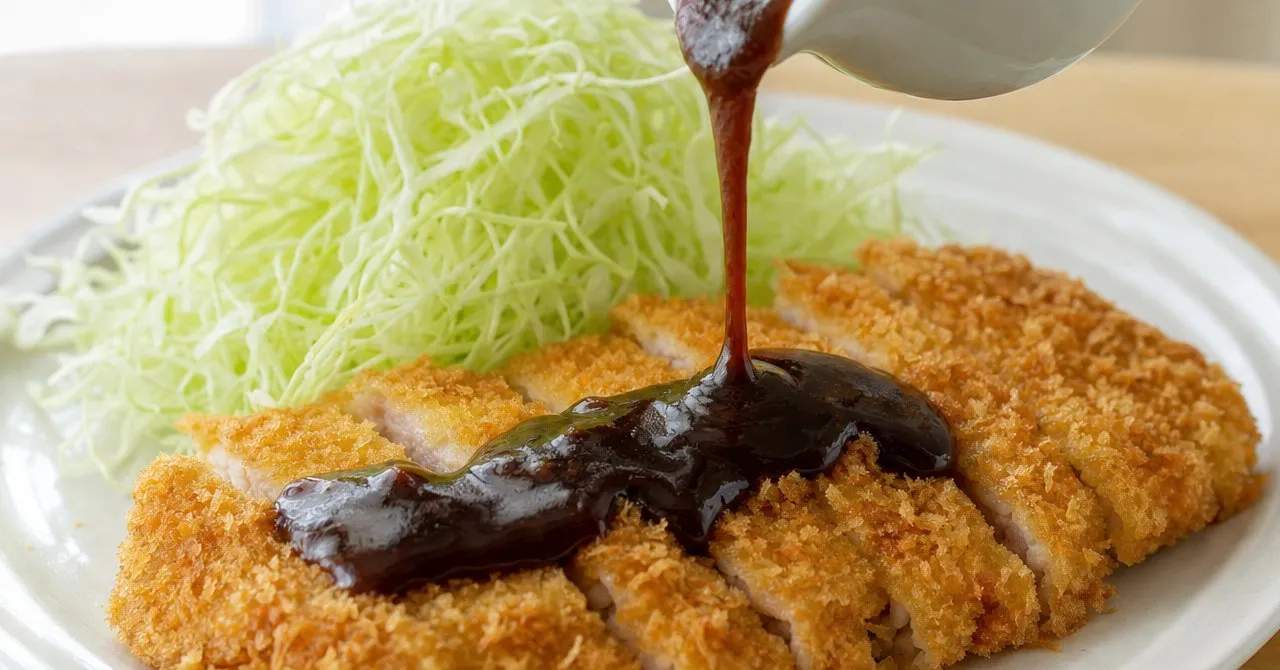
In English, “sauce” can mean almost anything. In Japanese, the borrowed word sōsu (ソース) usually means one thing when it stands alone. It means a brown, fruity, vinegary table condiment from the Worcestershire family, the bottle that gets poured over croquettes and fried pork cutlets.
That family has three official members. Japan’s national food standard for these sauces sorts them by one measurable property, viscosity: thin usutā sōsu (Worcester sauce), medium-thick chūnō sōsu, and thick nōkō sōsu. The thick one is what English-language recipes call tonkatsu sauce, or “katsu sauce.”
So if a Japanese recipe says “sauce” with no other word, it almost certainly means one of these. Below is what the standard says, what goes into the sauces, how they got to Japan, and how ketchup-based “katsu sauce” recipes in English relate to the bottles sold in Japan.
The short answer
- Plain “sōsu” means Worcestershire-style sauce. The Nihon Kokugo Daijiten notes that in Japan this sauce is normally called just “sauce.”
- Japan’s JAS standard sorts it by viscosity into Worcester (thin), chūnō (medium-thick) and nōkō (thick). Tonkatsu sauce is the industry’s name for the thick type.
- The standard defines the base as vegetable or fruit juice, broth or purée, plus sugars, vinegar, salt and spices.
- Ketchup + Worcestershire + soy “katsu sauce” is an approximation. One of the two recipes cited below calls itself a copycat and a substitute; the other calls its ketchup version “Homemade Bulldog Sauce.”
What “sauce” means in Japanese
Sōsu comes from the English word, but in Japanese its meaning narrowed. The Nipponica encyclopedia (Nihon Daihyakka Zensho) explains that Worcestershire sauce spread in Japan in the late Meiji era (Meiji ran from 1868 to 1912) along with Western-style cooking, and that “sauce” came to mean this sauce in particular.
Tsutsumi Takashi, managing director of the Japan Sauce Industry Association, made the same point in a 2015 article for ALIC (the Agriculture & Livestock Industries Corporation, a Japanese government agency). Worcestershire sauce was the first sauce to reach Japan, and the spread of Western-style cooking, along with efforts to produce the sauce domestically, spread the idea that, in the article’s words, 「ソースといえばウスターソース類」 (“when you say sauce, you mean Worcester-type sauces”).
Soy sauce, for its part, keeps its own name, shōyu (see Japanese Soy Sauce Types). So “add sauce” in a translated Japanese recipe points to the brown bottle, not to a sauce you are supposed to make.
The JAS standard: three sauces, sorted by thickness
Japan’s agriculture ministry (MAFF) publishes Japanese Agricultural Standards (JAS) for foods. This family’s is JAS 0565, usutā sōsu-rui (“Worcester sauces”), first set in 1974 and revised in 2025 (JAS 0565:2025, the version cited here).
It starts with a definition of the whole family: a brown or brown-black liquid seasoning made by adding sugars, vinegar, salt and spices to vegetable or fruit juice, broth or purée (or concentrates of these). The standard also allows versions with starch, seasonings and similar ingredients added on top.
Then it splits the family by viscosity, measured in pascal-seconds (Pa·s):
| Type | Japanese | Viscosity in JAS 0565 | Same cutoff in centipoise |
|---|---|---|---|
| Worcester sauce | ウスターソース usutā sōsu | under 0.2 Pa·s | under 200 cP |
| Medium-thick sauce | 中濃ソース chūnō sōsu | 0.2 Pa·s or more, under 2.0 Pa·s | 200 to under 2,000 cP |
| Thick sauce | 濃厚ソース nōkō sōsu | 2.0 Pa·s or more | 2,000 cP or more |
The definition for the thin type reads:
「ウスターソース類のうち,粘度が0.2 Pa・s 未満のもの」 “Of the Worcester sauces, those with a viscosity of less than 0.2 Pa·s.” — JAS 0565:2025, Ministry of Agriculture, Forestry and Fisheries
So the three names aren’t marketing terms; each names a band of thickness.
Where tonkatsu sauce fits
The phrase “tonkatsu sauce” doesn’t appear in the JAS standard. The link comes from the industry. In his 2015 article, Tsutsumi of the Japan Sauce Industry Association (Nihon Sōsu Kōgyōkai) describes the three types this way:
- Worcester sauce: low viscosity and free-flowing, because the vegetable and fruit pulp is filtered out during production; a dry (karakuchi) sauce.
- Chūnō sauce: a moderate thickness, between Worcester and thick.
- Nōkō sauce: also called tonkatsu sauce. Because it uses a lot of fruit, it was once called “fruit sauce.”
Bull-Dog Sauce’s securities report names its main products as Worcester, chūnō and tonkatsu sauce, the same three-way lineup.
The article also names two later, more specialized types: yakisoba sauce and okonomiyaki sauce. It describes okonomi sauce as less sour and less salty than the others, and thicker. The JAS standard doesn’t define either one.
The grades
The standard also sets two grades, tokkyū (special) and hyōjun (standard), with rules for salt-free soluble solids, salt and, for the special grade, a minimum vegetable and fruit content and brewed vinegar only. A few of the limits show how the types differ:
| Worcester | Chūnō | Nōkō (thick) | |
|---|---|---|---|
| Maximum salt (both grades) | 11% | 10% | 9% |
| Minimum vegetable and fruit content, special grade | 10% | 15% | 20% |
The thicker the sauce, the more vegetable and fruit the special grade requires and the less salt any grade allows, which fits the industry’s description of thick sauce as the fruit-heavy one.
What goes into Japanese sauce
The industry association’s article lists the typical raw materials:
- Vegetables: tomato, onion, carrot, celery
- Fruits: apple, prune, date, mandarin orange
- Sugar: several kinds, including jōhakutō (Japanese white sugar), sanontō (a light brown sugar) and chūzaratō (a coarse golden sugar)
- Salt, vinegar and spices
Okonomiyaki sauce follows the same pattern. Otafuku’s own description, published on the City of Hiroshima’s “Hiroshima Brand” page, calls its okonomi sauce a blend of vegetables, fruits and spices, with dates as its signature ingredient.
How sauce came to Japan
Japanese reference works agree on the outline and differ in some details.
| Year | Event | Source |
|---|---|---|
| 1887 | Yamasa Shoyu, a soy sauce brewer, makes “Mikado Sauce,” aimed at the American market. Sold at home as shinmi shōyu (“new-flavor soy sauce”), it sold poorly and was dropped. | Sekai Daihyakka Jiten (revised ed.); Nipponica |
| 1894 | “Mitsuya Sauce” goes on sale in Osaka. | Sekai Daihyakka Jiten (revised ed.) |
| 1896 | “Ikari-brand sauce” goes on sale. | Kansai Walker, 2017 |
| 1902 | Bull-Dog’s predecessor, Misawaya Shōten, is founded as a food wholesaler. | Bull-Dog Sauce securities report |
| 1904 | The earliest example the Nihon Kokugo Daijiten cites: “ushita sōsu” in a recipe in the winter volume of Murai Gensai’s Kuidōraku. | Nihon Kokugo Daijiten |
| 1905 | Misawaya begins making and selling sauce. | Bull-Dog Sauce securities report |
| 1947 | The Japan Sauce Industry Association is founded, on November 7. | Industry association article |
| 1948 | Oliver Sauce of Kobe says it sold the world’s first tonkatsu sauce. | Bunshun Online, 2017 |
| 1952 | Otafuku’s okonomi sauce goes on sale. | Otafuku, via City of Hiroshima |
Two cautions. Japanese reference works date the English original to around 1850 or the mid-19th century, while the industry association’s origin story, which it presents as something that “is said,” places it in the early 19th century. And a 2017 Kansai Walker feature calls Ikari, launched in 1896, the oldest sauce brand in Japan still in existence. That is the magazine’s description, which we could not confirm; the encyclopedia records earlier Japanese sauces, including Mitsuya Sauce in 1894, but we could not determine whether any survive. Ikari has been part of the Bull-Dog group since 2005, when a Bull-Dog subsidiary took over its business; Bull-Dog’s securities report for the year to March 2024 lists it as a consolidated subsidiary.
The tonkatsu sauce date comes from the company. In a 2017 interview, Oliver Sauce’s president said:
「…世界で最初のとんかつソースを1948年に売り出した…」 “…we put the world’s first tonkatsu sauce on sale in 1948…” — Oliver Sauce president Dōman Masahiko, interviewed by Bunshun Online, 2017
We found no independent record either way, so treat it as the company’s account. According to the interview, the sauce first caught on as a topping for takoyaki around Kobe and Akashi, then spread to okonomiyaki in Osaka.
Japanese curry is another Western-style (yōshoku) staple with a British connection; see Japanese Curry Is Not Indian Curry.
How it differs from English-style Worcestershire
Kikkoman’s English glossary describes Worcestershire sauce, an English original, as having a “smooth, liquid consistency.” That is the thin end of the Japanese family. What Japan’s standard adds is the thick end: two more official bands, chūnō and nōkō, that an English-style Worcestershire doesn’t cover.
The recipes differ too. The same glossary notes that Japanese manufacturers have developed their own Worcestershire sauces “by blending ingredients in different ratios,” and lists Japanese-style Worcestershire as its own variety. Japan’s standard defines the family as starting from vegetable or fruit juice, broth or purée, to which sugars (molasses is allowed), vinegar, salt and spices are added. English-style brands sold in the US, such as Lea & Perrins, follow their own recipes. We couldn’t confirm Lea & Perrins’ ingredient list from an official source, so if an ingredient matters to you, read the label.
The practical takeaway: a Japanese recipe that calls for usutā sōsu can be approximated with an English-style Worcestershire, but the bottle won’t be the same blend. A Japanese recipe that calls for chūnō or tonkatsu sauce expects a sauce in the JAS medium or thick band, which a thin Worcestershire is not.
“Katsu sauce” recipes in English
Some English-language “katsu sauce” recipes take a shortcut: ketchup, Worcestershire and soy sauce, sometimes with a little sugar. Two examples:
| Recipe (main ingredients) | Ketchup | Worcestershire | Soy sauce | Sugar |
|---|---|---|---|---|
| DriveMeHungry, “3-Ingredient Tonkatsu (Katsu) Sauce” | 60 mL (¼ cup) | about 37 mL (2½ tbsp) | 15 mL (1 tbsp) | about 7.5 mL (½ tbsp), optional |
| Chili Pepper Madness, “Tonkatsu Sauce Recipe” (easy version) | 60 mL (¼ cup) | 60 mL (¼ cup) | 15 mL (1 tbsp) | 5 mL (1 tsp), or honey or brown sugar |
DriveMeHungry also lists optional garlic and onion powder.
These make sense as approximations. Ketchup brings tomato, sweetness, acidity and body, standing in for the purée base and thickness of a nōkō sauce. Worcestershire brings spice and a sour edge; soy sauce adds salt.
The authors frame them differently. DriveMeHungry calls its version “a delicious copycat of Bulldog Tonkatsu sauce.” Chili Pepper Madness labels its ketchup version “Homemade Bulldog Sauce” and labels a longer, cooked version “authentic,” made with onion, apple, tomato, sake, soy sauce, Worcestershire and spices.
The longer version, which starts from fruit and vegetables, is closer to the Japanese definition. Still, “authentic” is a strong word for a homemade blend. In Japan, tonkatsu sauce is a manufactured product category defined by its ingredients and its viscosity. A fair way to describe these recipes is the way DriveMeHungry does: a substitute for the bottle.
(For another Japanese word that drifted into an American bottled sauce, see Teriyaki Is Not a Sauce.)
Reading a Japanese recipe that calls for sauce
| The recipe says | It means | If you don’t have it |
|---|---|---|
| ソース (sōsu) alone | A Worcester-family sauce; the word alone doesn’t say which thickness | A Japanese Worcester or chūnō bottle |
| ウスターソース (usutā sōsu) | The thin type | An English-style Worcestershire such as Lea & Perrins is the obvious thin stand-in, though it is a different blend |
| 中濃ソース (chūnō sōsu) | Medium-thick | Mix thin and thick Japanese sauces, or use tonkatsu sauce |
| とんかつソース / 濃厚ソース | The thick type | A Japanese bottle, or a ketchup-based approximation |
| お好みソース (okonomi sōsu) | Okonomiyaki sauce: thick, less sour and less salty | A Japanese bottle; tonkatsu sauce is the nearest relative |
The last column is our reading of the definitions, not manufacturers’ advice. A Japanese recipe’s “cup” is 200 mL, not a US cup. See Cooking Japanese Recipes in an American Kitchen.
FAQ
What is tonkatsu sauce made of?
In Japan, tonkatsu sauce is the thick (nōkō) type of Worcester-family sauce. The JAS standard defines the family as vegetable or fruit juice, broth or purée with sugar, vinegar, salt and spices. The Japan Sauce Industry Association lists typical ingredients such as tomato, onion, carrot, celery, apple, prune and date. Check the label of a specific brand for its exact recipe.
Is katsu sauce the same as tonkatsu sauce?
Usually. In recipes, “katsu sauce” is generally English shorthand for tonkatsu sauce, the thick brown sauce served with fried pork cutlets (tonkatsu). In Japan the standard calls this type nōkō sōsu, and the industry says it’s also known as tonkatsu sauce.
What is chūnō sauce?
Chūnō sōsu means “medium-thick sauce.” Under Japan’s JAS standard it is the Worcester-family sauce with a viscosity of at least 0.2 Pa·s but under 2.0 Pa·s, between thin Worcester sauce and thick tonkatsu sauce.
Can I use Worcestershire sauce instead of tonkatsu sauce?
Not on its own. Worcestershire is a thin liquid, while Japanese tonkatsu sauce is the thick type, and Japan’s standard defines it as starting from vegetable or fruit juice, broth or purée. Recipes in English, such as the two cited above, mix it with ketchup and soy sauce to get closer. That works as an approximation, not a duplicate.
Is Bull-Dog sauce tonkatsu sauce?
Bull-Dog is a brand, not a type. Its securities report lists Worcester, chūnō and tonkatsu sauce as its main products, so check the label.
What sauce goes on okonomiyaki?
Okonomi sauce, a thick member of the same family that the industry association describes as less sour and less salty than the others. According to Otafuku’s description on the City of Hiroshima’s Hiroshima Brand page, its okonomi sauce first went on sale in 1952 and is made from vegetables, fruits and spices, with dates as its signature ingredient.
How this article was researched
The definitions, viscosity bands and grade limits come from the text of JAS 0565:2025, published by Japan’s Ministry of Agriculture, Forestry and Fisheries. Descriptions of the three types and their ingredients come from an article by Tsutsumi Takashi of the Japan Sauce Industry Association. Historical dates come from Japanese dictionaries and encyclopedias, Bull-Dog Sauce’s securities report, Otafuku’s description on the City of Hiroshima’s site, and Japanese press interviews; where a date is a company’s own claim, we say so. Quotations from Japanese sources are kept short and translated by us. This article contains no recipe of its own, and this site has not prepared or tasted any of the sauces or recipes described.
Sources
Japanese standards and government:
- JAS 0565:2025 ウスターソース類 — Japanese Agricultural Standard for Worcester sauces, Ministry of Agriculture, Forestry and Fisheries (PDF)
- ウスターソース類についての検査方法 — MAFF, inspection method for Worcester sauces (PDF)
- 日本農林規格一覧 — MAFF, list of JAS standards
- Otafuku Okonomi Sauce — Otafuku’s product description on the City of Hiroshima’s Hiroshima Brand page
Industry and manufacturers:
- 日本(ニッポン)のソース「ウスターソース類」 — Tsutsumi Takashi, Japan Sauce Industry Association, on the website of ALIC (Agriculture & Livestock Industries Corporation), sugar section, October 2015
- ブルドックソース株式会社 有価証券報告書 第99期 — Bull-Dog Sauce securities report, fiscal year to March 2024 (PDF)
- Worcestershire sauce — Kikkoman, glossary of seasonings
Dictionaries and press:
- ウースターソース — Kotobank (Digital Daijisen, Nihon Kokugo Daijiten, Nipponica, Sekai Daihyakka Jiten, MyPedia)
- 神戸の老舗が挑む、とんかつソースのデータベース化って何? — Bunshun Online, interview with Oliver Sauce, 2017
- 関西の食卓を変えた味!「イカリ」ウスターソースのロングヒットの秘密 — Walkerplus / Kansai Walker, on Ikari Sauce, 2017
English-language recipes:
This is part of our series on what English-language Japanese recipes get wrong — and why. See also: Japanese Soy Sauce Types and Teriyaki Is Not a Sauce.